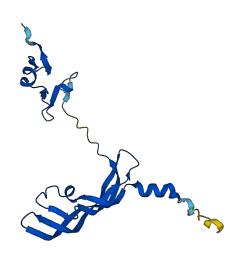
Descriptions
The autoinhibited protein was predicted that may have potential autoinhibitory elements via cis-regPred.
Autoinhibitory domains (AIDs)
Target domain |
|
Relief mechanism |
|
Assay |
cis-regPred |
Accessory elements
No accessory elements
Autoinhibited structure

Activated structure
1 structures for P26617
| Entry ID | Method | Resolution | Chain | Position | Source |
|---|---|---|---|---|---|
| AF-P26617-F1 | Predicted | AlphaFoldDB |
No variants for P26617
| Variant ID(s) | Position | Change | Description | Diseaes Association | Provenance |
|---|---|---|---|---|---|
| No variants for P26617 | |||||
No associated diseases with P26617
2 GO annotations of cellular component
| Name | Definition |
|---|---|
| extracellular region | The space external to the outermost structure of a cell. For cells without external protective or external encapsulating structures this refers to space outside of the plasma membrane. This term covers the host cell environment outside an intracellular parasite. |
| membrane | A lipid bilayer along with all the proteins and protein complexes embedded in it an attached to it. |
2 GO annotations of molecular function
| Name | Definition |
|---|---|
| growth factor activity | The function that stimulates a cell to grow or proliferate. Most growth factors have other actions besides the induction of cell growth or proliferation. |
| heparin binding | Binding to heparin, a member of a group of glycosaminoglycans found mainly as an intracellular component of mast cells and which consist predominantly of alternating alpha-(1->4)-linked D-galactose and N-acetyl-D-glucosamine-6-sulfate residues. |
11 GO annotations of biological process
| Name | Definition |
|---|---|
| angiogenesis | Blood vessel formation when new vessels emerge from the proliferation of pre-existing blood vessels. |
| motor neuron migration | The orderly movement of a motor neuron from one site to another. A motor neuron is an efferent neuron that passes from the central nervous system or a ganglion toward or to a muscle and conducts an impulse that causes movement. |
| positive regulation of angiogenesis | Any process that activates or increases angiogenesis. |
| positive regulation of cell division | Any process that activates or increases the frequency, rate or extent of cell division. |
| positive regulation of endothelial cell migration | Any process that increases the rate, frequency, or extent of the orderly movement of an endothelial cell into the extracellular matrix to form an endothelium. |
| positive regulation of endothelial cell proliferation | Any process that activates or increases the rate or extent of endothelial cell proliferation. |
| positive regulation of focal adhesion assembly | Any process that activates or increases the frequency, rate or extent of focal adhesion assembly, the establishment and maturation of focal adhesions. |
| positive regulation of peptidyl-tyrosine phosphorylation | Any process that activates or increases the frequency, rate or extent of the phosphorylation of peptidyl-tyrosine. |
| positive regulation of protein phosphorylation | Any process that activates or increases the frequency, rate or extent of addition of phosphate groups to amino acids within a protein. |
| positive regulation of protein-containing complex assembly | Any process that activates or increases the frequency, rate or extent of protein complex assembly. |
| tube formation | Creation of the central hole of a tube in an anatomical structure through which gases and/or liquids flow. |
No homologous proteins in AiPD
| UniProt AC | Gene Name | Protein Name | Species | Evidence Code |
|---|---|---|---|---|
| No homologous proteins | ||||
| 10 | 20 | 30 | 40 | 50 | 60 |
| APMAEGEQKP | REEVKFMDVY | KRSYCRPIEM | LVDIFQEYPD | EIEYIFKPSC | VPLMRCGGCC |
| 70 | 80 | 90 | 100 | 110 | 120 |
| NDESLECVPT | EEFNITMQIM | RIKPHQGQHI | GEMSFLQHSK | CECRPKKEKA | RQENPCGPCS |
| 130 | 140 | 150 | 160 | ||
| ERRKHLFVQD | PQTCKCSCRN | TDSRCKARQL | ELNERTCRCD | KPRR |