P26464
Gene name |
dnaN (STM3837) |
Protein name |
Beta sliding clamp |
Names |
Beta clamp, Sliding clamp, Beta-clamp processivity factor, DNA polymerase III beta sliding clamp subunit, DNA polymerase III subunit beta |
Species |
Salmonella typhimurium (strain LT2 / SGSC1412 / ATCC 700720) |
KEGG Pathway |
stm:STM3837 |
EC number |
|
Protein Class |
|
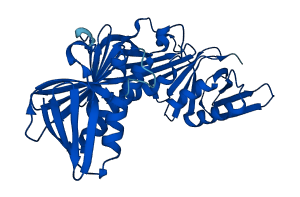
Descriptions
The autoinhibited protein was predicted that may have potential autoinhibitory elements via cis-regPred.
Autoinhibitory domains (AIDs)
Target domain |
|
Relief mechanism |
|
Assay |
cis-regPred |
Accessory elements
No accessory elements
Autoinhibited structure

Activated structure
1 structures for P26464
| Entry ID | Method | Resolution | Chain | Position | Source |
|---|---|---|---|---|---|
| AF-P26464-F1 | Predicted | AlphaFoldDB |
No variants for P26464
| Variant ID(s) | Position | Change | Description | Diseaes Association | Provenance |
|---|---|---|---|---|---|
| No variants for P26464 | |||||
No associated diseases with P26464
3 regional properties for P26464
| Type | Name | Position | InterPro Accession |
|---|---|---|---|
| conserved_site | Heat shock protein 70, conserved site | 7 - 14 | IPR018181-1 |
| conserved_site | Heat shock protein 70, conserved site | 166 - 179 | IPR018181-2 |
| conserved_site | Heat shock protein 70, conserved site | 307 - 321 | IPR018181-3 |
2 GO annotations of cellular component
| Name | Definition |
|---|---|
| cytoplasm | The contents of a cell excluding the plasma membrane and nucleus, but including other subcellular structures. |
| DNA polymerase III complex | The DNA polymerase III holoenzyme is a complex that contains 10 different types of subunits. These subunits are organized into 3 functionally essential sub-assemblies: the pol III core, the beta sliding clamp processivity factor and the clamp-loading complex. The pol III core carries out the polymerase and the 3'-5' exonuclease proofreading activities. The polymerase is tethered to the template via the sliding clamp processivity factor. The clamp-loading complex assembles the beta processivity factor onto the primer template and plays a central role in the organization and communication at the replication fork. |
3 GO annotations of molecular function
| Name | Definition |
|---|---|
| 3'-5' exonuclease activity | Catalysis of the hydrolysis of ester linkages within nucleic acids by removing nucleotide residues from the 3' end. |
| DNA binding | Any molecular function by which a gene product interacts selectively and non-covalently with DNA (deoxyribonucleic acid). |
| DNA-directed DNA polymerase activity | Catalysis of the reaction: deoxynucleoside triphosphate + DNA(n) = diphosphate + DNA(n+1); the synthesis of DNA from deoxyribonucleotide triphosphates in the presence of a DNA template and a 3'hydroxyl group. |
1 GO annotations of biological process
| Name | Definition |
|---|---|
| DNA strand elongation involved in DNA replication | The process in which an existing DNA strand is extended by activities including the addition of nucleotides to the 3' end of the strand, complementary to an existing template, as part of DNA replication. |
No homologous proteins in AiPD
| UniProt AC | Gene Name | Protein Name | Species | Evidence Code |
|---|---|---|---|---|
| No homologous proteins | ||||
| 10 | 20 | 30 | 40 | 50 | 60 |
| MKFTVEREHL | LKPLQQVSGP | LGGRPTLPIL | GNLLLQVADG | TLSLTGTDLE | MEMVARVTLS |
| 70 | 80 | 90 | 100 | 110 | 120 |
| QPHEPGATTV | PARKFFDICR | GLPEGAEIAV | QLEGDRMLVR | SGRSRFSLST | LPAADFPNLD |
| 130 | 140 | 150 | 160 | 170 | 180 |
| DWQSEVEFTL | PQATMKRLIE | STQFSMAHQD | VRYYLNGMLF | ETEGSELRTV | ATDGHRLAVC |
| 190 | 200 | 210 | 220 | 230 | 240 |
| SMPLEASLPS | HSVIVPRKGV | IELMRMLDGG | ENPLRVQIGS | NNIRAHVGDF | IFTSKLVDGR |
| 250 | 260 | 270 | 280 | 290 | 300 |
| FPDYRRVLPK | NPDKHLEAGC | DILKQAFARA | AILSNEKFRG | VRLYVSENQL | KITANNPEQE |
| 310 | 320 | 330 | 340 | 350 | 360 |
| EAEEILDVSY | GGTEMEIGFN | VSYVLDVLNA | LKCETVRIML | TDSVSSVQIE | DAASQSAAYV |
| VMPMRL |