P26443
Gene name |
Glud1 (Glud) |
Protein name |
Glutamate dehydrogenase 1, mitochondrial |
Names |
GDH 1 |
Species |
Mus musculus (Mouse) |
KEGG Pathway |
mmu:14661 |
EC number |
1.4.1.3: With NAD(+) or NADP(+) as acceptor |
Protein Class |
|
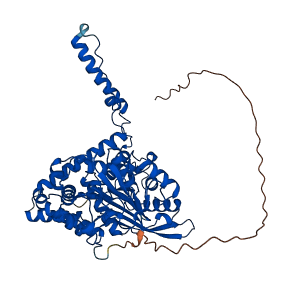
Descriptions
The autoinhibited protein was predicted that may have potential autoinhibitory elements via cis-regPred.
Autoinhibitory domains (AIDs)
Target domain |
|
Relief mechanism |
|
Assay |
cis-regPred |
Accessory elements
No accessory elements
Autoinhibited structure

Activated structure
1 structures for P26443
| Entry ID | Method | Resolution | Chain | Position | Source |
|---|---|---|---|---|---|
| AF-P26443-F1 | Predicted | AlphaFoldDB |
13 variants for P26443
| Variant ID(s) | Position | Change | Description | Diseaes Association | Provenance |
|---|---|---|---|---|---|
| rs256994266 | 40 | A>S | No | EVA | |
| rs3389313746 | 308 | G>E | No | EVA | |
| rs3389284000 | 327 | C>Y | No | EVA | |
| rs3389320461 | 355 | H>Y | No | EVA | |
| rs3389335248 | 360 | G>D | No | EVA | |
| rs3389315344 | 370 | S>R | No | EVA | |
| rs3389318646 | 372 | L>F | No | EVA | |
| rs3389313811 | 388 | L>F | No | EVA | |
| rs3405006732 | 492 | E>* | No | EVA | |
| rs3389311853 | 510 | L>F | No | EVA | |
| rs3389283942 | 512 | Y>* | No | EVA | |
| rs3389284081 | 523 | R>L | No | EVA | |
| rs3389318618 | 557 | F>I | No | EVA |
No associated diseases with P26443
4 regional properties for P26443
| Type | Name | Position | InterPro Accession |
|---|---|---|---|
| domain | Glutamate/phenylalanine/leucine/valine/L-tryptophan dehydrogenase, C-terminal | 263 - 554 | IPR006096 |
| domain | Glutamate/phenylalanine/leucine/valine/L-tryptophan dehydrogenase, dimerisation domain | 113 - 241 | IPR006097 |
| active_site | Leu/Phe/Val dehydrogenases active site | 177 - 190 | IPR033524 |
| domain | NAD(P) binding domain of glutamate dehydrogenase | 263 - 548 | IPR033922 |
Functions
| Description | ||
|---|---|---|
| EC Number | 1.4.1.3 | With NAD(+) or NADP(+) as acceptor |
| Subcellular Localization |
|
|
| PANTHER Family | ||
| PANTHER Subfamily | ||
| PANTHER Protein Class | ||
| PANTHER Pathway Category | No pathway information available | |
5 GO annotations of cellular component
| Name | Definition |
|---|---|
| cytoplasm | The contents of a cell excluding the plasma membrane and nucleus, but including other subcellular structures. |
| endoplasmic reticulum | The irregular network of unit membranes, visible only by electron microscopy, that occurs in the cytoplasm of many eukaryotic cells. The membranes form a complex meshwork of tubular channels, which are often expanded into slitlike cavities called cisternae. The ER takes two forms, rough (or granular), with ribosomes adhering to the outer surface, and smooth (with no ribosomes attached). |
| mitochondrial inner membrane | The inner, i.e. lumen-facing, lipid bilayer of the mitochondrial envelope. It is highly folded to form cristae. |
| mitochondrial matrix | The gel-like material, with considerable fine structure, that lies in the matrix space, or lumen, of a mitochondrion. It contains the enzymes of the tricarboxylic acid cycle and, in some organisms, the enzymes concerned with fatty acid oxidation. |
| mitochondrion | A semiautonomous, self replicating organelle that occurs in varying numbers, shapes, and sizes in the cytoplasm of virtually all eukaryotic cells. It is notably the site of tissue respiration. |
9 GO annotations of molecular function
| Name | Definition |
|---|---|
| ADP binding | Binding to ADP, adenosine 5'-diphosphate. |
| ATP binding | Binding to ATP, adenosine 5'-triphosphate, a universally important coenzyme and enzyme regulator. |
| enzyme binding | Binding to an enzyme, a protein with catalytic activity. |
| glutamate dehydrogenase (NAD+) activity | Catalysis of the reaction: L-glutamate + H2O + NAD+ = 2-oxoglutarate + NH3 + NADH + H+. |
| glutamate dehydrogenase (NADP+) activity | Catalysis of the reaction: L-glutamate + H2O + NADP+ = 2-oxoglutarate + NH3 + NADPH + H+. |
| glutamate dehydrogenase [NAD(P)+] activity | Catalysis of the reaction: L-glutamate + H2O + NAD(P)+ = 2-oxoglutarate + NH3 + NAD(P)H + H+. |
| GTP binding | Binding to GTP, guanosine triphosphate. |
| leucine binding | Binding to 2-amino-4-methylpentanoic acid. |
| NAD+ binding | Binding to the oxidized form, NAD, of nicotinamide adenine dinucleotide, a coenzyme involved in many redox and biosynthetic reactions. |
7 GO annotations of biological process
| Name | Definition |
|---|---|
| cerebellum development | The process whose specific outcome is the progression of the cerebellum over time, from its formation to the mature structure. The cerebellum is the portion of the brain in the back of the head between the cerebrum and the pons. In mice, the cerebellum controls balance for walking and standing, modulates the force and range of movement and is involved in the learning of motor skills. |
| glutamate catabolic process | The chemical reactions and pathways resulting in the breakdown of glutamate, the anion of 2-aminopentanedioic acid. |
| glutamine metabolic process | The chemical reactions and pathways involving glutamine, 2-amino-4-carbamoylbutanoic acid. |
| long-term memory | The memory process that deals with the storage, retrieval and modification of information a long time (typically weeks, months or years) after receiving that information. This type of memory is typically dependent on gene transcription regulated by second messenger activation. |
| positive regulation of insulin secretion | Any process that activates or increases the frequency, rate or extent of the regulated release of insulin. |
| response to aluminum ion | Any process that results in a change in state or activity of a cell or an organism (in terms of movement, secretion, enzyme production, gene expression, etc.) as a result of an aluminum ion stimulus. |
| tricarboxylic acid metabolic process | The chemical reactions and pathways involving dicarboxylic acids, any organic acid containing three carboxyl (COOH) groups or anions (COO-). |
No homologous proteins in AiPD
| UniProt AC | Gene Name | Protein Name | Species | Evidence Code |
|---|---|---|---|---|
| No homologous proteins | ||||
| 10 | 20 | 30 | 40 | 50 | 60 |
| MYRRLGEALL | LSRAGPAALG | SAAADSAALL | GWARGQPSAA | PQPGLTPVAR | RHYSEAAADR |
| 70 | 80 | 90 | 100 | 110 | 120 |
| EDDPNFFKMV | EGFFDRGASI | VEDKLVEDLK | TRESEEQKRN | RVRGILRIIK | PCNHVLSLSF |
| 130 | 140 | 150 | 160 | 170 | 180 |
| PIRRDDGSWE | VIEGYRAQHS | QHRTPCKGGI | RYSTDVSVDE | VKALASLMTY | KCAVVDVPFG |
| 190 | 200 | 210 | 220 | 230 | 240 |
| GAKAGVKINP | KNYTDNELEK | ITRRFTMELA | KKGFIGPGID | VPAPDMSTGE | REMSWIADTY |
| 250 | 260 | 270 | 280 | 290 | 300 |
| ASTIGHYDIN | AHACVTGKPI | SQGGIHGRIS | ATGRGVFHGI | ENFINEASYM | SILGMTPGFG |
| 310 | 320 | 330 | 340 | 350 | 360 |
| DKTFVVQGFG | NVGLHSMRYL | HRFGAKCVGV | GESDGSIWNP | DGIDPKELED | FKLQHGSILG |
| 370 | 380 | 390 | 400 | 410 | 420 |
| FPKAKVYEGS | ILEADCDILI | PAASEKQLTK | SNAPRVKAKI | IAEGANGPTT | PEADKIFLER |
| 430 | 440 | 450 | 460 | 470 | 480 |
| NIMVIPDLYL | NAGGVTVSYF | EWLKNLNHVS | YGRLTFKYER | DSNYHLLMSV | QESLERKFGK |
| 490 | 500 | 510 | 520 | 530 | 540 |
| HGGTIPVVPT | AEFQDRISGA | SEKDIVHSGL | AYTMERSARQ | IMRTAMKYNL | GLDLRTAAYV |
| 550 | |||||
| NAIEKVFKVY | NEAGVTFT |