P26293
Gene name |
petA (SYNPCC7002_A1910) |
Protein name |
Cytochrome f |
Names |
|
Species |
Synechococcus sp. (strain ATCC 27264 / PCC 7002 / PR-6) (Agmenellum quadruplicatum) |
KEGG Pathway |
syp:SYNPCC7002_A1910 |
EC number |
|
Protein Class |
|
Descriptions
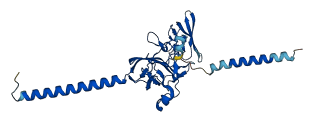
The autoinhibited protein was predicted that may have potential autoinhibitory elements via cis-regPred.
Autoinhibitory domains (AIDs)
Target domain |
|
Relief mechanism |
|
Assay |
cis-regPred |
Accessory elements
No accessory elements
Autoinhibited structure

Activated structure
1 structures for P26293
| Entry ID | Method | Resolution | Chain | Position | Source |
|---|---|---|---|---|---|
| AF-P26293-F1 | Predicted | AlphaFoldDB |
No variants for P26293
| Variant ID(s) | Position | Change | Description | Diseaes Association | Provenance |
|---|---|---|---|---|---|
| No variants for P26293 | |||||
No associated diseases with P26293
2 GO annotations of cellular component
| Name | Definition |
|---|---|
| integral component of thylakoid membrane | The component of the thylakoid membrane consisting of the gene products having at least some part of their peptide sequence embedded in the hydrophobic region of the membrane. |
| plasma membrane-derived thylakoid membrane | The pigmented membrane of a plasma membrane-derived thylakoid. |
3 GO annotations of molecular function
| Name | Definition |
|---|---|
| electron transfer activity | Any molecular entity that serves as an electron acceptor and electron donor in an electron transport chain. An electron transport chain is a process in which a series of electron carriers operate together to transfer electrons from donors to any of several different terminal electron acceptors to generate a transmembrane electrochemical gradient. |
| heme binding | Binding to a heme, a compound composed of iron complexed in a porphyrin (tetrapyrrole) ring. |
| iron ion binding | Binding to an iron (Fe) ion. |
1 GO annotations of biological process
| Name | Definition |
|---|---|
| photosynthesis | The synthesis by organisms of organic chemical compounds, especially carbohydrates, from carbon dioxide (CO2) using energy obtained from light rather than from the oxidation of chemical compounds. |
No homologous proteins in AiPD
| UniProt AC | Gene Name | Protein Name | Species | Evidence Code |
|---|---|---|---|---|
| No homologous proteins | ||||
| 10 | 20 | 30 | 40 | 50 | 60 |
| MKTPELMAIW | QRLKTACLVA | IATFGLFFAS | DVLFPQAAAA | YPFWAQQTAP | ETPREATGRI |
| 70 | 80 | 90 | 100 | 110 | 120 |
| VCANCHLAAK | EAEVEIPQSV | LPDQVFEAVV | KIPYDHSQQQ | VLGDGSKGGL | NVGAVLMLPD |
| 130 | 140 | 150 | 160 | 170 | 180 |
| GFKIAPADRL | SDELKEKTEG | LYFQSYAPDQ | ENVVIIGPIS | GDQYEEIVFP | VLSPDPKTDK |
| 190 | 200 | 210 | 220 | 230 | 240 |
| NINYGKYAVH | LGANRGRGQV | YPTGELSNNN | QFKASATGTI | TNIAVNEAAG | TDITISTEAG |
| 250 | 260 | 270 | 280 | 290 | 300 |
| EVIDTIPAGP | EVIVSEGQAI | AAGEALTNNP | NVGGFGQKDT | EVVLQNPARI | YGYMAFVAGI |
| 310 | 320 | ||||
| MLTQIFLVLK | KKQVERVQAA | GQLDF |