P26186
Gene name |
MGMT |
Protein name |
Methylated-DNA--protein-cysteine methyltransferase |
Names |
6-O-methylguanine-DNA methyltransferase, MGMT, O-6-methylguanine-DNA-alkyltransferase |
Species |
Cricetulus griseus (Chinese hamster) (Cricetulus barabensis griseus) |
KEGG Pathway |
|
EC number |
2.1.1.63: Methyltransferases |
Protein Class |
|
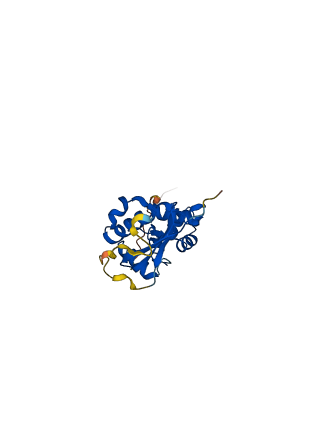
Descriptions
The autoinhibited protein was predicted that may have potential autoinhibitory elements via cis-regPred.
Autoinhibitory domains (AIDs)
Target domain |
|
Relief mechanism |
|
Assay |
cis-regPred |
Accessory elements
No accessory elements
Autoinhibited structure

Activated structure
1 structures for P26186
| Entry ID | Method | Resolution | Chain | Position | Source |
|---|---|---|---|---|---|
| AF-P26186-F1 | Predicted | AlphaFoldDB |
No variants for P26186
| Variant ID(s) | Position | Change | Description | Diseaes Association | Provenance |
|---|---|---|---|---|---|
| No variants for P26186 | |||||
1 associated diseases with P26186
[MIM: 212066]: Congenital disorder of glycosylation 2A (CDG2A)
A multisystem disorder caused by a defect in glycoprotein biosynthesis and characterized by under-glycosylated serum glycoproteins. Congenital disorders of glycosylation result in a wide variety of clinical features, such as defects in the nervous system development, psychomotor retardation, dysmorphic features, hypotonia, coagulation disorders, and immunodeficiency. The broad spectrum of features reflects the critical role of N-glycoproteins during embryonic development, differentiation, and maintenance of cell functions. {ECO:0000269|PubMed:11228641, ECO:0000269|PubMed:8808595}. Note=The disease is caused by variants affecting the gene represented in this entry.
Without disease ID
- A multisystem disorder caused by a defect in glycoprotein biosynthesis and characterized by under-glycosylated serum glycoproteins. Congenital disorders of glycosylation result in a wide variety of clinical features, such as defects in the nervous system development, psychomotor retardation, dysmorphic features, hypotonia, coagulation disorders, and immunodeficiency. The broad spectrum of features reflects the critical role of N-glycoproteins during embryonic development, differentiation, and maintenance of cell functions. {ECO:0000269|PubMed:11228641, ECO:0000269|PubMed:8808595}. Note=The disease is caused by variants affecting the gene represented in this entry.
No regional properties for P26186
| Type | Name | Position | InterPro Accession |
|---|---|---|---|
| No domain, repeats, and functional sites for P26186 | |||
Functions
| Description | ||
|---|---|---|
| EC Number | 2.1.1.63 | Methyltransferases |
| Subcellular Localization |
|
|
| PANTHER Family | ||
| PANTHER Subfamily | ||
| PANTHER Protein Class | ||
| PANTHER Pathway Category | No pathway information available | |
1 GO annotations of cellular component
| Name | Definition |
|---|---|
| nucleus | A membrane-bounded organelle of eukaryotic cells in which chromosomes are housed and replicated. In most cells, the nucleus contains all of the cell's chromosomes except the organellar chromosomes, and is the site of RNA synthesis and processing. In some species, or in specialized cell types, RNA metabolism or DNA replication may be absent. |
3 GO annotations of molecular function
| Name | Definition |
|---|---|
| DNA binding | Any molecular function by which a gene product interacts selectively and non-covalently with DNA (deoxyribonucleic acid). |
| metal ion binding | Binding to a metal ion. |
| methylated-DNA-[protein]-cysteine S-methyltransferase activity | Catalysis of the reaction: DNA (containing 6-O-methylguanine) + (protein)-L-cysteine = DNA (without 6-O-methylguanine) + protein S-methyl-L-cysteine. |
3 GO annotations of biological process
| Name | Definition |
|---|---|
| DNA modification | The covalent alteration of one or more nucleotide sites in DNA, resulting in a change in its properties. |
| DNA repair | The process of restoring DNA after damage. Genomes are subject to damage by chemical and physical agents in the environment (e.g. UV and ionizing radiations, chemical mutagens, fungal and bacterial toxins, etc.) and by free radicals or alkylating agents endogenously generated in metabolism. DNA is also damaged because of errors during its replication. A variety of different DNA repair pathways have been reported that include direct reversal, base excision repair, nucleotide excision repair, photoreactivation, bypass, double-strand break repair pathway, and mismatch repair pathway. |
| methylation | The process in which a methyl group is covalently attached to a molecule. |
No homologous proteins in AiPD
| UniProt AC | Gene Name | Protein Name | Species | Evidence Code |
|---|---|---|---|---|
| No homologous proteins | ||||
| 10 | 20 | 30 | 40 | 50 | 60 |
| MAETCKMKYT | VFHSPLGKIE | LCGCERGLHG | IRFLSGKTPS | SDPKEAPASP | ELLGGPEDLP |
| 70 | 80 | 90 | 100 | 110 | 120 |
| ESLVQCTTWL | EAYFQEPAAT | EGLPLPALHH | PVFQQDSFTR | QVLWKLLKVV | KFGEMVSYQQ |
| 130 | 140 | 150 | 160 | 170 | 180 |
| LAALAGNPKA | ARAVGGAMRN | NPVPILIPCH | RVICSNGSIG | NYSGGGQAVK | EWLLAHEGIP |
| 190 | 200 | ||||
| TRQPACKDLG | LTGTRLKPSG | GSTSSKLSG |