Descriptions
The autoinhibited protein was predicted that may have potential autoinhibitory elements via cis-regPred.
Autoinhibitory domains (AIDs)
Target domain |
|
Relief mechanism |
|
Assay |
cis-regPred |
Accessory elements
No accessory elements
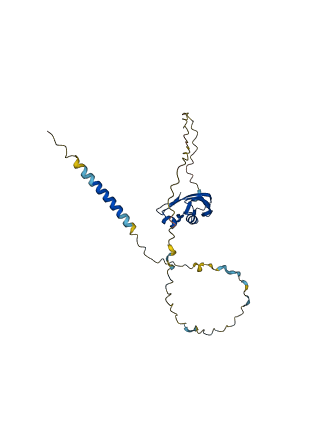
Autoinhibited structure

Activated structure
1 structures for P26185
| Entry ID | Method | Resolution | Chain | Position | Source |
|---|---|---|---|---|---|
| AF-P26185-F1 | Predicted | AlphaFoldDB |
No variants for P26185
| Variant ID(s) | Position | Change | Description | Diseaes Association | Provenance |
|---|---|---|---|---|---|
| No variants for P26185 | |||||
No associated diseases with P26185
3 GO annotations of cellular component
| Name | Definition |
|---|---|
| integral component of membrane | The component of a membrane consisting of the gene products and protein complexes having at least some part of their peptide sequence embedded in the hydrophobic region of the membrane. |
| outer membrane-bounded periplasmic space | The region between the inner (cytoplasmic or plasma) membrane and outer membrane of organisms with two membranes such as Gram negative bacteria. These periplasmic spaces are relatively thick and contain a thin peptidoglycan layer (PGL), also referred to as a thin cell wall. |
| plasma membrane | The membrane surrounding a cell that separates the cell from its external environment. It consists of a phospholipid bilayer and associated proteins. |
2 GO annotations of molecular function
| Name | Definition |
|---|---|
| energy transducer activity | The biological transducer activity that accepts energy and converts it to another form, often by transfer to another molecule within the cell. |
| siderophore transmembrane transporter activity | Enables the transfer of a solute or solutes from one side of a membrane to the other according to the reaction: siderophore-iron(out) + H+(out) = siderophore-iron(in) + H+(in). |
2 GO annotations of biological process
| Name | Definition |
|---|---|
| bacteriocin transport | The directed movement of a bacteriocin into, out of or within a cell, or between cells, by means of some agent such as a transporter or pore. Bacteriocins are a group of antibiotics produced by bacteria and are encoded by a group of naturally occurring plasmids, e.g. Col E1. Bacteriocins are toxic to bacteria closely related to the bacteriocin producing strain. |
| protein transport | The directed movement of proteins into, out of or within a cell, or between cells, by means of some agent such as a transporter or pore. |
No homologous proteins in AiPD
| UniProt AC | Gene Name | Protein Name | Species | Evidence Code |
|---|---|---|---|---|
| No homologous proteins | ||||
| 10 | 20 | 30 | 40 | 50 | 60 |
| MPLKKMFLNR | RISVPFVLSV | GLHSALVAGL | LYASVKEVVE | LPKPEDAPIS | VMMVNTAAMA |
| 70 | 80 | 90 | 100 | 110 | 120 |
| EPPPPAPAEP | EPPQVEPEPE | PEPEPIVEPP | PKAIVKPEPV | KPKPKPKPKP | KVEKQVKPEP |
| 130 | 140 | 150 | 160 | 170 | 180 |
| KKVEPREPSP | FNNDSPAKPI | DKAPVKQAPA | APVQGNSREV | GPRPISRANP | LYPPRAQALQ |
| 190 | 200 | 210 | 220 | 230 | 240 |
| IEGNVRVQFD | IDSDGRVSNV | RILSAEPRNM | FEREVKQAMR | KWRYEAKEAK | DRTVTIRFKL |
| NGTTELN |