P25651
Gene name |
CSM1 (SPO86, YCR086W, YCR86W) |
Protein name |
Monopolin complex subunit CSM1 |
Names |
Chromosome segregation in meiosis protein 1 |
Species |
Saccharomyces cerevisiae (strain ATCC 204508 / S288c) (Baker's yeast) |
KEGG Pathway |
sce:YCR086W |
EC number |
|
Protein Class |
|
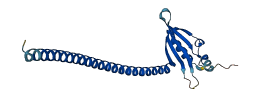
Descriptions
The autoinhibited protein was predicted that may have potential autoinhibitory elements via cis-regPred.
Autoinhibitory domains (AIDs)
Target domain |
|
Relief mechanism |
|
Assay |
cis-regPred |
Accessory elements
No accessory elements
Autoinhibited structure

Activated structure
9 structures for P25651
| Entry ID | Method | Resolution | Chain | Position | Source |
|---|---|---|---|---|---|
| 3N4R | X-ray | 260 A | A/B/C/D | 69-181 | PDB |
| 3N4S | X-ray | 235 A | A/B/C/D | 69-181 | PDB |
| 3N4X | X-ray | 341 A | A/B/C/D | 1-190 | PDB |
| 3N7N | X-ray | 390 A | A/B/C/D | 1-190 | PDB |
| 5KTB | X-ray | 305 A | A/B | 1-190 | PDB |
| 5V1A | X-ray | 214 A | A | 69-190 | PDB |
| 5V3N | X-ray | 130 A | A | 69-181 | PDB |
| 6DEI | X-ray | 170 A | A/B | 69-181 | PDB |
| AF-P25651-F1 | Predicted | AlphaFoldDB |
No variants for P25651
| Variant ID(s) | Position | Change | Description | Diseaes Association | Provenance |
|---|---|---|---|---|---|
| No variants for P25651 | |||||
No associated diseases with P25651
Functions
5 GO annotations of cellular component
| Name | Definition |
|---|---|
| chromosome, centromeric core domain | The innermost portion of the centromeric region of a chromosome, encompassing the core region of a chromosome centromere and the proteins that bind to it. |
| mitotic spindle | A spindle that forms as part of mitosis. Mitotic and meiotic spindles contain distinctive complements of proteins associated with microtubules. |
| monopolin complex | A protein complex required for clamping microtubule binding sites, ensuring orientation of sister kinetochores to the same pole (mono-orientation) during meiosis I. In the yeast S. cerevisiae this complex consists of Csm1p, Lrs4p, Hrr25p and Mam1p; in S. pombe Psc1 and Mde4 have been identified as subunits. |
| nuclear envelope | The double lipid bilayer enclosing the nucleus and separating its contents from the rest of the cytoplasm; includes the intermembrane space, a gap of width 20-40 nm (also called the perinuclear space). |
| nucleolus | A small, dense body one or more of which are present in the nucleus of eukaryotic cells. It is rich in RNA and protein, is not bounded by a limiting membrane, and is not seen during mitosis. Its prime function is the transcription of the nucleolar DNA into 45S ribosomal-precursor RNA, the processing of this RNA into 5.8S, 18S, and 28S components of ribosomal RNA, and the association of these components with 5S RNA and proteins synthesized outside the nucleolus. This association results in the formation of ribonucleoprotein precursors; these pass into the cytoplasm and mature into the 40S and 60S subunits of the ribosome. |
2 GO annotations of molecular function
| Name | Definition |
|---|---|
| identical protein binding | Binding to an identical protein or proteins. |
| microtubule site clamp | The binding activity of a molecule that attaches the spindle microtubules to the kinetochore. |
7 GO annotations of biological process
| Name | Definition |
|---|---|
| attachment of mitotic spindle microtubules to kinetochore | The cell cycle process in which spindle microtubules become physically associated with the proteins making up the kinetochore complex as part of mitotic metaphase plate congression. |
| homologous chromosome segregation | The cell cycle process in which replicated homologous chromosomes are organized and then physically separated and apportioned to two sets during the first division of the meiotic cell cycle. Each replicated chromosome, composed of two sister chromatids, aligns at the cell equator, paired with its homologous partner; this pairing off, referred to as synapsis, permits genetic recombination. One homolog (both sister chromatids) of each morphologic type goes into each of the resulting chromosome sets. |
| meiotic chromosome segregation | The process in which genetic material, in the form of chromosomes, is organized into specific structures and then physically separated and apportioned to two or more sets during M phase of the meiotic cell cycle. |
| meiotic sister chromatid segregation | The cell cycle process in which sister chromatids are organized and then physically separated and randomly apportioned to two sets during the second division of the meiotic cell cycle. |
| monopolar spindle attachment to meiosis I kinetochore | The process in which spindle microtubules become physically associated with the proteins making up the kinetochore complex during meiosis I. During meiosis I sister kinetochores are lying next to each other facing the same spindle pole and monopolar attachment of the chromatid to the spindle occurs. |
| protein localization to nucleolar rDNA repeats | Any process in which a protein is transported to, or maintained at, the rDNA repeats on a chromosome in the nucleolus. |
| rDNA chromatin condensation | The process in which the chromatin structure of the rDNA repeats is compacted. In S. cerevisiae, condensation and resolution of the rDNA occurs during anaphase. |
No homologous proteins in AiPD
| UniProt AC | Gene Name | Protein Name | Species | Evidence Code |
|---|---|---|---|---|
| No homologous proteins | ||||
| 10 | 20 | 30 | 40 | 50 | 60 |
| MDPLTVYKNS | VKQQIDSADL | LVANLVNENF | VLSEKLDTKA | TEIKQLQKQI | DSLNAQVKEL |
| 70 | 80 | 90 | 100 | 110 | 120 |
| KTQTSQQAEN | SEVIKDLYEY | LCNVRVHKSY | EDDSGLWFDI | SQGTHSGGSS | DDYSIMDYKL |
| 130 | 140 | 150 | 160 | 170 | 180 |
| GFVKGQAQVT | EVIYAPVLKQ | RSTEELYSLQ | SKLPEYLFET | LSFPLSSLNQ | FYNKIAKSLN |
| KKREKKDETE |