P25568
Gene name |
ATG22 (AUT4, YCL038C, YCL38C) |
Protein name |
Autophagy-related protein 22 |
Names |
|
Species |
Saccharomyces cerevisiae (strain ATCC 204508 / S288c) (Baker's yeast) |
KEGG Pathway |
sce:YCL038C |
EC number |
|
Protein Class |
|
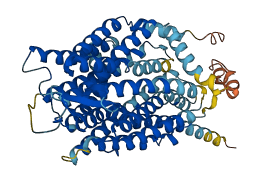
Descriptions
The autoinhibited protein was predicted that may have potential autoinhibitory elements via cis-regPred.
Autoinhibitory domains (AIDs)
Target domain |
|
Relief mechanism |
|
Assay |
cis-regPred |
Accessory elements
No accessory elements
Autoinhibited structure

Activated structure
1 structures for P25568
| Entry ID | Method | Resolution | Chain | Position | Source |
|---|---|---|---|---|---|
| AF-P25568-F1 | Predicted | AlphaFoldDB |
6 variants for P25568
| Variant ID(s) | Position | Change | Description | Diseaes Association | Provenance |
|---|---|---|---|---|---|
| s03-56291 | 79 | K>N | No | SGRP | |
| s03-56229 | 100 | V>A | No | SGRP | |
| s03-55969 | 187 | L>V | No | SGRP | |
| s03-55727 | 267 | I>M | No | SGRP | |
| s03-55716 | 271 | V>A | No | SGRP | |
| s03-55672 | 286 | E>Q | No | SGRP |
No associated diseases with P25568
No regional properties for P25568
| Type | Name | Position | InterPro Accession |
|---|---|---|---|
| No domain, repeats, and functional sites for P25568 | |||
2 GO annotations of cellular component
| Name | Definition |
|---|---|
| integral component of fungal-type vacuolar membrane | The component of the fungal-type vacuole membrane consisting of the gene products having at least some part of their peptide sequence embedded in the hydrophobic region of the membrane. |
| integral component of membrane | The component of a membrane consisting of the gene products and protein complexes having at least some part of their peptide sequence embedded in the hydrophobic region of the membrane. |
No GO annotations of molecular function
| Name | Definition |
|---|---|
| No GO annotations for molecular function |
2 GO annotations of biological process
| Name | Definition |
|---|---|
| amino acid transmembrane export from vacuole | The directed movement of amino acids out of the vacuole, across the vacuolar membrane. |
| autophagy | The cellular catabolic process in which cells digest parts of their own cytoplasm; allows for both recycling of macromolecular constituents under conditions of cellular stress and remodeling the intracellular structure for cell differentiation. |
No homologous proteins in AiPD
| UniProt AC | Gene Name | Protein Name | Species | Evidence Code |
|---|---|---|---|---|
| No homologous proteins | ||||
| 10 | 20 | 30 | 40 | 50 | 60 |
| MSYGTINDMN | ESVTNYRIKK | AQNNIKGWYA | YSFSSEPFVV | SAVSTYIPLL | LQQFASINGV |
| 70 | 80 | 90 | 100 | 110 | 120 |
| KVHDHSIPCL | SETGSDSDKC | VLGLFNNRIF | VDTSSFALYV | FSLSVLFQTI | IVISVSGIVD |
| 130 | 140 | 150 | 160 | 170 | 180 |
| LWGSVKFKGR | ILVWFGIVGA | LSTVAISKLN | DTQIYSLAGL | YIVANGCFGV | INVVGNSLLP |
| 190 | 200 | 210 | 220 | 230 | 240 |
| IFVKDSLKCQ | SQGAYEPDKV | DSLTTVISGR | GASLGYSSAL | IVQIVSMFLV | ASKKGSKQDV |
| 250 | 260 | 270 | 280 | 290 | 300 |
| QVAVLFVGIW | WFVWQLPMIW | LIDDVTIPIR | VDDSTLASAR | SPYPGEQDAL | GQLNWKNYLS |
| 310 | 320 | 330 | 340 | 350 | 360 |
| YGWVSLFESF | KHARLLKDVM | IFLIAWFIIS | DSITTINSTA | VLFSKAELHM | STLNLIMISV |
| 370 | 380 | 390 | 400 | 410 | 420 |
| LTVVNAMLGA | FMIPQFLATK | FRWTSSQTLM | YIIIWASFIP | FYGILGFFFN | AFGLKHKFEM |
| 430 | 440 | 450 | 460 | 470 | 480 |
| FLLAIWYGLS | LGGLSAVSRS | VFSLIVPPGK | ESTFFSMFSI | TDKGSSILGP | FLVGLLTDKT |
| 490 | 500 | 510 | 520 | ||
| HNIRYSFYFF | FLLLMLSLPV | LNCLDVKRGR | REAEELSQVL | PESERRLD |