P25453
Gene name |
DMC1 (ISC2, YER179W) |
Protein name |
Meiotic recombination protein DMC1 |
Names |
|
Species |
Saccharomyces cerevisiae (strain ATCC 204508 / S288c) (Baker's yeast) |
KEGG Pathway |
sce:YER179W |
EC number |
|
Protein Class |
|
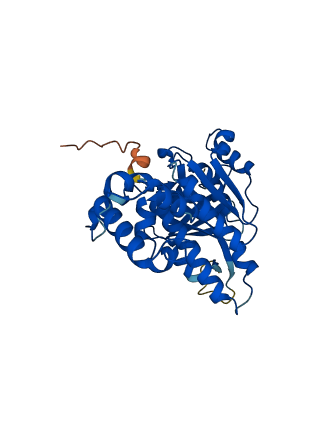
Descriptions
The autoinhibited protein was predicted that may have potential autoinhibitory elements via cis-regPred.
Autoinhibitory domains (AIDs)
Target domain |
|
Relief mechanism |
|
Assay |
cis-regPred |
Accessory elements
No accessory elements
Autoinhibited structure

Activated structure
3 structures for P25453
| Entry ID | Method | Resolution | Chain | Position | Source |
|---|---|---|---|---|---|
| 7EJ6 | EM | 321 A | A/B/C | 1-334 | PDB |
| 7EJ7 | EM | 341 A | A/B/C | 1-334 | PDB |
| AF-P25453-F1 | Predicted | AlphaFoldDB |
1 variants for P25453
| Variant ID(s) | Position | Change | Description | Diseaes Association | Provenance |
|---|---|---|---|---|---|
| s05-548838 | 111 | I>V | No | SGRP |
No associated diseases with P25453
4 regional properties for P25453
| Type | Name | Position | InterPro Accession |
|---|---|---|---|
| domain | AAA+ ATPase domain | 113 - 301 | IPR003593 |
| domain | DNA recombination and repair protein Rad51-like, C-terminal | 79 - 331 | IPR013632 |
| domain | DNA recombination and repair protein RecA, monomer-monomer interface | 270 - 334 | IPR020587 |
| domain | DNA recombination and repair protein RecA-like, ATP-binding domain | 92 - 263 | IPR020588 |
2 GO annotations of cellular component
| Name | Definition |
|---|---|
| condensed nuclear chromosome | A highly compacted molecule of DNA and associated proteins resulting in a cytologically distinct nuclear chromosome. |
| nucleus | A membrane-bounded organelle of eukaryotic cells in which chromosomes are housed and replicated. In most cells, the nucleus contains all of the cell's chromosomes except the organellar chromosomes, and is the site of RNA synthesis and processing. In some species, or in specialized cell types, RNA metabolism or DNA replication may be absent. |
7 GO annotations of molecular function
| Name | Definition |
|---|---|
| ATP binding | Binding to ATP, adenosine 5'-triphosphate, a universally important coenzyme and enzyme regulator. |
| ATP-dependent activity, acting on DNA | Catalytic activity that acts to modify DNA, driven by ATP hydrolysis. |
| ATP-dependent DNA damage sensor activity | A molecule that recognises toxic DNA structures, and initiates a signalling response, driven by ATP hydrolysis. |
| ATPase inhibitor activity | Binds to and stops, prevents or reduces an ATP hydrolysis activity. |
| DNA strand exchange activity | Catalysis of the identification and base-pairing of homologous sequences between single-stranded DNA and double-stranded DNA. |
| double-stranded DNA binding | Binding to double-stranded DNA. |
| single-stranded DNA binding | Binding to single-stranded DNA. |
9 GO annotations of biological process
| Name | Definition |
|---|---|
| chromosome organization involved in meiotic cell cycle | A process of chromosome organization that is involved in a meiotic cell cycle. |
| DNA recombinase assembly | The aggregation, arrangement and bonding together of strand exchange proteins (recombinases) into higher order oligomers on single-stranded DNA. |
| meiotic cell cycle | Progression through the phases of the meiotic cell cycle, in which canonically a cell replicates to produce four offspring with half the chromosomal content of the progenitor cell via two nuclear divisions. |
| meiotic joint molecule formation | The conversion of the paired broken DNA and homologous duplex DNA into a four-stranded branched intermediate, known as a joint molecule, formed during meiotic recombination. These joint molecules contain Holliday junctions on either side of heteroduplex DNA. |
| mitotic recombination | The exchange, reciprocal or nonreciprocal, of genetic material between one DNA molecule and a homologous DNA region that occurs during mitotic cell cycles. |
| reciprocal meiotic recombination | The cell cycle process in which double strand breaks are formed and repaired through a single or double Holliday junction intermediate. This results in the equal exchange of genetic material between non-sister chromatids in a pair of homologous chromosomes. These reciprocal recombinant products ensure the proper segregation of homologous chromosomes during meiosis I and create genetic diversity. |
| sporulation resulting in formation of a cellular spore | The process in which a relatively unspecialized cell acquires the specialized features of a cellular spore, a cell form that can be used for dissemination, for survival of adverse conditions because of its heat and dessication resistance, and/or for reproduction. |
| strand invasion | The process in which the nucleoprotein complex (composed of the broken single-strand DNA and the recombinase) searches and identifies a region of homology in intact duplex DNA. The broken single-strand DNA displaces the like strand and forms Watson-Crick base pairs with its complement, forming a duplex in which each strand is from one of the two recombining DNA molecules. |
| synaptonemal complex assembly | The cell cycle process in which the synaptonemal complex is formed. This is a structure that holds paired chromosomes together during prophase I of meiosis and that promotes genetic recombination. |
No homologous proteins in AiPD
| UniProt AC | Gene Name | Protein Name | Species | Evidence Code |
|---|---|---|---|---|
| No homologous proteins | ||||
| 10 | 20 | 30 | 40 | 50 | 60 |
| MSVTGTEIDS | DTAKNILSVD | ELQNYGINAS | DLQKLKSGGI | YTVNTVLSTT | RRHLCKIKGL |
| 70 | 80 | 90 | 100 | 110 | 120 |
| SEVKVEKIKE | AAGKIIQVGF | IPATVQLDIR | QRVYSLSTGS | KQLDSILGGG | IMTMSITEVF |
| 130 | 140 | 150 | 160 | 170 | 180 |
| GEFRCGKTQM | SHTLCVTTQL | PREMGGGEGK | VAYIDTEGTF | RPERIKQIAE | GYELDPESCL |
| 190 | 200 | 210 | 220 | 230 | 240 |
| ANVSYARALN | SEHQMELVEQ | LGEELSSGDY | RLIVVDSIMA | NFRVDYCGRG | ELSERQQKLN |
| 250 | 260 | 270 | 280 | 290 | 300 |
| QHLFKLNRLA | EEFNVAVFLT | NQVQSDPGAS | ALFASADGRK | PIGGHVLAHA | SATRILLRKG |
| 310 | 320 | 330 | |||
| RGDERVAKLQ | DSPDMPEKEC | VYVIGEKGIT | DSSD |