P25284
Gene name |
nuo40 (NCU02373) |
Protein name |
NADH-ubiquinone oxidoreductase 40 kDa subunit, mitochondrial |
Names |
Complex I-40kD, CI-40kD |
Species |
Neurospora crassa (strain ATCC 24698 / 74-OR23-1A / CBS 708.71 / DSM 1257 / FGSC 987) |
KEGG Pathway |
ncr:NCU02373 |
EC number |
|
Protein Class |
|
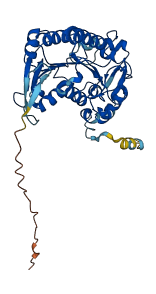
Descriptions
The autoinhibited protein was predicted that may have potential autoinhibitory elements via cis-regPred.
Autoinhibitory domains (AIDs)
Target domain |
|
Relief mechanism |
|
Assay |
cis-regPred |
Accessory elements
No accessory elements
Autoinhibited structure

Activated structure
1 structures for P25284
| Entry ID | Method | Resolution | Chain | Position | Source |
|---|---|---|---|---|---|
| AF-P25284-F1 | Predicted | AlphaFoldDB |
No variants for P25284
| Variant ID(s) | Position | Change | Description | Diseaes Association | Provenance |
|---|---|---|---|---|---|
| No variants for P25284 | |||||
No associated diseases with P25284
9 regional properties for P25284
| Type | Name | Position | InterPro Accession |
|---|---|---|---|
| repeat | WD40 repeat | 103 - 186 | IPR001680-1 |
| repeat | WD40 repeat | 190 - 336 | IPR001680-2 |
| repeat | WD40 repeat | 338 - 444 | IPR001680-3 |
| domain | LIS1 homology motif | 9 - 41 | IPR006594 |
| conserved_site | WD40 repeat, conserved site | 217 - 231 | IPR019775-1 |
| conserved_site | WD40 repeat, conserved site | 260 - 274 | IPR019775-2 |
| repeat | G-protein beta WD-40 repeat | 129 - 143 | IPR020472-1 |
| repeat | G-protein beta WD-40 repeat | 173 - 187 | IPR020472-2 |
| repeat | G-protein beta WD-40 repeat | 217 - 231 | IPR020472-3 |
3 GO annotations of cellular component
| Name | Definition |
|---|---|
| mitochondrial matrix | The gel-like material, with considerable fine structure, that lies in the matrix space, or lumen, of a mitochondrion. It contains the enzymes of the tricarboxylic acid cycle and, in some organisms, the enzymes concerned with fatty acid oxidation. |
| mitochondrion | A semiautonomous, self replicating organelle that occurs in varying numbers, shapes, and sizes in the cytoplasm of virtually all eukaryotic cells. It is notably the site of tissue respiration. |
| respirasome | The protein complexes that form the electron transport system (the respiratory chain), associated with a cell membrane, usually the plasma membrane (in prokaryotes) or the inner mitochondrial membrane (on eukaryotes). The respiratory chain complexes transfer electrons from an electron donor to an electron acceptor and are associated with a proton pump to create a transmembrane electrochemical gradient. |
1 GO annotations of molecular function
| Name | Definition |
|---|---|
| protein-containing complex binding | Binding to a macromolecular complex. |
1 GO annotations of biological process
| Name | Definition |
|---|---|
| ubiquinone-6 biosynthetic process | The chemical reactions and pathways resulting in the formation of ubiquinone-6. |
No homologous proteins in AiPD
| UniProt AC | Gene Name | Protein Name | Species | Evidence Code |
|---|---|---|---|---|
| No homologous proteins | ||||
| 10 | 20 | 30 | 40 | 50 | 60 |
| MAPLTAAMRS | TPRIIVSNAF | GFQRRAISDV | TITRTGKPII | RNQGGRSSLG | GHTATVFGAT |
| 70 | 80 | 90 | 100 | 110 | 120 |
| GQLGRYIVNR | LARQGCTVVI | PFRDEYNKRH | LKVTGDLGKV | VMIEFDLRNT | QSIEESVRHS |
| 130 | 140 | 150 | 160 | 170 | 180 |
| DVVYNLIGRD | YPTKNFSFED | VHIEGAERIA | EAVAKYDVDR | FIHVSSYNAD | PNSECEFFAT |
| 190 | 200 | 210 | 220 | 230 | 240 |
| KARGEQVVRS | IFPETTIVRP | APMFGFEDRL | LHKLASVKNI | LTSNGMQEKY | NPVHVIDVGQ |
| 250 | 260 | 270 | 280 | 290 | 300 |
| ALEQMLWDDN | TASETFELYG | PKTYTTAEIS | EMVDREIYKR | RRHVNVPKKI | LKPIAGVLNK |
| 310 | 320 | 330 | 340 | 350 | 360 |
| ALWWPIMSAD | EIEREFHDQV | IDPEAKTFKD | LGIEPADIAN | FTYHYLQSYR | SNAYYDLPPA |
| 370 | |||||
| TEKERREDRE | YIHML |