P25158
Gene name |
osk (CG10901) |
Protein name |
Maternal effect protein oskar |
Names |
|
Species |
Drosophila melanogaster (Fruit fly) |
KEGG Pathway |
dme:Dmel_CG10901 |
EC number |
|
Protein Class |
|
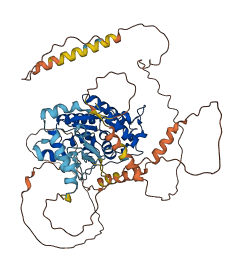
Descriptions
The autoinhibited protein was predicted that may have potential autoinhibitory elements via cis-regPred.
Autoinhibitory domains (AIDs)
Target domain |
|
Relief mechanism |
|
Assay |
cis-regPred |
Accessory elements
No accessory elements
Autoinhibited structure

Activated structure
8 structures for P25158
| Entry ID | Method | Resolution | Chain | Position | Source |
|---|---|---|---|---|---|
| 5A48 | X-ray | 235 A | A/B | 139-240 | PDB |
| 5A49 | X-ray | 210 A | A/B/C/D/E/F/G/H/I/J | 139-222 | PDB |
| 5A4A | X-ray | 170 A | A | 401-606 | PDB |
| 5CD7 | X-ray | 250 A | A/B/C/D/E/F | 150-224 | PDB |
| 5CD8 | X-ray | 300 A | A/B/C/D/E/F | 150-240 | PDB |
| 5CD9 | X-ray | 210 A | A | 393-606 | PDB |
| 5NT7 | X-ray | 140 A | A/C | 139-240 | PDB |
| AF-P25158-F1 | Predicted | AlphaFoldDB |
No variants for P25158
| Variant ID(s) | Position | Change | Description | Diseaes Association | Provenance |
|---|---|---|---|---|---|
| No variants for P25158 | |||||
No associated diseases with P25158
6 GO annotations of cellular component
| Name | Definition |
|---|---|
| cell cortex | The region of a cell that lies just beneath the plasma membrane and often, but not always, contains a network of actin filaments and associated proteins. |
| cytoplasm | The contents of a cell excluding the plasma membrane and nucleus, but including other subcellular structures. |
| germ cell nucleus | The nucleus of a germ cell, a reproductive cell in multicellular organisms. |
| P granule | A small cytoplasmic, non-membranous RNA/protein complex aggregate in the primordial germ cells of many higher eukaryotes. |
| pole plasm | Differentiated cytoplasm associated with a pole (animal, vegetal, anterior, or posterior) of an oocyte, egg or early embryo. |
| posterior cell cortex | The region that lies just beneath the plasma membrane in the part of a cell that is closest to the posterior as defined by the developing, or existing, anterior/posterior axis. |
1 GO annotations of molecular function
| Name | Definition |
|---|---|
| mRNA binding | Binding to messenger RNA (mRNA), an intermediate molecule between DNA and protein. mRNA includes UTR and coding sequences, but does not contain introns. |
19 GO annotations of biological process
| Name | Definition |
|---|---|
| cortical actin cytoskeleton organization | A process that is carried out at the cellular level which results in the assembly, arrangement of constituent parts, or disassembly of actin-based cytoskeletal structures in the cell cortex, i.e. just beneath the plasma membrane. |
| germ cell development | The process whose specific outcome is the progression of an immature germ cell over time, from its formation to the mature structure (gamete). A germ cell is any reproductive cell in a multicellular organism. |
| long-term memory | The memory process that deals with the storage, retrieval and modification of information a long time (typically weeks, months or years) after receiving that information. This type of memory is typically dependent on gene transcription regulated by second messenger activation. |
| oocyte microtubule cytoskeleton polarization | Establishment and maintenance of a specific axis of polarity of the oocyte microtubule network. The axis is set so that the minus and plus ends of the microtubules of the mid stage oocyte are positioned along the anterior cortex and at the posterior pole, respectively. An example of this is found in Drosophila melanogaster. |
| oogenesis | The complete process of formation and maturation of an ovum or female gamete from a primordial female germ cell. Examples of this process are found in Mus musculus and Drosophila melanogaster. |
| P granule assembly | The aggregation, arrangement and bonding together of a set of components to form a P granule. |
| P granule organization | A process that is carried out at the cellular level which results in the assembly, arrangement of constituent parts, or disassembly of polar granules, cytoplasmic, non-membranous RNA/protein complex aggregates in the primordial germ cells of many higher eukaryotes. |
| pole cell formation | Formation of a small group of cells (pole cells) at the posterior pole of the insect blastula. They are the first cells to cellularize after the arrival of nuclei at the end of the syncytial blastula stage and are the precursors to the insect germ cells. |
| pole plasm assembly | Establishment of the specialized cytoplasm found at the poles of the egg. An example of this is found in Drosophila melanogaster. |
| pole plasm mRNA localization | Any process in which mRNA is transported to, or maintained in, the oocyte pole plasm. An example of this is found in Drosophila melanogaster. |
| pole plasm protein localization | Any process in which a protein is transported to, or maintained in, the oocyte pole plasm. An example of this is found in Drosophila melanogaster. |
| posterior abdomen determination | The regionalization process in which the posterior (abdominal) regions of the embryo are specified by the gap genes. |
| protein localization to nucleus | A process in which a protein transports or maintains the localization of another protein to the nucleus. |
| regulation of mRNA stability | Any process that modulates the propensity of mRNA molecules to degradation. Includes processes that both stabilize and destabilize mRNAs. |
| regulation of oskar mRNA translation | Any process that modulates the frequency, rate or extent of oskar mRNA translation. To ensure the localization of Oskar protein at the posterior pole of the oocyte, translation of oskar mRNA is repressed during its transport to the posterior pole and activated upon localization of the mRNA at the posterior cortex. |
| segmentation | The regionalization process that divides an organism or part of an organism into a series of semi-repetitive parts, or segments, often arranged along a longitudinal axis. |
| thermosensory behavior | Behavior that is dependent upon the sensation of temperature. |
| visual behavior | The behavior of an organism in response to a visual stimulus. |
| visual learning | Any process in an organism in which a change in behavior of an individual occurs in response to repeated exposure to a visual cue. |
No homologous proteins in AiPD
| UniProt AC | Gene Name | Protein Name | Species | Evidence Code |
|---|---|---|---|---|
| No homologous proteins | ||||
| 10 | 20 | 30 | 40 | 50 | 60 |
| MAAVTSEFPS | KPISYTSTNT | SAKTYYLKSV | KKRVTTCFQQ | LRDKLQSSGS | FRKSSSSCLN |
| 70 | 80 | 90 | 100 | 110 | 120 |
| QIFVRSDFSA | CGERFRKIFK | SARKTELPEL | WKVPLVAHEL | TSRQSSQQLQ | VVARLFSSTQ |
| 130 | 140 | 150 | 160 | 170 | 180 |
| ISTKEITYNS | NSNTSENNMT | IIESNYISVR | EEYPDIDSEV | RAILLSHAQN | GITISSIKSE |
| 190 | 200 | 210 | 220 | 230 | 240 |
| YRKLTGNPFP | LHDNVTDFLL | TIPNVTAECS | ESGKRIFNLK | ASLKNGHLLD | MVLNQKERTS |
| 250 | 260 | 270 | 280 | 290 | 300 |
| DYSSGAPSLE | NIPRAPPRYW | KNPFKRRALS | QLNTSPRTVP | KITDEKTKDI | ATRPVSLHQM |
| 310 | 320 | 330 | 340 | 350 | 360 |
| ANEAAESNWC | YQDNWKHLNN | FYQQASVNAP | KMPVPINIYS | PDAPEEPINL | APPGHQPSCR |
| 370 | 380 | 390 | 400 | 410 | 420 |
| TQSQKTEPTE | NRHLGIFVHP | FNGMNIMKRR | HEMTPTPTIL | TSGTYNDSLL | TINSDYDAYL |
| 430 | 440 | 450 | 460 | 470 | 480 |
| LDFPLMGDDF | MLYLARMELK | CRFRRHERVL | QSGLCVSGLT | INGARNRLKR | VQLPEGTQII |
| 490 | 500 | 510 | 520 | 530 | 540 |
| VNIGSVDIMR | GKPLVQIEHD | FRLLIKEMHN | MRLVPILTNL | APLGNYCHDK | VLCDKIYRFN |
| 550 | 560 | 570 | 580 | 590 | 600 |
| KFIRSECCHL | KVIDIHSCLI | NERGVVRFDC | FQASPRQVTG | SKEPYLFWNK | IGRQRVLQVI |
| ETSLEY |