P25084
Gene name |
lasR (PA1430) |
Protein name |
Transcriptional activator protein LasR |
Names |
|
Species |
Pseudomonas aeruginosa (strain ATCC 15692 / DSM 22644 / CIP 104116 / JCM 14847 / LMG 12228 / 1C / PRS 101 / PAO1) |
KEGG Pathway |
pae:PA1430 |
EC number |
|
Protein Class |
|
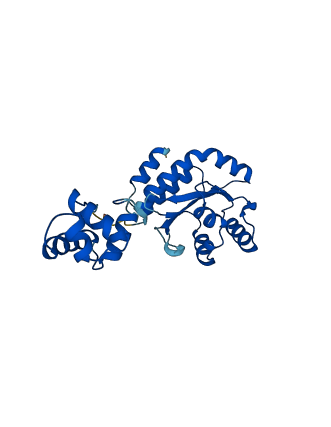
Descriptions
The autoinhibited protein was predicted that may have potential autoinhibitory elements via cis-regPred.
Autoinhibitory domains (AIDs)
Target domain |
|
Relief mechanism |
|
Assay |
cis-regPred |
Accessory elements
No accessory elements
Autoinhibited structure

Activated structure
22 structures for P25084
| Entry ID | Method | Resolution | Chain | Position | Source |
|---|---|---|---|---|---|
| 2UV0 | X-ray | 180 A | E/F/G/H | 1-173 | PDB |
| 3IX3 | X-ray | 140 A | A/B | 1-173 | PDB |
| 3IX4 | X-ray | 180 A | A/B/C/D/E/F/G/H | 1-173 | PDB |
| 3IX8 | X-ray | 180 A | A/B/C/D | 1-173 | PDB |
| 3JPU | X-ray | 230 A | A/B/C/D/E | 1-173 | PDB |
| 4NG2 | X-ray | 241 A | A/B/C/D | 1-170 | PDB |
| 6D6A | X-ray | 190 A | A/B/C/D/E/F/G/H | 1-170 | PDB |
| 6D6B | X-ray | 170 A | A/B/C/D/E/F/G/H | 1-170 | PDB |
| 6D6C | X-ray | 188 A | A/B/C/D/E/F/G/H/I/J/K/L | 1-170 | PDB |
| 6D6D | X-ray | 170 A | A/B | 1-169 | PDB |
| 6D6L | X-ray | 163 A | A/B/C/D | 1-170 | PDB |
| 6D6M | X-ray | 190 A | A/B/C/D | 1-170 | PDB |
| 6D6N | X-ray | 181 A | A/B/C/D | 1-170 | PDB |
| 6D6O | X-ray | 165 A | A/B/C/D | 1-170 | PDB |
| 6D6P | X-ray | 165 A | A/B/C/D | 1-170 | PDB |
| 6MWH | X-ray | 220 A | A/B | 1-239 | PDB |
| 6MWL | X-ray | 150 A | A/B | 1-239 | PDB |
| 6MWW | X-ray | 276 A | A/B | 1-239 | PDB |
| 6MWZ | X-ray | 166 A | A/B | 1-239 | PDB |
| 6V7W | X-ray | 300 A | B/E | 1-239 | PDB |
| 6V7X | X-ray | 290 A | B | 1-239 | PDB |
| AF-P25084-F1 | Predicted | AlphaFoldDB |
2 variants for P25084
| Variant ID(s) | Position | Change | Description | Diseaes Association | Provenance |
|---|---|---|---|---|---|
| 144 | M>I | strain: IFO 3455 and PA103 [UniProt] | No | ||
| 180 | R>W | strain: PA103 [UniProt] | No |
No associated diseases with P25084
1 GO annotations of cellular component
| Name | Definition |
|---|---|
| protein-DNA complex | A macromolecular complex containing both protein and DNA molecules. |
4 GO annotations of molecular function
| Name | Definition |
|---|---|
| DNA-binding transcription activator activity | A DNA-binding transcription factor activity that activates or increases transcription of specific gene sets. |
| DNA-binding transcription factor activity | A transcription regulator activity that modulates transcription of gene sets via selective and non-covalent binding to a specific double-stranded genomic DNA sequence (sometimes referred to as a motif) within a cis-regulatory region. Regulatory regions include promoters (proximal and distal) and enhancers. Genes are transcriptional units, and include bacterial operons. |
| sequence-specific DNA binding | Binding to DNA of a specific nucleotide composition, e.g. GC-rich DNA binding, or with a specific sequence motif or type of DNA e.g. promotor binding or rDNA binding. |
| transcription cis-regulatory region binding | Binding to a specific sequence of DNA that is part of a regulatory region that controls transcription of that section of the DNA. The transcribed region might be described as a gene, cistron, or operon. |
6 GO annotations of biological process
| Name | Definition |
|---|---|
| positive regulation of DNA-templated transcription | Any process that activates or increases the frequency, rate or extent of cellular DNA-templated transcription. |
| positive regulation of elastin biosynthetic process | Any process that activates or increases the frequency, rate or extent of the chemical reactions and pathways resulting in the formation of elastin. |
| quorum sensing | The cell-cell signaling process in which single-celled organisms carry out coordinated responses by monitoring their own population density, and often also that of other microbes, by producing small, diffusible, signal molecules, detecting the concentration of these molecules, and triggering a signal transduction pathway when a certain threshold is reached. Quorum sensing can occur amongst microbial communities in the environment or within host organisms. |
| regulation of DNA-templated transcription | Any process that modulates the frequency, rate or extent of cellular DNA-templated transcription. |
| regulation of elastin catabolic process | Any process that modulates the rate, frequency or extent of elastin catabolism, the chemical reactions and pathways resulting in the breakdown of elastin. |
| regulation of gene expression | Any process that modulates the frequency, rate or extent of gene expression. Gene expression is the process in which a gene's coding sequence is converted into a mature gene product (protein or RNA). |
No homologous proteins in AiPD
| UniProt AC | Gene Name | Protein Name | Species | Evidence Code |
|---|---|---|---|---|
| No homologous proteins | ||||
| 10 | 20 | 30 | 40 | 50 | 60 |
| MALVDGFLEL | ERSSGKLEWS | AILQKMASDL | GFSKILFGLL | PKDSQDYENA | FIVGNYPAAW |
| 70 | 80 | 90 | 100 | 110 | 120 |
| REHYDRAGYA | RVDPTVSHCT | QSVLPIFWEP | SIYQTRKQHE | FFEEASAAGL | VYGLTMPLHG |
| 130 | 140 | 150 | 160 | 170 | 180 |
| ARGELGALSL | SVEAENRAEA | NRFMESVLPT | LWMLKDYALQ | SGAGLAFEHP | VSKPVVLTSR |
| 190 | 200 | 210 | 220 | 230 | |
| EKEVLQWCAI | GKTSWEISVI | CNCSEANVNF | HMGNIRRKFG | VTSRRVAAIM | AVNLGLITL |