P23880
Gene name |
sds21 (SPCC31H12.05c) |
Protein name |
Serine/threonine-protein phosphatase PP1-2 |
Names |
Suppressor protein SDS21 |
Species |
Schizosaccharomyces pombe (strain 972 / ATCC 24843) (Fission yeast) |
KEGG Pathway |
|
EC number |
3.1.3.16: Phosphoric monoester hydrolases |
Protein Class |
|
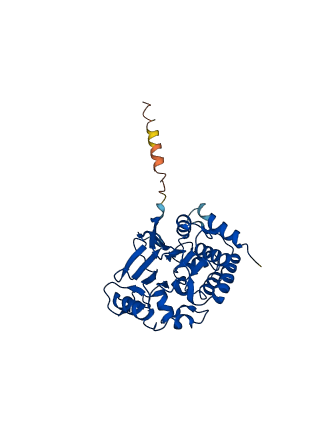
Descriptions
The autoinhibited protein was predicted that may have potential autoinhibitory elements via cis-regPred.
Autoinhibitory domains (AIDs)
Target domain |
|
Relief mechanism |
|
Assay |
cis-regPred |
Accessory elements
No accessory elements
Autoinhibited structure

Activated structure
1 structures for P23880
| Entry ID | Method | Resolution | Chain | Position | Source |
|---|---|---|---|---|---|
| AF-P23880-F1 | Predicted | AlphaFoldDB |
No variants for P23880
| Variant ID(s) | Position | Change | Description | Diseaes Association | Provenance |
|---|---|---|---|---|---|
| No variants for P23880 | |||||
No associated diseases with P23880
3 regional properties for P23880
Functions
| Description | ||
|---|---|---|
| EC Number | 3.1.3.16 | Phosphoric monoester hydrolases |
| Subcellular Localization |
|
|
| PANTHER Family | ||
| PANTHER Subfamily | ||
| PANTHER Protein Class | ||
| PANTHER Pathway Category | No pathway information available | |
6 GO annotations of cellular component
| Name | Definition |
|---|---|
| chromatin | The ordered and organized complex of DNA, protein, and sometimes RNA, that forms the chromosome. |
| cytoplasm | The contents of a cell excluding the plasma membrane and nucleus, but including other subcellular structures. |
| nucleolus | A small, dense body one or more of which are present in the nucleus of eukaryotic cells. It is rich in RNA and protein, is not bounded by a limiting membrane, and is not seen during mitosis. Its prime function is the transcription of the nucleolar DNA into 45S ribosomal-precursor RNA, the processing of this RNA into 5.8S, 18S, and 28S components of ribosomal RNA, and the association of these components with 5S RNA and proteins synthesized outside the nucleolus. This association results in the formation of ribonucleoprotein precursors; these pass into the cytoplasm and mature into the 40S and 60S subunits of the ribosome. |
| nucleus | A membrane-bounded organelle of eukaryotic cells in which chromosomes are housed and replicated. In most cells, the nucleus contains all of the cell's chromosomes except the organellar chromosomes, and is the site of RNA synthesis and processing. In some species, or in specialized cell types, RNA metabolism or DNA replication may be absent. |
| protein phosphatase type 1 complex | A protein complex that possesses magnesium-dependent protein serine/threonine phosphatase (AMD phosphatase) activity, and consists of a catalytic subunit and one or more regulatory subunits that dictates the phosphatase's substrate specificity, function, and activity. |
| PTW/PP1 phosphatase complex | A protein serine/threonine phosphatase complex that contains a catalytic subunit (PPP1CA, PPP1CB or PPP1CC) and the regulatory subunits PPP1R10 (PNUTS), TOX4 and WDR82, and plays a role in the control of chromatin structure and cell cycle progression during the transition from mitosis into interphase. |
3 GO annotations of molecular function
| Name | Definition |
|---|---|
| metal ion binding | Binding to a metal ion. |
| myosin phosphatase activity | Catalysis of the reaction: phosphomyosin + H2O = myosin + phosphate. |
| protein serine/threonine phosphatase activity | Catalysis of the reaction: protein serine phosphate + H2O = protein serine + phosphate, and protein threonine phosphate + H2O = protein threonine + phosphate. |
5 GO annotations of biological process
| Name | Definition |
|---|---|
| cell cycle | The progression of biochemical and morphological phases and events that occur in a cell during successive cell replication or nuclear replication events. Canonically, the cell cycle comprises the replication and segregation of genetic material followed by the division of the cell, but in endocycles or syncytial cells nuclear replication or nuclear division may not be followed by cell division. |
| cell division | The process resulting in division and partitioning of components of a cell to form more cells; may or may not be accompanied by the physical separation of a cell into distinct, individually membrane-bounded daughter cells. |
| chromosome segregation | The process in which genetic material, in the form of chromosomes, is organized into specific structures and then physically separated and apportioned to two or more sets. In eukaryotes, chromosome segregation begins with the condensation of chromosomes, includes chromosome separation, and ends when chromosomes have completed movement to the spindle poles. |
| positive regulation of establishment of cell polarity regulating cell shape | Any process that activates or increases the frequency, rate or extent of establishment of cell polarity regulating cell shape. |
| regulation of mitotic cell cycle | Any process that modulates the rate or extent of progress through the mitotic cell cycle. |
No homologous proteins in AiPD
| UniProt AC | Gene Name | Protein Name | Species | Evidence Code |
|---|---|---|---|---|
| No homologous proteins | ||||
| 10 | 20 | 30 | 40 | 50 | 60 |
| MDYDIDAIIE | KLVKARNGKP | SKQVQLSDAE | IRYLCTTSRS | IFLSQPMLLE | LEAPLKICGD |
| 70 | 80 | 90 | 100 | 110 | 120 |
| IHGQYSDLLR | LFEYGGYPPD | ANYLFLGDYV | DRGKQSLEVI | CLLFAYKIKY | PENFFLLRGN |
| 130 | 140 | 150 | 160 | 170 | 180 |
| HEFASINRIY | GFYDECKRRY | SIKLWKTFTD | CFNCMPVAAV | IDEKIFCMHG | GLSPDLNSLD |
| 190 | 200 | 210 | 220 | 230 | 240 |
| QIQRIIRPTD | IPDTGLLCDL | VWSDPEKDLT | GWGENDRGVS | YTFGADVVSR | FLQKHDLDLI |
| 250 | 260 | 270 | 280 | 290 | 300 |
| CRAHQVVEDG | YEFFGKRQLV | TIFSAPNYCG | EFDNVGAMMS | VNEDLLCSFQ | ILKPAEKRQR |
| 310 | 320 | ||||
| VSQSSIKESK | SATNSLKKSK | NN |