P23871
Gene name |
hemH |
Protein name |
Ferrochelatase |
Names |
Heme synthase, Protoheme ferro-lyase |
Species |
Escherichia coli (strain K12) |
KEGG Pathway |
eco:b0475 |
EC number |
4.98.1.1: Forming coordination complexes |
Protein Class |
|
Descriptions
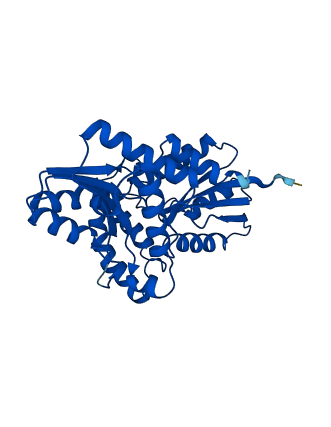
The autoinhibited protein was predicted that may have potential autoinhibitory elements via cis-regPred.
Autoinhibitory domains (AIDs)
Target domain |
|
Relief mechanism |
|
Assay |
cis-regPred |
Accessory elements
No accessory elements
Autoinhibited structure

Activated structure
1 structures for P23871
| Entry ID | Method | Resolution | Chain | Position | Source |
|---|---|---|---|---|---|
| AF-P23871-F1 | Predicted | AlphaFoldDB |
No variants for P23871
| Variant ID(s) | Position | Change | Description | Diseaes Association | Provenance |
|---|---|---|---|---|---|
| No variants for P23871 | |||||
No associated diseases with P23871
Functions
| Description | ||
|---|---|---|
| EC Number | 4.98.1.1 | Forming coordination complexes |
| Subcellular Localization |
|
|
| PANTHER Family | ||
| PANTHER Subfamily | ||
| PANTHER Protein Class | ||
| PANTHER Pathway Category | No pathway information available | |
1 GO annotations of cellular component
| Name | Definition |
|---|---|
| cytoplasm | The contents of a cell excluding the plasma membrane and nucleus, but including other subcellular structures. |
2 GO annotations of molecular function
| Name | Definition |
|---|---|
| ferrochelatase activity | Catalysis of the reaction: heme B (protoheme) + H+ = Fe(2+) + protoporphyrin IX. |
| metal ion binding | Binding to a metal ion. |
3 GO annotations of biological process
| Name | Definition |
|---|---|
| heme biosynthetic process | The chemical reactions and pathways resulting in the formation of heme, any compound of iron complexed in a porphyrin (tetrapyrrole) ring, from less complex precursors. |
| protoporphyrinogen IX metabolic process | The chemical reactions and pathways involving protoporphyrinogen IX, the specific substrate for the enzyme ferrochelatase, which catalyzes the insertion of iron to form protoheme. It is probably also the substrate for chlorophyll formation. |
| response to light stimulus | Any process that results in a change in state or activity of a cell or an organism (in terms of movement, secretion, enzyme production, gene expression, etc.) as a result of a light stimulus, electromagnetic radiation of wavelengths classified as infrared, visible or ultraviolet light. |
No homologous proteins in AiPD
| UniProt AC | Gene Name | Protein Name | Species | Evidence Code |
|---|---|---|---|---|
| No homologous proteins | ||||
| 10 | 20 | 30 | 40 | 50 | 60 |
| MRQTKTGILL | ANLGTPDAPT | PEAVKRYLKQ | FLSDRRVVDT | SRLLWWPLLR | GVILPLRSPR |
| 70 | 80 | 90 | 100 | 110 | 120 |
| VAKLYASVWM | EGGSPLMVYS | RQQQQALAQR | LPEMPVALGM | SYGSPSLESA | VDELLAEHVD |
| 130 | 140 | 150 | 160 | 170 | 180 |
| HIVVLPLYPQ | FSCSTVGAVW | DELARILARK | RSIPGISFIR | DYADNHDYIN | ALANSVRASF |
| 190 | 200 | 210 | 220 | 230 | 240 |
| AKHGEPDLLL | LSYHGIPQRY | ADEGDDYPQR | CRTTTRELAS | ALGMAPEKVM | MTFQSRFGRE |
| 250 | 260 | 270 | 280 | 290 | 300 |
| PWLMPYTDET | LKMLGEKGVG | HIQVMCPGFA | ADCLETLEEI | AEQNREVFLG | AGGKKYEYIP |
| 310 | |||||
| ALNATPEHIE | MMANLVAAYR |