P23755
Gene name |
rbcL |
Protein name |
Ribulose bisphosphate carboxylase large chain |
Names |
RuBisCO large subunit |
Species |
Galdieria sulphuraria (Red alga) |
KEGG Pathway |
|
EC number |
4.1.1.39: Carboxy-lyases |
Protein Class |
|
Descriptions
The autoinhibited protein was predicted that may have potential autoinhibitory elements via cis-regPred.
Autoinhibitory domains (AIDs)
Target domain |
|
Relief mechanism |
|
Assay |
cis-regPred |
Accessory elements
No accessory elements
Autoinhibited structure

Activated structure
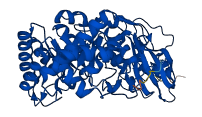
4 structures for P23755
| Entry ID | Method | Resolution | Chain | Position | Source |
|---|---|---|---|---|---|
| 4F0H | X-ray | 196 A | A | 1-493 | PDB |
| 4F0K | X-ray | 205 A | A | 1-493 | PDB |
| 4F0M | X-ray | 225 A | A | 1-493 | PDB |
| AF-P23755-F1 | Predicted | AlphaFoldDB |
No variants for P23755
| Variant ID(s) | Position | Change | Description | Diseaes Association | Provenance |
|---|---|---|---|---|---|
| No variants for P23755 | |||||
No associated diseases with P23755
3 regional properties for P23755
| Type | Name | Position | InterPro Accession |
|---|---|---|---|
| domain | Ribulose bisphosphate carboxylase, large subunit, C-terminal | 164 - 470 | IPR000685 |
| domain | Ribulose bisphosphate carboxylase, large subunit, ferrodoxin-like N-terminal | 33 - 153 | IPR017443 |
| active_site | Ribulose bisphosphate carboxylase, large chain, active site | 205 - 213 | IPR020878 |
Functions
| Description | ||
|---|---|---|
| EC Number | 4.1.1.39 | Carboxy-lyases |
| Subcellular Localization |
|
|
| PANTHER Family | ||
| PANTHER Subfamily | ||
| PANTHER Protein Class | ||
| PANTHER Pathway Category | No pathway information available | |
1 GO annotations of cellular component
| Name | Definition |
|---|---|
| chloroplast | A chlorophyll-containing plastid with thylakoids organized into grana and frets, or stroma thylakoids, and embedded in a stroma. |
3 GO annotations of molecular function
| Name | Definition |
|---|---|
| magnesium ion binding | Binding to a magnesium (Mg) ion. |
| monooxygenase activity | Catalysis of the incorporation of one atom from molecular oxygen into a compound and the reduction of the other atom of oxygen to water. |
| ribulose-bisphosphate carboxylase activity | Catalysis of the reaction: 2 (2R)-3-phosphoglycerate + 2 H+ = CO2 + D-ribulose 1,5-bisphosphate + H2O. |
1 GO annotations of biological process
| Name | Definition |
|---|---|
| reductive pentose-phosphate cycle | The fixation of carbon dioxide (CO2) as glucose in the chloroplasts of C3 plants; uses ATP and NADPH formed in the light reactions of photosynthesis; carbon dioxide reacts with ribulose 1,5-bisphosphate (catalyzed by the function of ribulose-bisphosphate carboxylase) to yield two molecules of 3-phosphoglycerate; these are then phosphorylated by ATP to 1,3-bisphosphateglyceraldehyde which, in turn, is then reduced by NADPH to glyceraldehyde 3-phosphate. The glyceraldehyde 3-phosphate is converted to fructose 5-phosphate and ribulose 5-phosphate by aldolase and other enzymes; the ribulose 5-phosphate is phosphorylated by ATP to ribulose 1,5-bisphosphate. |
No homologous proteins in AiPD
| UniProt AC | Gene Name | Protein Name | Species | Evidence Code |
|---|---|---|---|---|
| No homologous proteins | ||||
| 10 | 20 | 30 | 40 | 50 | 60 |
| MSQSLEEKSV | QERTRIKNSR | YESGVIPYAK | MGYWNPDYQV | KDTDVLALFR | VTPQPGVDPI |
| 70 | 80 | 90 | 100 | 110 | 120 |
| EAAAAVAGES | STATWTVVWT | DLLTAADLYR | AKAYKVDQVP | NNPEQYFAYI | AYELDLFEEG |
| 130 | 140 | 150 | 160 | 170 | 180 |
| SIANLTASII | GNVFGFKAVK | ALRLEDMRLP | FAYIKTFQGP | ATGVILERER | LDKFGRPLLG |
| 190 | 200 | 210 | 220 | 230 | 240 |
| CTTKPKLGLS | GKNYGRVVYE | ALKGGLDFVK | DDENINSQPF | MRWRERYLFV | MEAVNKAAAA |
| 250 | 260 | 270 | 280 | 290 | 300 |
| TGEVKGHYLN | VTAATMEEMY | ARAQLAKELG | SVIIMIDLVI | GYTAIQTMAK | WARDNDMILH |
| 310 | 320 | 330 | 340 | 350 | 360 |
| LHRAGNSTYS | RQKNHGMNFR | VICKWMRMAG | VDHIHAGTVV | GKLEGDPIIT | RGFYKTLLLP |
| 370 | 380 | 390 | 400 | 410 | 420 |
| KLERNLQEGL | FFDMDWASLR | KVMPVASGGI | HAGQMHQLIH | YLGEDVVLQF | GGGTIGHPDG |
| 430 | 440 | 450 | 460 | 470 | 480 |
| IQSGATANRV | ALEAMILARN | ENRDFLTEGP | EILREAAKNC | GALRTALDLW | KDITFNYTST |
| 490 | |||||
| DTSDFVETPT | ANI |