P23636
Gene name |
ppa2 (SPBC16H5.07c) |
Protein name |
Major serine/threonine-protein phosphatase PP2A-2 catalytic subunit |
Names |
|
Species |
Schizosaccharomyces pombe (strain 972 / ATCC 24843) (Fission yeast) |
KEGG Pathway |
spo:SPBC16H5.07c |
EC number |
3.1.3.16: Phosphoric monoester hydrolases |
Protein Class |
|
Descriptions
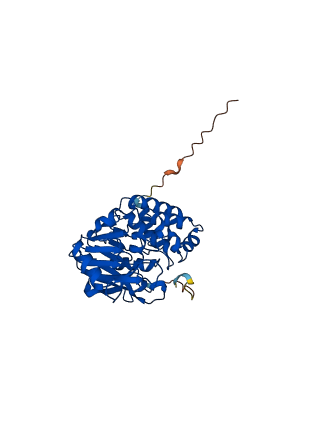
The autoinhibited protein was predicted that may have potential autoinhibitory elements via cis-regPred.
Autoinhibitory domains (AIDs)
Target domain |
|
Relief mechanism |
|
Assay |
cis-regPred |
Accessory elements
No accessory elements
Autoinhibited structure

Activated structure
1 structures for P23636
| Entry ID | Method | Resolution | Chain | Position | Source |
|---|---|---|---|---|---|
| AF-P23636-F1 | Predicted | AlphaFoldDB |
No variants for P23636
| Variant ID(s) | Position | Change | Description | Diseaes Association | Provenance |
|---|---|---|---|---|---|
| No variants for P23636 | |||||
No associated diseases with P23636
4 regional properties for P23636
Functions
| Description | ||
|---|---|---|
| EC Number | 3.1.3.16 | Phosphoric monoester hydrolases |
| Subcellular Localization |
|
|
| PANTHER Family | ||
| PANTHER Subfamily | ||
| PANTHER Protein Class | ||
| PANTHER Pathway Category | No pathway information available | |
5 GO annotations of cellular component
| Name | Definition |
|---|---|
| chromosome, centromeric region | The region of a chromosome that includes the centromeric DNA and associated proteins. In monocentric chromosomes, this region corresponds to a single area of the chromosome, whereas in holocentric chromosomes, it is evenly distributed along the chromosome. |
| cytoplasm | The contents of a cell excluding the plasma membrane and nucleus, but including other subcellular structures. |
| cytosol | The part of the cytoplasm that does not contain organelles but which does contain other particulate matter, such as protein complexes. |
| nucleus | A membrane-bounded organelle of eukaryotic cells in which chromosomes are housed and replicated. In most cells, the nucleus contains all of the cell's chromosomes except the organellar chromosomes, and is the site of RNA synthesis and processing. In some species, or in specialized cell types, RNA metabolism or DNA replication may be absent. |
| protein phosphatase type 2A complex | A protein complex that has protein serine/threonine phosphatase activity that is polycation-stimulated (PCS), being directly stimulated by protamine, polylysine, or histone H1; it constitutes a subclass of several enzymes activated by different histones and polylysine, and consists of catalytic, scaffolding, and regulatory subunits. The catalytic and scaffolding subunits form the core enzyme, and the holoenzyme also includes the regulatory subunit. |
4 GO annotations of molecular function
| Name | Definition |
|---|---|
| metal ion binding | Binding to a metal ion. |
| myosin phosphatase activity | Catalysis of the reaction: phosphomyosin + H2O = myosin + phosphate. |
| phosphoprotein phosphatase activity | Catalysis of the reaction: a phosphoprotein + H2O = a protein + phosphate. Together with protein kinases, these enzymes control the state of phosphorylation of cellular proteins and thereby provide an important mechanism for regulating cellular activity. |
| protein serine/threonine phosphatase activity | Catalysis of the reaction: protein serine phosphate + H2O = protein serine + phosphate, and protein threonine phosphate + H2O = protein threonine + phosphate. |
6 GO annotations of biological process
| Name | Definition |
|---|---|
| cell division | The process resulting in division and partitioning of components of a cell to form more cells; may or may not be accompanied by the physical separation of a cell into distinct, individually membrane-bounded daughter cells. |
| meiotic centromeric cohesion protection | The process in which the association between sister chromatids of a replicated chromosome centromeric region is maintained during homologous chromosome segregation after cohesin is cleaved by separase along the arm regions. |
| mitotic cell cycle | Progression through the phases of the mitotic cell cycle, the most common eukaryotic cell cycle, which canonically comprises four successive phases called G1, S, G2, and M and includes replication of the genome and the subsequent segregation of chromosomes into daughter cells. In some variant cell cycles nuclear replication or nuclear division may not be followed by cell division, or G1 and G2 phases may be absent. |
| negative regulation of G2/M transition of mitotic cell cycle | Any signalling pathway that decreases or inhibits the activity of a cell cycle cyclin-dependent protein kinase to modulate the switch from G2 phase to M phase of the mitotic cell cycle. |
| negative regulation of induction of conjugation with cellular fusion | Any process that stops, prevents, or reduces the frequency or rate of initiation of conjugation with cellular fusion. |
| signaling | The entirety of a process in which information is transmitted within a biological system. This process begins with an active signal and ends when a cellular response has been triggered. |
No homologous proteins in AiPD
| UniProt AC | Gene Name | Protein Name | Species | Evidence Code |
|---|---|---|---|---|
| No homologous proteins | ||||
| 10 | 20 | 30 | 40 | 50 | 60 |
| MSIDPANDSK | LAPEANDATL | GDVDRWIEQL | KKCEPLSEAD | VEMLCDKARE | VLCQENNVQP |
| 70 | 80 | 90 | 100 | 110 | 120 |
| VRNPVTVCGD | IHGQFHDLME | LFKIGGDVPD | MNYLFMGDYV | DRGYHSVETV | SLLVAMKLRY |
| 130 | 140 | 150 | 160 | 170 | 180 |
| PNRITILRGN | HESRQITQVY | GFYDECLRKY | GSANVWKHFT | NLFDYFPLTA | LIEDRIFCLH |
| 190 | 200 | 210 | 220 | 230 | 240 |
| GGLSPSIDSL | DHVRTLDRVQ | EVPHEGPMCD | LLWSDPDDRC | GWGISPRGAG | YTFGQDISET |
| 250 | 260 | 270 | 280 | 290 | 300 |
| FNHANGLSLT | ARAHQLVMEG | FNWAHDGDVV | TIFSAPNYCY | RCGNQAAILE | VDDTMNQVFL |
| 310 | 320 | ||||
| QFDPAPREGE | PVIARRTPDY | FL |