P22458
Gene name |
VTN |
Protein name |
Vitronectin |
Names |
VN, Glycoprotein 66, S-protein, Serum-spreading factor |
Species |
Oryctolagus cuniculus (Rabbit) |
KEGG Pathway |
ocu:100009128 |
EC number |
|
Protein Class |
|
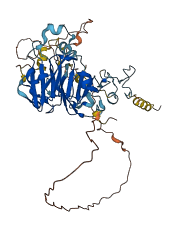
Descriptions
The autoinhibited protein was predicted that may have potential autoinhibitory elements via cis-regPred.
Autoinhibitory domains (AIDs)
Target domain |
|
Relief mechanism |
|
Assay |
cis-regPred |
Accessory elements
No accessory elements
Autoinhibited structure

Activated structure
1 structures for P22458
| Entry ID | Method | Resolution | Chain | Position | Source |
|---|---|---|---|---|---|
| AF-P22458-F1 | Predicted | AlphaFoldDB |
No variants for P22458
| Variant ID(s) | Position | Change | Description | Diseaes Association | Provenance |
|---|---|---|---|---|---|
| No variants for P22458 | |||||
No associated diseases with P22458
11 regional properties for P22458
| Type | Name | Position | InterPro Accession |
|---|---|---|---|
| domain | Hemopexin-like domain | 154 - 469 | IPR000585 |
| domain | Somatomedin B domain | 20 - 63 | IPR001212 |
| conserved_site | Hemopexin, conserved site | 196 - 210 | IPR018486-1 |
| conserved_site | Hemopexin, conserved site | 335 - 350 | IPR018486-2 |
| repeat | Hemopexin-like repeats | 158 - 204 | IPR018487-1 |
| repeat | Hemopexin-like repeats | 203 - 252 | IPR018487-2 |
| repeat | Hemopexin-like repeats | 251 - 305 | IPR018487-3 |
| repeat | Hemopexin-like repeats | 419 - 469 | IPR018487-4 |
| domain | Somatomedin B domain, chordata | 19 - 32 | IPR020436-1 |
| domain | Somatomedin B domain, chordata | 36 - 47 | IPR020436-2 |
| domain | Somatomedin B domain, chordata | 48 - 59 | IPR020436-3 |
1 GO annotations of cellular component
| Name | Definition |
|---|---|
| extracellular space | That part of a multicellular organism outside the cells proper, usually taken to be outside the plasma membranes, and occupied by fluid. |
3 GO annotations of molecular function
| Name | Definition |
|---|---|
| heparin binding | Binding to heparin, a member of a group of glycosaminoglycans found mainly as an intracellular component of mast cells and which consist predominantly of alternating alpha-(1->4)-linked D-galactose and N-acetyl-D-glucosamine-6-sulfate residues. |
| polysaccharide binding | Binding to a polysaccharide, a polymer of many (typically more than 10) monosaccharide residues linked glycosidically. |
| scavenger receptor activity | Combining with any modified low-density lipoprotein (LDL) or other polyanionic ligand and delivering the ligand into the cell via endocytosis. Ligands include acetylated and oxidized LDL, Gram-positive and Gram-negative bacteria, apoptotic cells, amyloid-beta fibrils, and advanced glycation end products (AGEs). |
2 GO annotations of biological process
| Name | Definition |
|---|---|
| cell adhesion | The attachment of a cell, either to another cell or to an underlying substrate such as the extracellular matrix, via cell adhesion molecules. |
| immune response | Any immune system process that functions in the calibrated response of an organism to a potential internal or invasive threat. |
No homologous proteins in AiPD
| UniProt AC | Gene Name | Protein Name | Species | Evidence Code |
|---|---|---|---|---|
| No homologous proteins | ||||
| 10 | 20 | 30 | 40 | 50 | 60 |
| MAPLRPIFTL | ALLLWVVLAD | QESCKDRCTE | GFNANRKCQC | DELCSYYQSC | CADYAAECKP |
| 70 | 80 | 90 | 100 | 110 | 120 |
| QVTRGDVFTM | PEDEYGPYDY | IEQTKDNASV | HAQPESPTVG | QEPTLSPDLQ | TEGGAEPTHE |
| 130 | 140 | 150 | 160 | 170 | 180 |
| VPLEPEMETL | RPEGEDLQAG | TTELGTSASP | AEEELCSGKP | FDAFTDLKNG | SLFAFRGQYC |
| 190 | 200 | 210 | 220 | 230 | 240 |
| YELDETAVRP | GYPKLIQDVW | GIEGPIDAAF | TRINCQGKTY | LFKGSQYWRF | EDGILDPDYP |
| 250 | 260 | 270 | 280 | 290 | 300 |
| RNISEGFSGI | PDNVDAAFAL | PAHSYSGRER | VYFFKGDKYW | EYQFQQQPSQ | EECEGSSLSA |
| 310 | 320 | 330 | 340 | 350 | 360 |
| VFEHFAMLHR | DSWEDIFKLL | FWGRPSGGAR | QPQFISRDWH | GVPGKVDAAM | AGRIYISGLT |
| 370 | 380 | 390 | 400 | 410 | 420 |
| PSPSAKKQKS | RRRSRKRYRS | RYGRGRSQNS | RRLSRSISRL | WFSSEEVSLG | PYNYEDYETS |
| 430 | 440 | 450 | 460 | 470 | |
| WLKPATSEPI | QSVYFFSGDK | YYRVNLRTQR | VDTVNPPYPR | SIAQYWLGCP | APGGQ |