Descriptions
The autoinhibited protein was predicted that may have potential autoinhibitory elements via cis-regPred.
Autoinhibitory domains (AIDs)
Target domain |
|
Relief mechanism |
|
Assay |
cis-regPred |
Accessory elements
No accessory elements
Autoinhibited structure

Activated structure
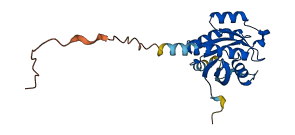
1 structures for P22129
| Entry ID | Method | Resolution | Chain | Position | Source |
|---|---|---|---|---|---|
| AF-P22129-F1 | Predicted | AlphaFoldDB |
No variants for P22129
| Variant ID(s) | Position | Change | Description | Diseaes Association | Provenance |
|---|---|---|---|---|---|
| No variants for P22129 | |||||
No associated diseases with P22129
1 regional properties for P22129
| Type | Name | Position | InterPro Accession |
|---|---|---|---|
| domain | Small GTP-binding protein domain | 10 - 168 | IPR005225 |
Functions
6 GO annotations of cellular component
| Name | Definition |
|---|---|
| anchoring junction | A cell junction that mechanically attaches a cell (and its cytoskeleton) to neighboring cells or to the extracellular matrix. |
| phagocytic vesicle | A membrane-bounded intracellular vesicle that arises from the ingestion of particulate material by phagocytosis. |
| phagocytic vesicle membrane | The lipid bilayer surrounding a phagocytic vesicle. |
| recycling endosome membrane | The lipid bilayer surrounding a recycling endosome. |
| synaptic vesicle | A secretory organelle, typically 50 nm in diameter, of presynaptic nerve terminals; accumulates in high concentrations of neurotransmitters and secretes these into the synaptic cleft by fusion with the 'active zone' of the presynaptic plasma membrane. |
| synaptic vesicle membrane | The lipid bilayer surrounding a synaptic vesicle. |
3 GO annotations of molecular function
| Name | Definition |
|---|---|
| GDP binding | Binding to GDP, guanosine 5'-diphosphate. |
| GTP binding | Binding to GTP, guanosine triphosphate. |
| GTPase activity | Catalysis of the reaction: GTP + H2O = GDP + H+ + phosphate. |
11 GO annotations of biological process
| Name | Definition |
|---|---|
| cellular response to acidic pH | Any process that results in a change in state or activity of a cell (in terms of movement, secretion, enzyme production, gene expression, etc.) as a result of a pH stimulus with pH < 7. pH is a measure of the acidity or basicity of an aqueous solution. |
| constitutive secretory pathway | A process of exocytosis found in all eukaryotic cells, in which transport vesicles destined for the plasma membrane leave the trans-Golgi network in a steady stream. Upon exocytosis, the membrane proteins and lipids in these vesicles provide new components for the plasma membrane, and the soluble proteins inside the vesicles are released into the extracellular space. |
| endocytic recycling | The directed movement of membrane-bounded vesicles from endosomes back to the plasma membrane, a trafficking pathway that promotes the recycling of internalized transmembrane proteins. |
| insulin secretion involved in cellular response to glucose stimulus | The regulated release of proinsulin from secretory granules (B granules) in the B cells of the pancreas; accompanied by cleavage of proinsulin to form mature insulin, in response to a glucose stimulus. |
| melanosome transport | The directed movement of melanosomes into, out of or within a cell, or between cells, by means of some agent such as a transporter or pore. |
| receptor recycling | The process that results in the return of receptor molecules to an active state and an active cellular location after they have been stimulated by a ligand. An active state is when the receptor is ready to receive a signal. |
| regulated exocytosis | A process of exocytosis in which soluble proteins and other substances are initially stored in secretory vesicles for later release. It is found mainly in cells that are specialized for secreting products such as hormones, neurotransmitters, or digestive enzymes rapidly on demand. |
| regulation of anion transport | Any process that modulates the frequency, rate or extent of the directed movement of anions, atoms or small molecules with a net negative charge into, out of or within a cell, or between cells, by means of some agent such as a transporter or pore. |
| regulation of endocytic recycling | Any process that modulates the frequency, rate or extent of endocytic recycling. |
| regulation of protein localization to cell surface | Any process that modulates the frequency, rate or extent of protein localization to the cell surface. |
| transferrin transport | The directed movement of transferrin into, out of or within a cell, or between cells, by means of some agent such as a transporter or pore. |
No homologous proteins in AiPD
| UniProt AC | Gene Name | Protein Name | Species | Evidence Code |
|---|---|---|---|---|
| No homologous proteins | ||||
| 10 | 20 | 30 | 40 | 50 | 60 |
| MGTRDDEYDY | LFKVVLIGDS | GVGKSNLLSR | FTRNEFNLES | KSTIGVEFAT | RSIQVDGKTI |
| 70 | 80 | 90 | 100 | 110 | 120 |
| KAQIWDTAGQ | ERYRAITSAY | YRGAVGALLV | YDIAKHLTYE | NVERWLKELR | DHADNNIVIM |
| 130 | 140 | 150 | 160 | 170 | 180 |
| LVGNKSDLRH | LRAVPTDEAR | AFAEKNNLSF | IETSALDSTN | VEEAFKNILT | EIYRIVSQKQ |
| 190 | 200 | 210 | |||
| ISDRSAHDES | PGNNVVDISV | PPTTDGQKSN | KLQCCQNM |