P22010
Gene name |
GRP78 (BIP, KLLA0D09559g) |
Protein name |
Endoplasmic reticulum chaperone BiP |
Names |
Immunoglobulin heavy chain-binding protein homolog, BiP |
Species |
Kluyveromyces lactis (strain ATCC 8585 / CBS 2359 / DSM 70799 / NBRC 1267 / NRRL Y-1140 / WM37) (Yeast) (Candida sphaerica) |
KEGG Pathway |
kla:KLLA0_D09559g |
EC number |
3.6.4.10: Acting on ATP; involved in cellular and subcellular movement |
Protein Class |
|
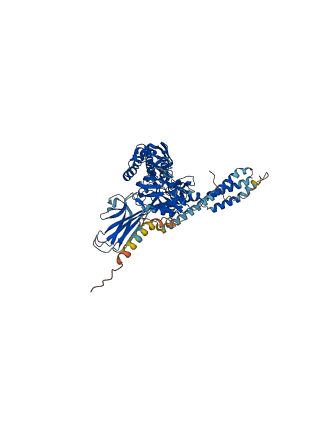
Descriptions
The autoinhibited protein was predicted that may have potential autoinhibitory elements via cis-regPred.
Autoinhibitory domains (AIDs)
Target domain |
|
Relief mechanism |
|
Assay |
cis-regPred |
Accessory elements
No accessory elements
Autoinhibited structure

Activated structure
1 structures for P22010
| Entry ID | Method | Resolution | Chain | Position | Source |
|---|---|---|---|---|---|
| AF-P22010-F1 | Predicted | AlphaFoldDB |
No variants for P22010
| Variant ID(s) | Position | Change | Description | Diseaes Association | Provenance |
|---|---|---|---|---|---|
| No variants for P22010 | |||||
No associated diseases with P22010
Functions
| Description | ||
|---|---|---|
| EC Number | 3.6.4.10 | Acting on ATP; involved in cellular and subcellular movement |
| Subcellular Localization |
|
|
| PANTHER Family | ||
| PANTHER Subfamily | ||
| PANTHER Protein Class | ||
| PANTHER Pathway Category | No pathway information available | |
1 GO annotations of cellular component
| Name | Definition |
|---|---|
| luminal surveillance complex | A multiprotein complex that recognizes ERAD-luminal misfolded substrates and brings them to the ubiquitination/extraction machinery. In yeast, this complex consists of Yos9p, Kar2p and Hrd3p proteins. |
4 GO annotations of molecular function
| Name | Definition |
|---|---|
| ATP binding | Binding to ATP, adenosine 5'-triphosphate, a universally important coenzyme and enzyme regulator. |
| ATP hydrolysis activity | Catalysis of the reaction: ATP + H2O = ADP + H+ phosphate. ATP hydrolysis is used in some reactions as an energy source, for example to catalyze a reaction or drive transport against a concentration gradient. |
| ATP-dependent protein folding chaperone | Binding to a protein or a protein-containing complex to assist the protein folding process, driven by ATP hydrolysis. |
| unfolded protein binding | Binding to an unfolded protein. |
6 GO annotations of biological process
| Name | Definition |
|---|---|
| fungal-type cell wall beta-glucan biosynthetic process | The chemical reactions and pathways resulting in the formation of beta-glucans, compounds composed of glucose residues linked by beta-D-glucosidic bonds, found in the walls of fungal cells. |
| karyogamy involved in conjugation with cellular fusion | During sexual reproduction, the creation of a single nucleus from multiple nuclei as a result of fusing the lipid bilayers that surround each nuclei. This occurs after cytogamy. |
| post-translational protein targeting to membrane, translocation | The process in which a protein translocates through the ER membrane posttranslationally. |
| response to unfolded protein | Any process that results in a change in state or activity of a cell or an organism (in terms of movement, secretion, enzyme production, gene expression, etc.) as a result of an unfolded protein stimulus. |
| SRP-dependent cotranslational protein targeting to membrane, translocation | The process during cotranslational membrane targeting wherein proteins move across a membrane. SRP and its receptor initiate the transfer of the nascent chain across the endoplasmic reticulum (ER) membrane; they then dissociate from the chain, which is transferred to a set of transmembrane proteins, collectively called the translocon. Once the nascent chain translocon complex is assembled, the elongating chain passes directly from the large ribosomal subunit into the centers of the translocon, a protein-lined channel within the membrane. The growing chain is never exposed to the cytosol and does not fold until it reaches the ER lumen. |
| ubiquitin-dependent ERAD pathway | The series of steps necessary to target endoplasmic reticulum (ER)-resident proteins for degradation by the cytoplasmic proteasome. Begins with recognition of the ER-resident protein, includes retrotranslocation (dislocation) of the protein from the ER to the cytosol, protein ubiquitination necessary for correct substrate transfer, transport of the protein to the proteasome, and ends with degradation of the protein by the cytoplasmic proteasome. |
No homologous proteins in AiPD
| UniProt AC | Gene Name | Protein Name | Species | Evidence Code |
|---|---|---|---|---|
| No homologous proteins | ||||
| 10 | 20 | 30 | 40 | 50 | 60 |
| MFSARKSSVG | WLVSSLAVFY | VLLAVIMPIA | LTGSQSSRVV | ARAAEDHEDY | GTVIGIDLGT |
| 70 | 80 | 90 | 100 | 110 | 120 |
| TYSCVAVMKN | GKTEILANEQ | GNRITPSYVS | FTDDERLIGD | AAKNQAASNP | KNTIFDIKRL |
| 130 | 140 | 150 | 160 | 170 | 180 |
| IGLQYNDPTV | QRDIKHLPYT | VVNKGNKPYV | EVTVKGEKKE | FTPEEVSGMI | LGKMKQIAED |
| 190 | 200 | 210 | 220 | 230 | 240 |
| YLGKKVTHAV | VTVPAYFNDA | QRQATKDAGA | IAGLNILRIV | NEPTAAAIAY | GLDKTEDEHQ |
| 250 | 260 | 270 | 280 | 290 | 300 |
| IIVYDLGGGT | FDVSLLSIEN | GVFEVQATAG | DTHLGGEDFD | YKLVRHFAQL | FQKKHDLDVT |
| 310 | 320 | 330 | 340 | 350 | 360 |
| KNDKAMAKLK | REAEKAKRSL | SSQTSTRIEI | DSFFNGIDFS | ETLTRAKFEE | LNLALFKKTL |
| 370 | 380 | 390 | 400 | 410 | 420 |
| KPVEKVLKDS | GLQKEDIDDI | VLVGGSTRIP | KVQQLLEKFF | NGKKASKGIN | PDEAVAYGAA |
| 430 | 440 | 450 | 460 | 470 | 480 |
| VQAGVLSGEE | GVEDIVLLDV | NALTLGIETT | GGVMTPLIKR | NTAIPTKKSQ | IFSTAVDNQK |
| 490 | 500 | 510 | 520 | 530 | 540 |
| AVRIQVYEGE | RAMVKDNNLL | GNFELSDIRA | APRGVPQIEV | TFALDANGIL | TVSATDKDTG |
| 550 | 560 | 570 | 580 | 590 | 600 |
| KSESITIAND | KGRLSQDDID | RMVEEAEKYA | AEDAKFKAKS | EARNTFENFV | HYVKNSVNGE |
| 610 | 620 | 630 | 640 | 650 | 660 |
| LAEIMDEDDK | ETVLDNVNES | LEWLEDNSDV | AEAEDFEEKM | ASFKESVEPI | LAKASASQGS |
| 670 | |||||
| TSGEGFEDED | DDDYFDDEL |