P21165
Gene name |
pepQ (b3847, JW3823) |
Protein name |
Xaa-Pro dipeptidase |
Names |
X-Pro dipeptidase, Imidodipeptidase, Proline dipeptidase, Prolidase |
Species |
Escherichia coli (strain K12) |
KEGG Pathway |
eco:b3847 |
EC number |
3.4.13.9: Dipeptidases |
Protein Class |
|
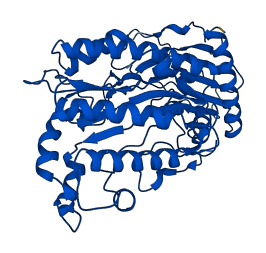
Descriptions
The autoinhibited protein was predicted that may have potential autoinhibitory elements via cis-regPred.
Autoinhibitory domains (AIDs)
Target domain |
|
Relief mechanism |
|
Assay |
cis-regPred |
Accessory elements
No accessory elements
Autoinhibited structure

Activated structure
2 structures for P21165
| Entry ID | Method | Resolution | Chain | Position | Source |
|---|---|---|---|---|---|
| 4QR8 | X-ray | 200 A | A/B | 1-443 | PDB |
| AF-P21165-F1 | Predicted | AlphaFoldDB |
No variants for P21165
| Variant ID(s) | Position | Change | Description | Diseaes Association | Provenance |
|---|---|---|---|---|---|
| No variants for P21165 | |||||
No associated diseases with P21165
Functions
| Description | ||
|---|---|---|
| EC Number | 3.4.13.9 | Dipeptidases |
| Subcellular Localization |
|
|
| PANTHER Family | ||
| PANTHER Subfamily | ||
| PANTHER Protein Class | ||
| PANTHER Pathway Category | No pathway information available | |
1 GO annotations of cellular component
| Name | Definition |
|---|---|
| cytosol | The part of the cytoplasm that does not contain organelles but which does contain other particulate matter, such as protein complexes. |
7 GO annotations of molecular function
| Name | Definition |
|---|---|
| aminopeptidase activity | Catalysis of the hydrolysis of a single N-terminal amino acid residue from a polypeptide chain. |
| dipeptidase activity | Catalysis of the hydrolysis of a dipeptide. |
| manganese ion binding | Binding to a manganese ion (Mn). |
| metallodipeptidase activity | Catalysis of the hydrolysis of a dipeptide by a mechanism in which water acts as a nucleophile, one or two metal ions hold the water molecule in place, and charged amino acid side chains are ligands for the metal ions. |
| peptidase activity | Catalysis of the hydrolysis of a peptide bond. A peptide bond is a covalent bond formed when the carbon atom from the carboxyl group of one amino acid shares electrons with the nitrogen atom from the amino group of a second amino acid. |
| phosphoric triester hydrolase activity | Catalysis of the hydrolysis of a phosphoric triester. |
| proline dipeptidase activity | Catalysis of the reaction: H2O + a dipeptide with proline at the C-terminal <=> L-proline + a standard alpha amino acid. |
2 GO annotations of biological process
| Name | Definition |
|---|---|
| peptide catabolic process | The chemical reactions and pathways resulting in the breakdown of peptides, compounds of 2 or more (but usually less than 100) amino acids where the alpha carboxyl group of one is bound to the alpha amino group of another. |
| proteolysis | The hydrolysis of proteins into smaller polypeptides and/or amino acids by cleavage of their peptide bonds. |
No homologous proteins in AiPD
| UniProt AC | Gene Name | Protein Name | Species | Evidence Code |
|---|---|---|---|---|
| No homologous proteins | ||||
| 10 | 20 | 30 | 40 | 50 | 60 |
| MESLASLYKN | HIATLQERTR | DALARFKLDA | LLIHSGELFN | VFLDDHPYPF | KVNPQFKAWV |
| 70 | 80 | 90 | 100 | 110 | 120 |
| PVTQVPNCWL | LVDGVNKPKL | WFYLPVDYWH | NVEPLPTSFW | TEDVEVIALP | KADGIGSLLP |
| 130 | 140 | 150 | 160 | 170 | 180 |
| AARGNIGYIG | PVPERALQLG | IEASNINPKG | VIDYLHYYRS | FKTEYELACM | REAQKMAVNG |
| 190 | 200 | 210 | 220 | 230 | 240 |
| HRAAEEAFRS | GMSEFDINIA | YLTATGHRDT | DVPYSNIVAL | NEHAAVLHYT | KLDHQAPEEM |
| 250 | 260 | 270 | 280 | 290 | 300 |
| RSFLLDAGAE | YNGYAADLTR | TWSAKSDNDY | AQLVKDVNDE | QLALIATMKA | GVSYVDYHIQ |
| 310 | 320 | 330 | 340 | 350 | 360 |
| FHQRIAKLLR | KHQIITDMSE | EAMVENDLTG | PFMPHGIGHP | LGLQVHDVAG | FMQDDSGTHL |
| 370 | 380 | 390 | 400 | 410 | 420 |
| AAPAKYPYLR | CTRILQPGMV | LTIEPGIYFI | ESLLAPWREG | QFSKHFNWQK | IEALKPFGGI |
| 430 | 440 | ||||
| RIEDNVVIHE | NNVENMTRDL | KLA |