P20964
Gene name |
obg |
Protein name |
GTPase Obg |
Names |
T-cell receptor T3 zeta chain, GTP-binding protein Obg, OrfA, Spo0B-associated GTP-binding protein |
Species |
Bacillus subtilis (strain 168) |
KEGG Pathway |
bsu:BSU27920 |
EC number |
|
Protein Class |
|
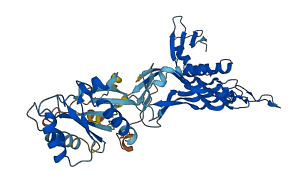
Descriptions
The autoinhibited protein was predicted that may have potential autoinhibitory elements via cis-regPred.
Autoinhibitory domains (AIDs)
Target domain |
|
Relief mechanism |
|
Assay |
cis-regPred |
Accessory elements
No accessory elements
Autoinhibited structure

Activated structure
2 structures for P20964
| Entry ID | Method | Resolution | Chain | Position | Source |
|---|---|---|---|---|---|
| 1LNZ | X-ray | 260 A | A/B | 1-342 | PDB |
| AF-P20964-F1 | Predicted | AlphaFoldDB |
No variants for P20964
| Variant ID(s) | Position | Change | Description | Diseaes Association | Provenance |
|---|---|---|---|---|---|
| No variants for P20964 | |||||
No associated diseases with P20964
6 regional properties for P20964
| Type | Name | Position | InterPro Accession |
|---|---|---|---|
| domain | Small GTP-binding protein domain | 160 - 320 | IPR005225 |
| domain | GTP binding domain | 160 - 283 | IPR006073 |
| conserved_site | GTP1/OBG, conserved site | 212 - 225 | IPR006074 |
| domain | GTP1/OBG domain | 1 - 158 | IPR006169 |
| domain | GTP-binding protein OBG, C-terminal | 350 - 428 | IPR015349 |
| domain | OBG-type guanine nucleotide-binding (G) domain | 159 - 329 | IPR031167 |
Functions
1 GO annotations of cellular component
| Name | Definition |
|---|---|
| cytoplasm | The contents of a cell excluding the plasma membrane and nucleus, but including other subcellular structures. |
3 GO annotations of molecular function
| Name | Definition |
|---|---|
| GTP binding | Binding to GTP, guanosine triphosphate. |
| GTPase activity | Catalysis of the reaction: GTP + H2O = GDP + H+ + phosphate. |
| magnesium ion binding | Binding to a magnesium (Mg) ion. |
2 GO annotations of biological process
| Name | Definition |
|---|---|
| ribosome biogenesis | A cellular process that results in the biosynthesis of constituent macromolecules, assembly, and arrangement of constituent parts of ribosome subunits; includes transport to the sites of protein synthesis. |
| sporulation resulting in formation of a cellular spore | The process in which a relatively unspecialized cell acquires the specialized features of a cellular spore, a cell form that can be used for dissemination, for survival of adverse conditions because of its heat and dessication resistance, and/or for reproduction. |
No homologous proteins in AiPD
| UniProt AC | Gene Name | Protein Name | Species | Evidence Code |
|---|---|---|---|---|
| No homologous proteins | ||||
| 10 | 20 | 30 | 40 | 50 | 60 |
| MFVDQVKVYV | KGGDGGNGMV | AFRREKYVPK | GGPAGGDGGK | GGDVVFEVDE | GLRTLMDFRY |
| 70 | 80 | 90 | 100 | 110 | 120 |
| KKHFKAIRGE | HGMSKNQHGR | NADDMVIKVP | PGTVVTDDDT | KQVIADLTEH | GQRAVIARGG |
| 130 | 140 | 150 | 160 | 170 | 180 |
| RGGRGNSRFA | TPANPAPQLS | ENGEPGKERY | IVLELKVLAD | VGLVGFPSVG | KSTLLSVVSS |
| 190 | 200 | 210 | 220 | 230 | 240 |
| AKPKIADYHF | TTLVPNLGMV | ETDDGRSFVM | ADLPGLIEGA | HQGVGLGHQF | LRHIERTRVI |
| 250 | 260 | 270 | 280 | 290 | 300 |
| VHVIDMSGLE | GRDPYDDYLT | INQELSEYNL | RLTERPQIIV | ANKMDMPEAA | ENLEAFKEKL |
| 310 | 320 | 330 | 340 | 350 | 360 |
| TDDYPVFPIS | AVTREGLREL | LFEVANQLEN | TPEFPLYDEE | ELTQNRVMYT | MENEEVPFNI |
| 370 | 380 | 390 | 400 | 410 | 420 |
| TRDPDGVFVL | SGDSLERLFK | MTDFSRDESV | KRFARQMRGM | GVDEALRERG | AKDGDIIRLL |
| EFEFEFID |