P20606
Gene name |
SAR1 (YPL218W) |
Protein name |
Small COPII coat GTPase SAR1 |
Names |
GTP-binding protein SAR1, Secretion-associated RAS-related protein 1 |
Species |
Saccharomyces cerevisiae (strain ATCC 204508 / S288c) (Baker's yeast) |
KEGG Pathway |
sce:YPL218W |
EC number |
|
Protein Class |
|
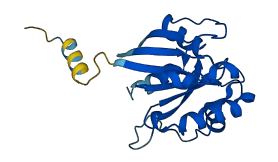
Descriptions
The autoinhibited protein was predicted that may have potential autoinhibitory elements via cis-regPred.
Autoinhibitory domains (AIDs)
Target domain |
|
Relief mechanism |
|
Assay |
cis-regPred |
Accessory elements
No accessory elements
Autoinhibited structure

Activated structure
8 structures for P20606
No variants for P20606
| Variant ID(s) | Position | Change | Description | Diseaes Association | Provenance |
|---|---|---|---|---|---|
| No variants for P20606 | |||||
No associated diseases with P20606
1 regional properties for P20606
| Type | Name | Position | InterPro Accession |
|---|---|---|---|
| domain | Small GTP-binding protein domain | 22 - 143 | IPR005225 |
Functions
7 GO annotations of cellular component
| Name | Definition |
|---|---|
| COPII vesicle coat | One of two multimeric complexes that forms a membrane vesicle coat. COPII is best characterized in S. cerevisiae, where the subunits are called Sar1p, Sec13p, Sec31p, Sec23p, and Sec24p. Vesicles with COPII coats are found associated with endoplasmic reticulum (ER) membranes at steady state. |
| endoplasmic reticulum | The irregular network of unit membranes, visible only by electron microscopy, that occurs in the cytoplasm of many eukaryotic cells. The membranes form a complex meshwork of tubular channels, which are often expanded into slitlike cavities called cisternae. The ER takes two forms, rough (or granular), with ribosomes adhering to the outer surface, and smooth (with no ribosomes attached). |
| endoplasmic reticulum exit site | An endoplasmic reticulum part at which COPII-coated vesicles are produced. |
| endoplasmic reticulum membrane | The lipid bilayer surrounding the endoplasmic reticulum. |
| Golgi membrane | The lipid bilayer surrounding any of the compartments of the Golgi apparatus. |
| mitochondria-associated endoplasmic reticulum membrane | A zone of apposition between endoplasmic-reticulum and mitochondrial membranes, structured by bridging complexes. These contact sites are thought to facilitate inter-organelle calcium and phospholipid exchange. |
| mitochondrion | A semiautonomous, self replicating organelle that occurs in varying numbers, shapes, and sizes in the cytoplasm of virtually all eukaryotic cells. It is notably the site of tissue respiration. |
2 GO annotations of molecular function
| Name | Definition |
|---|---|
| GTP binding | Binding to GTP, guanosine triphosphate. |
| GTPase activity | Catalysis of the reaction: GTP + H2O = GDP + H+ + phosphate. |
10 GO annotations of biological process
| Name | Definition |
|---|---|
| endoplasmic reticulum to Golgi vesicle-mediated transport | The directed movement of substances from the endoplasmic reticulum (ER) to the Golgi, mediated by COP II vesicles. Small COP II coated vesicles form from the ER and then fuse directly with the cis-Golgi. Larger structures are transported along microtubules to the cis-Golgi. |
| intracellular protein transport | The directed movement of proteins in a cell, including the movement of proteins between specific compartments or structures within a cell, such as organelles of a eukaryotic cell. |
| membrane organization | A process which results in the assembly, arrangement of constituent parts, or disassembly of a membrane. A membrane is a double layer of lipid molecules that encloses all cells, and, in eukaryotes, many organelles; may be a single or double lipid bilayer; also includes associated proteins. |
| mitochondrial fission | The division of a mitochondrion within a cell to form two or more separate mitochondrial compartments. |
| mitochondrial membrane organization | A process that is carried out at the cellular level which results in the assembly, arrangement of constituent parts, or disassembly of a mitochondrial membrane, either of the lipid bilayer surrounding a mitochondrion. |
| nuclear envelope organization | A process that is carried out at the cellular level which results in the assembly, arrangement of constituent parts, or disassembly of the nuclear envelope. |
| positive regulation of ER to Golgi vesicle-mediated transport | Any process that activates or increases the frequency, rate or extent of ER to Golgi vesicle-mediated transport. |
| positive regulation of protein exit from endoplasmic reticulum | Any process that activates or increases the frequency, rate or extent of directed movement of proteins from the endoplasmic reticulum. |
| regulation of COPII vesicle coating | Any process that modulates the rate, frequency, or extent of the addition of COPII proteins and adaptor proteins to ER membranes during the formation of transport vesicles, forming a vesicle coat. |
| vesicle organization | A process that is carried out at the cellular level which results in the assembly, arrangement of constituent parts, or disassembly of a vesicle. |
No homologous proteins in AiPD
| UniProt AC | Gene Name | Protein Name | Species | Evidence Code |
|---|---|---|---|---|
| No homologous proteins | ||||
| 10 | 20 | 30 | 40 | 50 | 60 |
| MAGWDIFGWF | RDVLASLGLW | NKHGKLLFLG | LDNAGKTTLL | HMLKNDRLAT | LQPTWHPTSE |
| 70 | 80 | 90 | 100 | 110 | 120 |
| ELAIGNIKFT | TFDLGGHIQA | RRLWKDYFPE | VNGIVFLVDA | ADPERFDEAR | VELDALFNIA |
| 130 | 140 | 150 | 160 | 170 | 180 |
| ELKDVPFVIL | GNKIDAPNAV | SEAELRSALG | LLNTTGSQRI | EGQRPVEVFM | CSVVMRNGYL |
| EAFQWLSQYI |