P20083
Gene name |
parE |
Protein name |
DNA topoisomerase 4 subunit B |
Names |
Topoisomerase IV subunit B |
Species |
Escherichia coli (strain K12) |
KEGG Pathway |
eco:b3030 |
EC number |
5.6.2.2: Enzymes altering nucleic acid conformation |
Protein Class |
|
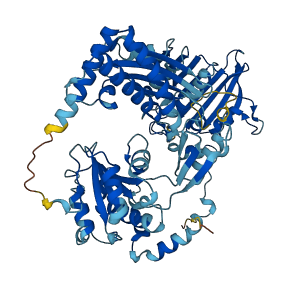
Descriptions
The autoinhibited protein was predicted that may have potential autoinhibitory elements via cis-regPred.
Autoinhibitory domains (AIDs)
Target domain |
|
Relief mechanism |
|
Assay |
cis-regPred |
Accessory elements
No accessory elements
Autoinhibited structure

Activated structure
5 structures for P20083
| Entry ID | Method | Resolution | Chain | Position | Source |
|---|---|---|---|---|---|
| 1S14 | X-ray | 200 A | A/B | 1-217 | PDB |
| 1S16 | X-ray | 210 A | A/B | 1-390 | PDB |
| 3FV5 | X-ray | 180 A | A/B | 15-215 | PDB |
| 4HZ0 | X-ray | 220 A | A/B | 12-216 | PDB |
| AF-P20083-F1 | Predicted | AlphaFoldDB |
1 variants for P20083
| Variant ID(s) | Position | Change | Description | Diseaes Association | Provenance |
|---|---|---|---|---|---|
| 445 | L>H | strain: DH161; quinolone-resistant [UniProt] | No |
No associated diseases with P20083
5 regional properties for P20083
| Type | Name | Position | InterPro Accession |
|---|---|---|---|
| domain | DNA gyrase B subunit, C-terminal | 556 - 620 | IPR002288 |
| domain | Histidine kinase/HSP90-like ATPase | 27 - 173 | IPR003594 |
| domain | TOPRIM domain | 412 - 525 | IPR006171 |
| domain | DNA topoisomerase, type IIA, subunit B, domain 2 | 218 - 384 | IPR013506 |
| conserved_site | DNA topoisomerase, type IIA, conserved site | 416 - 424 | IPR018522 |
Functions
| Description | ||
|---|---|---|
| EC Number | 5.6.2.2 | Enzymes altering nucleic acid conformation |
| Subcellular Localization |
|
|
| PANTHER Family | ||
| PANTHER Subfamily | ||
| PANTHER Protein Class | ||
| PANTHER Pathway Category | No pathway information available | |
3 GO annotations of cellular component
| Name | Definition |
|---|---|
| chromosome | A structure composed of a very long molecule of DNA and associated proteins (e.g. histones) that carries hereditary information. |
| cytosol | The part of the cytoplasm that does not contain organelles but which does contain other particulate matter, such as protein complexes. |
| DNA topoisomerase type II (double strand cut, ATP-hydrolyzing) complex | Complex that possesses DNA topoisomerase II (double strand cut, ATP-hydrolyzing) activity. |
4 GO annotations of molecular function
| Name | Definition |
|---|---|
| ATP binding | Binding to ATP, adenosine 5'-triphosphate, a universally important coenzyme and enzyme regulator. |
| DNA binding | Any molecular function by which a gene product interacts selectively and non-covalently with DNA (deoxyribonucleic acid). |
| DNA topoisomerase type II (double strand cut, ATP-hydrolyzing) activity | Catalysis of a DNA topological transformation by transiently cleaving a pair of complementary DNA strands to form a gate through which a second double-stranded DNA segment is passed, after which the severed strands in the first DNA segment are rejoined, driven by ATP hydrolysis. The enzyme changes the linking number in multiples of 2. |
| metal ion binding | Binding to a metal ion. |
5 GO annotations of biological process
| Name | Definition |
|---|---|
| chromosome organization | A process that is carried out at the cellular level that results in the assembly, arrangement of constituent parts, or disassembly of chromosomes, structures composed of a very long molecule of DNA and associated proteins that carries hereditary information. This term covers covalent modifications at the molecular level as well as spatial relationships among the major components of a chromosome. |
| DNA topological change | The process in which a transformation is induced in the topological structure of a double-stranded DNA helix, resulting in a change in linking number. |
| plasmid partitioning | Any process in which plasmids are segregated or distributed into daughter cells upon cell division. |
| response to antibiotic | Any process that results in a change in state or activity of a cell or an organism (in terms of movement, secretion, enzyme production, gene expression, etc.) as a result of an antibiotic stimulus. An antibiotic is a chemical substance produced by a microorganism which has the capacity to inhibit the growth of or to kill other microorganisms. |
| sister chromatid cohesion | The cell cycle process in which the sister chromatids of a replicated chromosome become tethered to each other. |
No homologous proteins in AiPD
| UniProt AC | Gene Name | Protein Name | Species | Evidence Code |
|---|---|---|---|---|
| No homologous proteins | ||||
| 10 | 20 | 30 | 40 | 50 | 60 |
| MTQTYNADAI | EVLTGLEPVR | RRPGMYTDTT | RPNHLGQEVI | DNSVDEALAG | HAKRVDVILH |
| 70 | 80 | 90 | 100 | 110 | 120 |
| ADQSLEVIDD | GRGMPVDIHP | EEGVPAVELI | LCRLHAGGKF | SNKNYQFSGG | LHGVGISVVN |
| 130 | 140 | 150 | 160 | 170 | 180 |
| ALSKRVEVNV | RRDGQVYNIA | FENGEKVQDL | QVVGTCGKRN | TGTSVHFWPD | ETFFDSPRFS |
| 190 | 200 | 210 | 220 | 230 | 240 |
| VSRLTHVLKA | KAVLCPGVEI | TFKDEINNTE | QRWCYQDGLN | DYLAEAVNGL | PTLPEKPFIG |
| 250 | 260 | 270 | 280 | 290 | 300 |
| NFAGDTEAVD | WALLWLPEGG | ELLTESYVNL | IPTMQGGTHV | NGLRQGLLDA | MREFCEYRNI |
| 310 | 320 | 330 | 340 | 350 | 360 |
| LPRGVKLSAE | DIWDRCAYVL | SVKMQDPQFA | GQTKERLSSR | QCAAFVSGVV | KDAFILWLNQ |
| 370 | 380 | 390 | 400 | 410 | 420 |
| NVQAAELLAE | MAISSAQRRM | RAAKKVVRKK | LTSGPALPGK | LADCTAQDLN | RTELFLVEGD |
| 430 | 440 | 450 | 460 | 470 | 480 |
| SAGGSAKQAR | DREYQAIMPL | KGKILNTWEV | SSDEVLASQE | VHDISVAIGI | DPDSDDLSQL |
| 490 | 500 | 510 | 520 | 530 | 540 |
| RYGKICILAD | ADSDGLHIAT | LLCALFVKHF | RALVKHGHVY | VALPPLYRID | LGKEVYYALT |
| 550 | 560 | 570 | 580 | 590 | 600 |
| EEEKEGVLEQ | LKRKKGKPNV | QRFKGLGEMN | PMQLRETTLD | PNTRRLVQLT | IDDEDDQRTD |
| 610 | 620 | ||||
| AMMDMLLAKK | RSEDRRNWLQ | EKGDMAEIEV |