P19824
Gene name |
PRKA |
Protein name |
Phosphoribulokinase, chloroplastic |
Names |
PRK, PRKase, Phosphopentokinase |
Species |
Chlamydomonas reinhardtii (Chlamydomonas smithii) |
KEGG Pathway |
cre:CHLRE_12g554800v5 |
EC number |
2.7.1.19: Phosphotransferases with an alcohol group as acceptor |
Protein Class |
|
Descriptions
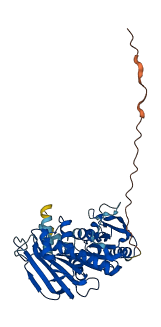
The autoinhibited protein was predicted that may have potential autoinhibitory elements via cis-regPred.
Autoinhibitory domains (AIDs)
Target domain |
|
Relief mechanism |
|
Assay |
cis-regPred |
Accessory elements
No accessory elements
Autoinhibited structure

Activated structure
2 structures for P19824
| Entry ID | Method | Resolution | Chain | Position | Source |
|---|---|---|---|---|---|
| 6H7G | X-ray | 260 A | A/B | 32-375 | PDB |
| AF-P19824-F1 | Predicted | AlphaFoldDB |
1 variants for P19824
| Variant ID(s) | Position | Change | Description | Diseaes Association | Provenance |
|---|---|---|---|---|---|
| 95 | R>C | mutant 12-2B; increase in substrate affinity [UniProt] | No |
No associated diseases with P19824
1 regional properties for P19824
| Type | Name | Position | InterPro Accession |
|---|---|---|---|
| domain | Phosphoribulokinase/uridine kinase | 38 - 236 | IPR006083 |
Functions
| Description | ||
|---|---|---|
| EC Number | 2.7.1.19 | Phosphotransferases with an alcohol group as acceptor |
| Subcellular Localization |
|
|
| PANTHER Family | ||
| PANTHER Subfamily | ||
| PANTHER Protein Class | ||
| PANTHER Pathway Category | No pathway information available | |
3 GO annotations of cellular component
| Name | Definition |
|---|---|
| chloroplast | A chlorophyll-containing plastid with thylakoids organized into grana and frets, or stroma thylakoids, and embedded in a stroma. |
| stromule | Thin filamentous structure extending from the surface of all plastid types examined so far, including chloroplast, proplastid, etioplast, leucoplast, amyloplast, and chromoplast. In general, stromules are more abundant in tissues containing non-green plastids, and in cells containing smaller plastids. The primary function of stromules is still unresolved, although the presence of stromules markedly increases the plastid surface area, potentially increasing transport to and from the cytosol. Other functions of stromules, such as transfer of macromolecules between plastids and starch granule formation in cereal endosperm, may be restricted to particular tissues and cell types. |
| supramolecular complex | A cellular component that consists of an indeterminate number of proteins or macromolecular complexes, organized into a regular, higher-order structure such as a polymer, sheet, network or a fiber. |
5 GO annotations of molecular function
| Name | Definition |
|---|---|
| ATP binding | Binding to ATP, adenosine 5'-triphosphate, a universally important coenzyme and enzyme regulator. |
| disordered domain specific binding | Binding to a disordered domain of a protein. |
| enzyme binding | Binding to an enzyme, a protein with catalytic activity. |
| phosphoribulokinase activity | Catalysis of the reaction: D-ribulose 5-phosphate + ATP = D-ribulose 1,5-bisphosphate + ADP + 2 H(+). |
| protein homodimerization activity | Binding to an identical protein to form a homodimer. |
3 GO annotations of biological process
| Name | Definition |
|---|---|
| phosphorylation | The process of introducing a phosphate group into a molecule, usually with the formation of a phosphoric ester, a phosphoric anhydride or a phosphoric amide. |
| reductive pentose-phosphate cycle | The fixation of carbon dioxide (CO2) as glucose in the chloroplasts of C3 plants; uses ATP and NADPH formed in the light reactions of photosynthesis; carbon dioxide reacts with ribulose 1,5-bisphosphate (catalyzed by the function of ribulose-bisphosphate carboxylase) to yield two molecules of 3-phosphoglycerate; these are then phosphorylated by ATP to 1,3-bisphosphateglyceraldehyde which, in turn, is then reduced by NADPH to glyceraldehyde 3-phosphate. The glyceraldehyde 3-phosphate is converted to fructose 5-phosphate and ribulose 5-phosphate by aldolase and other enzymes; the ribulose 5-phosphate is phosphorylated by ATP to ribulose 1,5-bisphosphate. |
| response to cold | Any process that results in a change in state or activity of a cell or an organism (in terms of movement, secretion, enzyme production, gene expression, etc.) as a result of a cold stimulus, a temperature stimulus below the optimal temperature for that organism. |
No homologous proteins in AiPD
| UniProt AC | Gene Name | Protein Name | Species | Evidence Code |
|---|---|---|---|---|
| No homologous proteins | ||||
| 10 | 20 | 30 | 40 | 50 | 60 |
| MAFTMRAPAP | RATAQSRVTA | NRARRSLVVR | ADKDKTVVIG | LAADSGCGKS | TFMRRMTSIF |
| 70 | 80 | 90 | 100 | 110 | 120 |
| GGVPKPPAGG | NPDSNTLISD | MTTVICLDDY | HCLDRNGRKV | KGVTALAPEA | QNFDLMYNQV |
| 130 | 140 | 150 | 160 | 170 | 180 |
| KALKEGKSVD | KPIYNHVSGL | IDAPEKIESP | PILVIEGLHP | FYDKRVAELL | DFKIYLDISD |
| 190 | 200 | 210 | 220 | 230 | 240 |
| DIKFAWKIQR | DMAERGHSLE | SIKSSIAARK | PDFDAYIDPQ | KKDADMIIQV | LPTQLVPDDK |
| 250 | 260 | 270 | 280 | 290 | 300 |
| GQYLRVRLIM | KEGSKMFDPV | YLFDEGSTIS | WIPCGRKLTC | SFPGIKMFYG | PDTWYGQEVS |
| 310 | 320 | 330 | 340 | 350 | 360 |
| VLEMDGQFDK | LEELIYVESH | LSNTSAKFYG | EITQQMLKNS | GFPGSNNGTG | LFQTIVGLKV |
| 370 | |||||
| REVYERIVKK | DVVPV |