P19734
Gene name |
dmpP |
Protein name |
Phenol 2-monooxygenase, reductase component DmpP |
Names |
Phenol 2-monooxygenase P5 component, Phenol hydroxylase P5 protein |
Species |
Pseudomonas sp (strain CF600) |
KEGG Pathway |
|
EC number |
1.14.13.244: With NADH or NADPH as one donor, and incorporation of one atom of oxygen |
Protein Class |
|
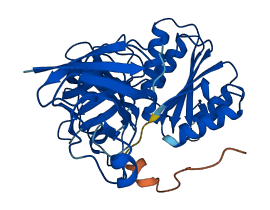
Descriptions
The autoinhibited protein was predicted that may have potential autoinhibitory elements via cis-regPred.
Autoinhibitory domains (AIDs)
Target domain |
|
Relief mechanism |
|
Assay |
cis-regPred |
Accessory elements
No accessory elements
Autoinhibited structure

Activated structure
1 structures for P19734
| Entry ID | Method | Resolution | Chain | Position | Source |
|---|---|---|---|---|---|
| AF-P19734-F1 | Predicted | AlphaFoldDB |
No variants for P19734
| Variant ID(s) | Position | Change | Description | Diseaes Association | Provenance |
|---|---|---|---|---|---|
| No variants for P19734 | |||||
No associated diseases with P19734
5 regional properties for P19734
| Type | Name | Position | InterPro Accession |
|---|---|---|---|
| domain | 2Fe-2S ferredoxin-type iron-sulfur binding domain | 3 - 93 | IPR001041 |
| domain | Oxidoreductase FAD/NAD(P)-binding | 210 - 315 | IPR001433 |
| binding_site | 2Fe-2S ferredoxin, iron-sulphur binding site | 37 - 45 | IPR006058 |
| domain | Flavoprotein pyridine nucleotide cytochrome reductase-like, FAD-binding domain | 110 - 198 | IPR008333 |
| domain | FAD-binding domain, ferredoxin reductase-type | 102 - 201 | IPR017927 |
Functions
| Description | ||
|---|---|---|
| EC Number | 1.14.13.244 | With NADH or NADPH as one donor, and incorporation of one atom of oxygen |
| Subcellular Localization |
|
|
| PANTHER Family | ||
| PANTHER Subfamily | ||
| PANTHER Protein Class | ||
| PANTHER Pathway Category | No pathway information available | |
1 GO annotations of cellular component
| Name | Definition |
|---|---|
| extrachromosomal circular DNA | Circular DNA structures that are not part of a chromosome. |
3 GO annotations of molecular function
| Name | Definition |
|---|---|
| 2 iron, 2 sulfur cluster binding | Binding to a 2 iron, 2 sulfur (2Fe-2S) cluster; this cluster consists of two iron atoms, with two inorganic sulfur atoms found between the irons and acting as bridging ligands. |
| metal ion binding | Binding to a metal ion. |
| phenol 2-monooxygenase activity | Catalysis of the reaction: phenol + NADPH + H+ + O2 = catechol + NADP+ + H2O. |
1 GO annotations of biological process
| Name | Definition |
|---|---|
| aerobic phenol-containing compound catabolic process | The chemical reactions and pathways resulting in the breakdown of a phenol, any compound containing one or more hydroxyl groups directly attached to an aromatic carbon ring, in the presence of oxygen. |
No homologous proteins in AiPD
| UniProt AC | Gene Name | Protein Name | Species | Evidence Code |
|---|---|---|---|---|
| No homologous proteins | ||||
| 10 | 20 | 30 | 40 | 50 | 60 |
| MSYNVTIEPT | GEVIEVEDGQ | TILQAALRQG | VWLPFACGHG | TCATCKVQVV | EGEVDIGEAS |
| 70 | 80 | 90 | 100 | 110 | 120 |
| PFALMDIERD | ERKVLACCAI | PLSDLVIEAD | VDADPDFLGH | PVEDYRGVVS | ALVDLSPTIK |
| 130 | 140 | 150 | 160 | 170 | 180 |
| GLHIKLDRPM | PFQAGQYVNL | ALPGIDGTRA | FSLANPPSRN | DEVELHVRLV | EGGAATGFIH |
| 190 | 200 | 210 | 220 | 230 | 240 |
| KQLKVGDAVE | LSGPYGQFFV | RDSQAGDLIF | IAGGSGLSSP | QSMILDLLER | GDTRRITLFQ |
| 250 | 260 | 270 | 280 | 290 | 300 |
| GARNRAELYN | CELFEELAAR | HPNFSYVPAL | NQANDDPEWQ | GFKGFVHDAA | KAHFDGRFGG |
| 310 | 320 | 330 | 340 | 350 | |
| QKAYLCGPPP | MIDAAITTLM | QGRLFERDIF | MERFYTAADG | AGESSRSALF | KRI |