P19569
Gene name |
psaD (slr0737) |
Protein name |
Photosystem I reaction center subunit II |
Names |
Photosystem I 16 kDa polypeptide, PSI-D |
Species |
Synechocystis sp (strain PCC 6803 / Kazusa) |
KEGG Pathway |
syn:slr0737 |
EC number |
|
Protein Class |
|
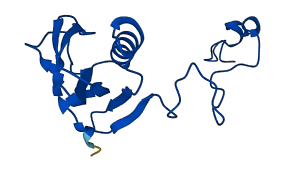
Descriptions
The autoinhibited protein was predicted that may have potential autoinhibitory elements via cis-regPred.
Autoinhibitory domains (AIDs)
Target domain |
|
Relief mechanism |
|
Assay |
cis-regPred |
Accessory elements
No accessory elements
Autoinhibited structure

Activated structure
11 structures for P19569
| Entry ID | Method | Resolution | Chain | Position | Source |
|---|---|---|---|---|---|
| 4KT0 | X-ray | 280 A | D | 1-141 | PDB |
| 4L6V | X-ray | 380 A | 4/D/d | 1-141 | PDB |
| 6HQB | X-ray | 400 A | D | 1-141 | PDB |
| 6NWA | EM | 348 A | D/O/d | 1-141 | PDB |
| 6UZV | EM | 310 A | 4/D/d | 1-141 | PDB |
| 7O1V | EM | 431 A | D | 1-141 | PDB |
| 7UMH | EM | 260 A | D/P/d | 1-141 | PDB |
| 8AM5 | EM | 310 A | d | 1-141 | PDB |
| 8ASL | EM | 315 A | d | 1-141 | PDB |
| 8ASP | EM | 290 A | d | 1-141 | PDB |
| AF-P19569-F1 | Predicted | AlphaFoldDB |
No variants for P19569
| Variant ID(s) | Position | Change | Description | Diseaes Association | Provenance |
|---|---|---|---|---|---|
| No variants for P19569 | |||||
No associated diseases with P19569
No regional properties for P19569
| Type | Name | Position | InterPro Accession |
|---|---|---|---|
| No domain, repeats, and functional sites for P19569 | |||
2 GO annotations of cellular component
| Name | Definition |
|---|---|
| photosystem I reaction center | A photochemical system containing P700, the chlorophyll a dimer that functions as a primary electron donor. Functioning as a light-dependent plastocyanin-ferredoxin oxidoreductase, it transfers electrons from plastocyanin to ferredoxin. |
| plasma membrane-derived photosystem I | A protein complex located in the plasma membrane-derived thylakoid. The photosystem functions as a light-dependent plastocyanin-ferredoxin oxidoreductase, transferring electrons from plastocyanin to ferredoxin. Examples of this complex are found in bacterial species. |
No GO annotations of molecular function
| Name | Definition |
|---|---|
| No GO annotations for molecular function |
1 GO annotations of biological process
| Name | Definition |
|---|---|
| photosynthesis | The synthesis by organisms of organic chemical compounds, especially carbohydrates, from carbon dioxide (CO2) using energy obtained from light rather than from the oxidation of chemical compounds. |
No homologous proteins in AiPD
| UniProt AC | Gene Name | Protein Name | Species | Evidence Code |
|---|---|---|---|---|
| No homologous proteins | ||||
| 10 | 20 | 30 | 40 | 50 | 60 |
| MTELSGQPPK | FGGSTGGLLS | KANREEKYAI | TWTSASEQVF | EMPTGGAAIM | NEGENLLYLA |
| 70 | 80 | 90 | 100 | 110 | 120 |
| RKEQCLALGT | QLRTKFKPKI | QDYKIYRVYP | SGEVQYLHPA | DGVFPEKVNE | GREAQGTKTR |
| 130 | 140 | ||||
| RIGQNPEPVT | IKFSGKAPYE | V |