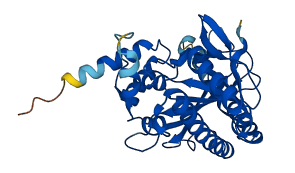
Descriptions
The autoinhibited protein was predicted that may have potential autoinhibitory elements via cis-regPred.
Autoinhibitory domains (AIDs)
Target domain |
|
Relief mechanism |
|
Assay |
cis-regPred |
Accessory elements
No accessory elements
Autoinhibited structure

Activated structure
1 structures for P19464
| Entry ID | Method | Resolution | Chain | Position | Source |
|---|---|---|---|---|---|
| AF-P19464-F1 | Predicted | AlphaFoldDB |
No variants for P19464
| Variant ID(s) | Position | Change | Description | Diseaes Association | Provenance |
|---|---|---|---|---|---|
| No variants for P19464 | |||||
No associated diseases with P19464
No GO annotations of cellular component
| Name | Definition |
|---|---|
| No GO annotations for cellular component |
3 GO annotations of molecular function
| Name | Definition |
|---|---|
| 1-aminocyclopropane-1-carboxylate oxidase activity | Catalysis of the reaction: 1-aminocyclopropane-1-carboxylate + L-ascorbate + O(2) = CO(2) + dehydroascorbate + ethylene + 2 H(2)O + hydrogen cyanide. Ethene is also known as ethylene. |
| L-ascorbic acid binding | Binding to L-ascorbic acid, (2R)-2-[(1S)-1,2-dihydroxyethyl]-4-hydroxy-5-oxo-2,5-dihydrofuran-3-olate; L-ascorbic acid is vitamin C and has co-factor and anti-oxidant activities in many species. |
| metal ion binding | Binding to a metal ion. |
2 GO annotations of biological process
| Name | Definition |
|---|---|
| ethylene biosynthetic process | The chemical reactions and pathways resulting in the formation of ethylene (C2-H4, ethene), a simple hydrocarbon gas that can function in plants as a growth regulator. |
| fruit ripening | An developmental maturation process that has as participant a fruit. Ripening causes changes in one or more characteristics of a fruit (color, aroma, flavor, texture, hardness, cell wall structure) and may make it more attractive to animals and aid in seed dispersal. |
No homologous proteins in AiPD
| UniProt AC | Gene Name | Protein Name | Species | Evidence Code |
|---|---|---|---|---|
| No homologous proteins | ||||
| 10 | 20 | 30 | 40 | 50 | 60 |
| MDSFPVINME | KLEGQERAAT | MKLINDACEN | WGFFELVNHS | IPVELMDEVE | RLTKEHYKKC |
| 70 | 80 | 90 | 100 | 110 | 120 |
| MEQRFKELMA | SKVEGAVVDA | NDMDWESTFF | IRHLPVSNLS | EIPDLTDEHR | KVMKEFAEKL |
| 130 | 140 | 150 | 160 | 170 | 180 |
| EKLAEQVLDL | LCENLGLEKG | YLKMAFAGTT | TGLPTFGTKV | SNYPPCPRPE | LFKGLRAHTD |
| 190 | 200 | 210 | 220 | 230 | 240 |
| AGGLILLFQD | DRVAGLQLLK | DGEWVDVPPM | NHSIVINLGD | QVEVITNGKY | KSVMHRVVAQ |
| 250 | 260 | 270 | 280 | 290 | 300 |
| TDGNRMSLAS | FYNPGSDAVI | FPAPALVEKE | AEEKKEVYPK | FVFEDYMNLY | AGLKFQAKEP |
| 310 | |||||
| RFEVMKMKAV | ETANLSPITT |