P19262
Gene name |
KGD2 (YDR148C, YD8358.05C) |
Protein name |
Dihydrolipoyllysine-residue succinyltransferase component of 2-oxoglutarate dehydrogenase complex, mitochondrial |
Names |
2-oxoglutarate dehydrogenase complex component E2, OGDC-E2, Dihydrolipoamide succinyltransferase component of 2-oxoglutarate dehydrogenase complex |
Species |
Saccharomyces cerevisiae (strain ATCC 204508 / S288c) (Baker's yeast) |
KEGG Pathway |
sce:YDR148C |
EC number |
2.3.1.61: Transferring groups other than amino-acyl groups |
Protein Class |
|
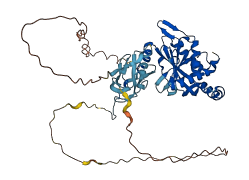
Descriptions
The autoinhibited protein was predicted that may have potential autoinhibitory elements via cis-regPred.
Autoinhibitory domains (AIDs)
Target domain |
|
Relief mechanism |
|
Assay |
cis-regPred |
Accessory elements
No accessory elements
Autoinhibited structure

Activated structure
1 structures for P19262
| Entry ID | Method | Resolution | Chain | Position | Source |
|---|---|---|---|---|---|
| AF-P19262-F1 | Predicted | AlphaFoldDB |
1 variants for P19262
| Variant ID(s) | Position | Change | Description | Diseaes Association | Provenance |
|---|---|---|---|---|---|
| s04-754561 | 168 | A>V | No | SGRP |
No associated diseases with P19262
Functions
| Description | ||
|---|---|---|
| EC Number | 2.3.1.61 | Transferring groups other than amino-acyl groups |
| Subcellular Localization |
|
|
| PANTHER Family | ||
| PANTHER Subfamily | ||
| PANTHER Protein Class | ||
| PANTHER Pathway Category | No pathway information available | |
4 GO annotations of cellular component
| Name | Definition |
|---|---|
| mitochondrial alpha-ketoglutarate dehydrogenase complex | Mitochondrial complex that possesses alpha-ketoglutarate dehydrogenase activity. |
| mitochondrial nucleoid | The region of a mitochondrion to which the DNA is confined. |
| mitochondrial oxoglutarate dehydrogenase complex | A complex of multiple copies of three enzymatic components: oxoglutarate dehydrogenase (lipoamide) (E1), dihydrolipoamide S-succinyltransferase (E2) and dihydrolipoamide dehydrogenase (E3); catalyzes the overall conversion of 2-oxoglutarate to succinyl-CoA and carbon dioxide (CO2) within the mitochondrial matrix. An example of this complex is found in Mus musculus. |
| mitochondrion | A semiautonomous, self replicating organelle that occurs in varying numbers, shapes, and sizes in the cytoplasm of virtually all eukaryotic cells. It is notably the site of tissue respiration. |
1 GO annotations of molecular function
| Name | Definition |
|---|---|
| dihydrolipoyllysine-residue succinyltransferase activity | Catalysis of the reaction: succinyl-CoA + dihydrolipoamide = CoA + S-succinyldihydrolipoamide. |
3 GO annotations of biological process
| Name | Definition |
|---|---|
| 2-oxoglutarate metabolic process | The chemical reactions and pathways involving oxoglutarate, the dianion of 2-oxoglutaric acid. It is a key constituent of the TCA cycle and a key intermediate in amino-acid metabolism. |
| L-lysine catabolic process to acetyl-CoA via saccharopine | The chemical reactions and pathways resulting in the breakdown of L-lysine into other compounds, including acetyl-CoA, via the intermediate saccharopine. |
| tricarboxylic acid cycle | A nearly universal metabolic pathway in which the acetyl group of acetyl coenzyme A is effectively oxidized to two CO2 and four pairs of electrons are transferred to coenzymes. The acetyl group combines with oxaloacetate to form citrate, which undergoes successive transformations to isocitrate, 2-oxoglutarate, succinyl-CoA, succinate, fumarate, malate, and oxaloacetate again, thus completing the cycle. In eukaryotes the tricarboxylic acid is confined to the mitochondria. See also glyoxylate cycle. |
No homologous proteins in AiPD
| UniProt AC | Gene Name | Protein Name | Species | Evidence Code |
|---|---|---|---|---|
| No homologous proteins | ||||
| 10 | 20 | 30 | 40 | 50 | 60 |
| MLSRATRTAA | AKSLVKSKVA | RNVMAASFVK | RHASTSLFKQ | ANKVESLGSI | YLSGKKISVA |
| 70 | 80 | 90 | 100 | 110 | 120 |
| ANPFSITSNR | FKSTSIEVPP | MAESLTEGSL | KEYTKNVGDF | IKEDELLATI | ETDKIDIEVN |
| 130 | 140 | 150 | 160 | 170 | 180 |
| SPVSGTVTKL | NFKPEDTVTV | GEELAQVEPG | EAPAEGSGES | KPEPTEQAEP | SQGVAARENS |
| 190 | 200 | 210 | 220 | 230 | 240 |
| SEETASKKEA | APKKEAAPKK | EVTEPKKADQ | PKKTVSKAQE | PPVASNSFTP | FPRTETRVKM |
| 250 | 260 | 270 | 280 | 290 | 300 |
| NRMRLRIAER | LKESQNTAAS | LTTFNEVDMS | ALMEMRKLYK | DEIIKKTGTK | FGFMGLFSKA |
| 310 | 320 | 330 | 340 | 350 | 360 |
| CTLAAKDIPA | VNGAIEGDQI | VYRDYTDISV | AVATPKGLVT | PVVRNAESLS | VLDIENEIVR |
| 370 | 380 | 390 | 400 | 410 | 420 |
| LSHKARDGKL | TLEDMTGGTF | TISNGGVFGS | LYGTPIINSP | QTAVLGLHGV | KERPVTVNGQ |
| 430 | 440 | 450 | 460 | ||
| IVSRPMMYLA | LTYDHRLLDG | REAVTFLKTV | KELIEDPRKM | LLW |