P18286
Gene name |
pcbC |
Protein name |
Isopenicillin N synthase |
Names |
IPNS |
Species |
Streptomyces jumonjinensis |
KEGG Pathway |
|
EC number |
1.21.3.1: With oxygen as acceptor |
Protein Class |
|
Descriptions
The autoinhibited protein was predicted that may have potential autoinhibitory elements via cis-regPred.
Autoinhibitory domains (AIDs)
Target domain |
|
Relief mechanism |
|
Assay |
cis-regPred |
Accessory elements
No accessory elements
Autoinhibited structure

Activated structure
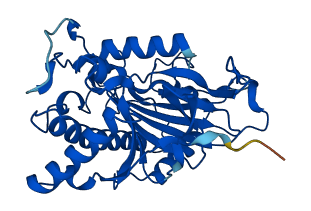
1 structures for P18286
| Entry ID | Method | Resolution | Chain | Position | Source |
|---|---|---|---|---|---|
| AF-P18286-F1 | Predicted | AlphaFoldDB |
No variants for P18286
| Variant ID(s) | Position | Change | Description | Diseaes Association | Provenance |
|---|---|---|---|---|---|
| No variants for P18286 | |||||
No associated diseases with P18286
5 regional properties for P18286
| Type | Name | Position | InterPro Accession |
|---|---|---|---|
| conserved_site | Isopenicillin N synthase, conserved site | 97 - 106 | IPR002057-1 |
| conserved_site | Isopenicillin N synthase, conserved site | 248 - 261 | IPR002057-2 |
| domain | Oxoglutarate/iron-dependent dioxygenase | 180 - 286 | IPR005123 |
| domain | Non-haem dioxygenase N-terminal domain | 10 - 132 | IPR026992 |
| domain | Isopenicillin N synthase-like, Fe(2+) 2OG dioxygenase domain | 186 - 284 | IPR044861 |
Functions
| Description | ||
|---|---|---|
| EC Number | 1.21.3.1 | With oxygen as acceptor |
| Subcellular Localization |
|
|
| PANTHER Family | ||
| PANTHER Subfamily | ||
| PANTHER Protein Class | ||
| PANTHER Pathway Category | No pathway information available | |
No GO annotations of cellular component
| Name | Definition |
|---|---|
| No GO annotations for cellular component |
3 GO annotations of molecular function
| Name | Definition |
|---|---|
| iron ion binding | Binding to an iron (Fe) ion. |
| isopenicillin-N synthase activity | Catalysis of the reaction: N-[(5S)-5-amino-5-carboxypentanoyl]-L-cysteinyl-D-valine + O(2) = 2 H(2)O + isopenicillin N. |
| L-ascorbic acid binding | Binding to L-ascorbic acid, (2R)-2-[(1S)-1,2-dihydroxyethyl]-4-hydroxy-5-oxo-2,5-dihydrofuran-3-olate; L-ascorbic acid is vitamin C and has co-factor and anti-oxidant activities in many species. |
1 GO annotations of biological process
| Name | Definition |
|---|---|
| antibiotic biosynthetic process | The chemical reactions and pathways resulting in the formation of an antibiotic, a substance produced by or derived from certain fungi, bacteria, and other organisms, that can destroy or inhibit the growth of other microorganisms. |
No homologous proteins in AiPD
| UniProt AC | Gene Name | Protein Name | Species | Evidence Code |
|---|---|---|---|---|
| No homologous proteins | ||||
| 10 | 20 | 30 | 40 | 50 | 60 |
| MPILMPSAEV | PTIDISPLSG | DDAKAKQRVA | QEINKAARGS | GFFYASNHGV | DVQLLQDVVN |
| 70 | 80 | 90 | 100 | 110 | 120 |
| EFHRNMSDQE | KHDLAINAYN | KDNPHVRNGY | YKAIKGKKAV | ESFCYLNPSF | SDDHPMIKSE |
| 130 | 140 | 150 | 160 | 170 | 180 |
| TPMHEVNLWP | DEEKHPRFRP | FCEDYYRQLL | RLSTVIMRGY | ALALGRREDF | FDEALAEADT |
| 190 | 200 | 210 | 220 | 230 | 240 |
| LSSVSLIRYP | YLEEYPPVKT | GADGTKLSFE | DHLDVSMITV | LYQTEVQNLQ | VETVDGWQDI |
| 250 | 260 | 270 | 280 | 290 | 300 |
| PRSDEDFLVN | CGTYMGHITH | DYFPAPNHRV | KFINAERLSL | PFFLNAGHNS | VIEPFVPEGA |
| 310 | 320 | ||||
| AGTVKNPTTS | YGEYLQHGLR | ALIVKNGQT |