P17886
Gene name |
crn (CG3193) |
Protein name |
Protein crooked neck |
Names |
|
Species |
Drosophila melanogaster (Fruit fly) |
KEGG Pathway |
dme:Dmel_CG3193 |
EC number |
|
Protein Class |
|
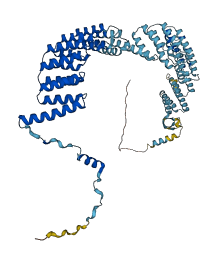
Descriptions
The autoinhibited protein was predicted that may have potential autoinhibitory elements via cis-regPred.
Autoinhibitory domains (AIDs)
Target domain |
|
Relief mechanism |
|
Assay |
cis-regPred |
Accessory elements
No accessory elements
Autoinhibited structure

Activated structure
1 structures for P17886
| Entry ID | Method | Resolution | Chain | Position | Source |
|---|---|---|---|---|---|
| AF-P17886-F1 | Predicted | AlphaFoldDB |
No variants for P17886
| Variant ID(s) | Position | Change | Description | Diseaes Association | Provenance |
|---|---|---|---|---|---|
| No variants for P17886 | |||||
No associated diseases with P17886
14 regional properties for P17886
| Type | Name | Position | InterPro Accession |
|---|---|---|---|
| repeat | HAT (Half-A-TPR) repeat | 56 - 88 | IPR003107-1 |
| repeat | HAT (Half-A-TPR) repeat | 90 - 122 | IPR003107-2 |
| repeat | HAT (Half-A-TPR) repeat | 124 - 156 | IPR003107-3 |
| repeat | HAT (Half-A-TPR) repeat | 158 - 189 | IPR003107-4 |
| repeat | HAT (Half-A-TPR) repeat | 191 - 222 | IPR003107-5 |
| repeat | HAT (Half-A-TPR) repeat | 224 - 259 | IPR003107-6 |
| repeat | HAT (Half-A-TPR) repeat | 261 - 295 | IPR003107-7 |
| repeat | HAT (Half-A-TPR) repeat | 339 - 373 | IPR003107-8 |
| repeat | HAT (Half-A-TPR) repeat | 383 - 419 | IPR003107-9 |
| repeat | HAT (Half-A-TPR) repeat | 421 - 452 | IPR003107-10 |
| repeat | HAT (Half-A-TPR) repeat | 454 - 486 | IPR003107-11 |
| repeat | HAT (Half-A-TPR) repeat | 488 - 522 | IPR003107-12 |
| repeat | HAT (Half-A-TPR) repeat | 524 - 555 | IPR003107-13 |
| repeat | HAT (Half-A-TPR) repeat | 567 - 605 | IPR003107-14 |
8 GO annotations of cellular component
| Name | Definition |
|---|---|
| catalytic step 2 spliceosome | A spliceosomal complex that contains three snRNPs, including U5, bound to a splicing intermediate in which the first catalytic cleavage of the 5' splice site has occurred. The precise subunit composition differs significantly from that of the catalytic step 1, or activated, spliceosome, and includes many proteins in addition to those found in the associated snRNPs. |
| cytosol | The part of the cytoplasm that does not contain organelles but which does contain other particulate matter, such as protein complexes. |
| nuclear speck | A discrete extra-nucleolar subnuclear domain, 20-50 in number, in which splicing factors are seen to be localized by immunofluorescence microscopy. |
| nucleus | A membrane-bounded organelle of eukaryotic cells in which chromosomes are housed and replicated. In most cells, the nucleus contains all of the cell's chromosomes except the organellar chromosomes, and is the site of RNA synthesis and processing. In some species, or in specialized cell types, RNA metabolism or DNA replication may be absent. |
| post-mRNA release spliceosomal complex | A spliceosomal complex that is formed following the release of the spliced product from the post-spliceosomal complex and contains the excised intron and three snRNPs, including U5. |
| precatalytic spliceosome | A spliceosomal complex that is formed by the recruitment of a preassembled U5-containing tri-snRNP to the prespliceosome. Although all 5 snRNPs are present, the precatalytic spliceosome is catalytically inactive. The precatalytic spliceosome includes many proteins in addition to those found in the associated snRNPs. |
| Prp19 complex | A protein complex consisting of Prp19 and associated proteins that is involved in the transition from the precatalytic spliceosome to the activated form that catalyzes step 1 of splicing, and which remains associated with the spliceosome through the second catalytic step. It is widely conserved, found in both yeast and mammals, though the exact composition varies. In S. cerevisiae, it contains Prp19p, Ntc20p, Snt309p, Isy1p, Syf2p, Cwc2p, Prp46p, Clf1p, Cef1p, and Syf1p. |
| U2-type catalytic step 2 spliceosome | A spliceosomal complex that contains the U2, U5 and U6 snRNPs bound to a splicing intermediate in which the first catalytic cleavage of the 5' splice site has occurred. The precise subunit composition differs significantly from that of the catalytic step 1, or activated, spliceosome, and includes many proteins in addition to those found in the U2, U5 and U6 snRNPs. |
1 GO annotations of molecular function
| Name | Definition |
|---|---|
| RNA binding | Binding to an RNA molecule or a portion thereof. |
7 GO annotations of biological process
| Name | Definition |
|---|---|
| axon ensheathment | Any process in which the axon of a neuron is insulated, and that insulation maintained, thereby preventing dispersion of the electrical signal. |
| glial cell migration | The orderly movement of a glial cell, non-neuronal cells that provide support and nutrition, maintain homeostasis, form myelin, and participate in signal transmission in the nervous system. |
| Malpighian tubule morphogenesis | The process in which the anatomical structures of the Malpighian tubule are generated and organized. This process takes place entirely during the embryonic phase. A Malpighian tubule is a fine, thin-walled excretory tubule in insects which leads into the posterior part of the gut. |
| mRNA splicing, via spliceosome | The joining together of exons from one or more primary transcripts of messenger RNA (mRNA) and the excision of intron sequences, via a spliceosomal mechanism, so that mRNA consisting only of the joined exons is produced. |
| oenocyte development | The process whose specific outcome is the progression of the oenocyte over time, from its formation to the mature structure. The oenocytes are large secretory cells found in clusters underlying the epidermis of larval abdominal segments. |
| regulation of alternative mRNA splicing, via spliceosome | Any process that modulates the frequency, rate or extent of alternative splicing of nuclear mRNAs. |
| spliceosomal complex assembly | The aggregation, arrangement and bonding together of a spliceosomal complex, a ribonucleoprotein apparatus that catalyzes nuclear mRNA splicing via transesterification reactions. |
| 10 | 20 | 30 | 40 | 50 | 60 |
| MERPQKMPKV | AKVKNKAPAE | VQITAEQLLR | EAKERDLEIL | PPPPKQKISD | PAELADYQQR |
| 70 | 80 | 90 | 100 | 110 | 120 |
| KRKTFEDNLR | KNRMVVSHWI | KYAQWEEQQQ | EIQRARSIWE | RALDNEHRNV | TLWLKYAEME |
| 130 | 140 | 150 | 160 | 170 | 180 |
| MKNKQVNHAR | NLWDRAVTIM | PRVNQFWYKY | TYMEEMLENV | AGARQVFERW | MEWQPEEQAW |
| 190 | 200 | 210 | 220 | 230 | 240 |
| QTYVNFELRY | KEIDRAREIY | ERFVYVHPDV | KNWIKFARFE | ESHGFIHGSR | RVFERAVEFF |
| 250 | 260 | 270 | 280 | 290 | 300 |
| GDDYIEERLF | IAFARFEEGQ | KEHDRARIIY | KYALDHLPKD | RTQELFKAYT | KHEKKYGDRA |
| 310 | 320 | 330 | 340 | 350 | 360 |
| GIEDVIVSKR | KYQYEQEVAA | NPTNYDAWFD | YLRLIEAEGD | RDQIRETYER | AISNVPPANE |
| 370 | 380 | 390 | 400 | 410 | 420 |
| KNFWRRYIYL | WINYALYEEL | EAEDAERTRQ | IYKTCLELIP | HKQFTFSKLW | LLYAQFEIRC |
| 430 | 440 | 450 | 460 | 470 | 480 |
| KELQRARKAL | GLAIGMCPRD | KLFRGYIDLE | IQLREFERCR | MLYEKFLEFG | PENCVTWMKF |
| 490 | 500 | 510 | 520 | 530 | 540 |
| AELENLLGDT | DRARAIFELA | VQQPRLDMPE | LLWKAYIDFE | VALGETELAR | QLYERLLERT |
| 550 | 560 | 570 | 580 | 590 | 600 |
| QHVKVWMSFA | KFEMGLSHGD | SGPDAELNVQ | LARRIYERAN | EMLRQLGDKE | SRVLLLEAWR |
| 610 | 620 | 630 | 640 | 650 | 660 |
| DFERDASDSQ | EMQKVMDKMP | RRIKKRQKIV | SDNGVEEGWE | EVFDYIFPED | EMARPNLKLL |
| 670 | 680 | 690 | 700 | ||
| AAAKMWKTQK | DNTVDDPPAT | AIASEPEPAA | DAAPADTTDS | GD |