P17413
Gene name |
frdC (WS0832) |
Protein name |
Fumarate reductase cytochrome b subunit |
Names |
Quinol-fumarate reductase cytochrome b subunit, QFR cytochrome b subunit |
Species |
Wolinella succinogenes (strain ATCC 29543 / DSM 1740 / LMG 7466 / NCTC 11488 / FDC 602W) (Vibrio succinogenes) |
KEGG Pathway |
wsu:WS0832 |
EC number |
|
Protein Class |
|
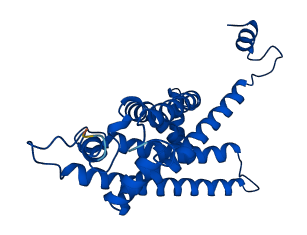
Descriptions
The autoinhibited protein was predicted that may have potential autoinhibitory elements via cis-regPred.
Autoinhibitory domains (AIDs)
Target domain |
|
Relief mechanism |
|
Assay |
cis-regPred |
Accessory elements
No accessory elements
Autoinhibited structure

Activated structure
No variants for P17413
| Variant ID(s) | Position | Change | Description | Diseaes Association | Provenance |
|---|---|---|---|---|---|
| No variants for P17413 | |||||
No associated diseases with P17413
No regional properties for P17413
| Type | Name | Position | InterPro Accession |
|---|---|---|---|
| No domain, repeats, and functional sites for P17413 | |||
3 GO annotations of cellular component
| Name | Definition |
|---|---|
| integral component of membrane | The component of a membrane consisting of the gene products and protein complexes having at least some part of their peptide sequence embedded in the hydrophobic region of the membrane. |
| plasma membrane | The membrane surrounding a cell that separates the cell from its external environment. It consists of a phospholipid bilayer and associated proteins. |
| respirasome | The protein complexes that form the electron transport system (the respiratory chain), associated with a cell membrane, usually the plasma membrane (in prokaryotes) or the inner mitochondrial membrane (on eukaryotes). The respiratory chain complexes transfer electrons from an electron donor to an electron acceptor and are associated with a proton pump to create a transmembrane electrochemical gradient. |
2 GO annotations of molecular function
| Name | Definition |
|---|---|
| metal ion binding | Binding to a metal ion. |
| oxidoreductase activity, acting on the CH-CH group of donors | Catalysis of an oxidation-reduction (redox) reaction in which a CH-CH group acts as a hydrogen or electron donor and reduces a hydrogen or electron acceptor. |
1 GO annotations of biological process
| Name | Definition |
|---|---|
| tricarboxylic acid cycle | A nearly universal metabolic pathway in which the acetyl group of acetyl coenzyme A is effectively oxidized to two CO2 and four pairs of electrons are transferred to coenzymes. The acetyl group combines with oxaloacetate to form citrate, which undergoes successive transformations to isocitrate, 2-oxoglutarate, succinyl-CoA, succinate, fumarate, malate, and oxaloacetate again, thus completing the cycle. In eukaryotes the tricarboxylic acid is confined to the mitochondria. See also glyoxylate cycle. |
No homologous proteins in AiPD
| UniProt AC | Gene Name | Protein Name | Species | Evidence Code |
|---|---|---|---|---|
| No homologous proteins | ||||
| 10 | 20 | 30 | 40 | 50 | 60 |
| MTNESILESY | SGVTPERKKS | RMPAKLDWWQ | SATGLFLGLF | MIGHMFFVST | ILLGDNVMLW |
| 70 | 80 | 90 | 100 | 110 | 120 |
| VTKKFELDFI | FEGGKPIVVS | FLAAFVFAVF | IAHAFLAMRK | FPINYRQYLT | FKTHKDLMRH |
| 130 | 140 | 150 | 160 | 170 | 180 |
| GDTTLWWIQA | MTGFAMFFLG | SVHLYIMMTQ | PQTIGPVSSS | FRMVSEWMWP | LYLVLLFAVE |
| 190 | 200 | 210 | 220 | 230 | 240 |
| LHGSVGLYRL | AVKWGWFDGE | TPDKTRANLK | KLKTLMSAFL | IVLGLLTFGA | YVKKGLEQTD |
| 250 | |||||
| PNIDYKYFDY | KRTHHR |