P17247
Gene name |
tgfb2 |
Protein name |
Transforming growth factor beta-2 proprotein |
Names |
|
Species |
Xenopus laevis (African clawed frog) |
KEGG Pathway |
xla:373801 |
EC number |
|
Protein Class |
|
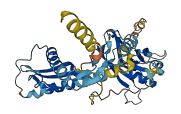
Descriptions
The autoinhibited protein was predicted that may have potential autoinhibitory elements via cis-regPred.
Autoinhibitory domains (AIDs)
Target domain |
|
Relief mechanism |
|
Assay |
cis-regPred |
Accessory elements
No accessory elements
Autoinhibited structure

Activated structure
1 structures for P17247
| Entry ID | Method | Resolution | Chain | Position | Source |
|---|---|---|---|---|---|
| AF-P17247-F1 | Predicted | AlphaFoldDB |
No variants for P17247
| Variant ID(s) | Position | Change | Description | Diseaes Association | Provenance |
|---|---|---|---|---|---|
| No variants for P17247 | |||||
No associated diseases with P17247
1 GO annotations of cellular component
| Name | Definition |
|---|---|
| extracellular space | That part of a multicellular organism outside the cells proper, usually taken to be outside the plasma membranes, and occupied by fluid. |
2 GO annotations of molecular function
| Name | Definition |
|---|---|
| growth factor activity | The function that stimulates a cell to grow or proliferate. Most growth factors have other actions besides the induction of cell growth or proliferation. |
| transforming growth factor beta receptor binding | Binding to a transforming growth factor beta receptor. |
3 GO annotations of biological process
| Name | Definition |
|---|---|
| embryo development | The process whose specific outcome is the progression of an embryo from its formation until the end of its embryonic life stage. The end of the embryonic stage is organism-specific. For example, for mammals, the process would begin with zygote formation and end with birth. For insects, the process would begin at zygote formation and end with larval hatching. For plant zygotic embryos, this would be from zygote formation to the end of seed dormancy. For plant vegetative embryos, this would be from the initial determination of the cell or group of cells to form an embryo until the point when the embryo becomes independent of the parent plant. |
| positive regulation of cell division | Any process that activates or increases the frequency, rate or extent of cell division. |
| tissue development | The process whose specific outcome is the progression of a tissue over time, from its formation to the mature structure. |
No homologous proteins in AiPD
| UniProt AC | Gene Name | Protein Name | Species | Evidence Code |
|---|---|---|---|---|
| No homologous proteins | ||||
| 10 | 20 | 30 | 40 | 50 | 60 |
| MHYYVLFTFL | TLDLAPVALS | LSTCSALDMD | QFMRKRIEAI | RGQILSKLKL | NSPPEDYPEP |
| 70 | 80 | 90 | 100 | 110 | 120 |
| GEVSQDVISI | YNSTRDLLQE | KANERATSCE | RERSEDEYYA | KEVYKIDMLP | YYTSENVIPP |
| 130 | 140 | 150 | 160 | 170 | 180 |
| SYTTPYFRIV | RFDVSSMEKN | ASNLVKAEFR | VFRLMNTKAR | VSEQRIELYQ | ILKSKDLASP |
| 190 | 200 | 210 | 220 | 230 | 240 |
| TQRYIDSKVV | KTRAEGEWLS | FDVTEAVNEW | LHHKDRNLGF | KISLHCPCCT | FIPSNNYIIP |
| 250 | 260 | 270 | 280 | 290 | 300 |
| NKSEELETRF | AGIDDAYMYA | GGDSKSKTGR | KKHTGRTPHL | LLMLLPSYRL | ESQQSSRRKK |
| 310 | 320 | 330 | 340 | 350 | 360 |
| RALDAAYCFR | NVQDNCCLRP | LYIDFKKDLG | WKWIHEPKGY | NANFCAGACP | YLWSSDTQHS |
| 370 | 380 | 390 | 400 | 410 | |
| RVLSLYNTIN | PEASASPCCV | SQDLDSLTIL | YYIGNKPKIE | QLSNMIVKSC | KCS |