P17177
Gene name |
CYP27A1 (CYP27) |
Protein name |
Sterol 26-hydroxylase, mitochondrial |
Names |
5-beta-cholestane-3-alpha,7-alpha,12-alpha-triol 26-hydroxylase, Cytochrome P-450C27/25, Cytochrome P450 27, Sterol 27-hydroxylase, Vitamin D(3) 25-hydroxylase |
Species |
Oryctolagus cuniculus (Rabbit) |
KEGG Pathway |
ocu:100348736 |
EC number |
1.14.15.15: With reduced iron-sulfur protein as one donor, and incorporation of one atom of oxygen |
Protein Class |
|
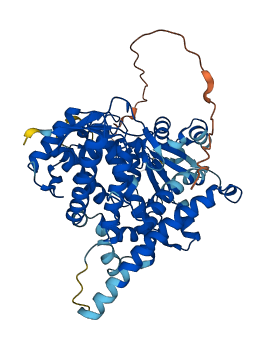
Descriptions
The autoinhibited protein was predicted that may have potential autoinhibitory elements via cis-regPred.
Autoinhibitory domains (AIDs)
Target domain |
|
Relief mechanism |
|
Assay |
cis-regPred |
Accessory elements
No accessory elements
Autoinhibited structure

Activated structure
1 structures for P17177
| Entry ID | Method | Resolution | Chain | Position | Source |
|---|---|---|---|---|---|
| AF-P17177-F1 | Predicted | AlphaFoldDB |
No variants for P17177
| Variant ID(s) | Position | Change | Description | Diseaes Association | Provenance |
|---|---|---|---|---|---|
| No variants for P17177 | |||||
No associated diseases with P17177
1 regional properties for P17177
| Type | Name | Position | InterPro Accession |
|---|---|---|---|
| conserved_site | Cytochrome P450, conserved site | 473 - 482 | IPR017972 |
Functions
| Description | ||
|---|---|---|
| EC Number | 1.14.15.15 | With reduced iron-sulfur protein as one donor, and incorporation of one atom of oxygen |
| Subcellular Localization |
|
|
| PANTHER Family | ||
| PANTHER Subfamily | ||
| PANTHER Protein Class | ||
| PANTHER Pathway Category | No pathway information available | |
1 GO annotations of cellular component
| Name | Definition |
|---|---|
| mitochondrial inner membrane | The inner, i.e. lumen-facing, lipid bilayer of the mitochondrial envelope. It is highly folded to form cristae. |
10 GO annotations of molecular function
| Name | Definition |
|---|---|
| 3-alpha,7-alpha,12-alpha-trihydroxycholestan-26-al 26-oxidoreductase activity | Catalysis of the reaction: H2O + NAD+ + 3-alpha,7-alpha,12-alpha-trihydroxy-5-beta-cholestan-26-al = NADH + 3-alpha,7-alpha,12-alpha-trihydroxy-5-beta-cholestanate. |
| cholestanetetraol 26-dehydrogenase activity | Catalysis of the reaction: 5-beta-cholestane-3-alpha,7-alpha,12-alpha,26-tetraol + NAD+ = 3-alpha,7-alpha,12-alpha-trihydroxy-5-beta-cholestan-26-al + NADH. |
| cholestanetriol 26-monooxygenase activity | Catalysis of the reaction: 5-beta-cholestane-3-alpha,7-alpha,12-alpha-triol + NADPH + O2 = 5-beta-cholestane-3-alpha,7-alpha,12-alpha,26-tetraol + NADP+ + H2O. |
| cholesterol 26-hydroxylase activity | Catalysis of the hydroxylation of cholesterol at position 26 of the side chain, to produce 26-hydroxycholesterol. |
| cholesterol 7-alpha-monooxygenase activity | Catalysis of the reaction: cholesterol + NADPH + H+ + O2 = 7-alpha-hydroxycholesterol + NADP+ + H2O. |
| cholesterol monooxygenase (side-chain-cleaving) activity | Catalysis of the reaction: cholesterol + reduced adrenal ferredoxin + O2 = pregnenolone + 4-methylpentanal + oxidized adrenal ferredoxin + H2O. |
| heme binding | Binding to a heme, a compound composed of iron complexed in a porphyrin (tetrapyrrole) ring. |
| Hsp70 protein binding | Binding to a Hsp70 protein, heat shock proteins around 70kDa in size. |
| iron ion binding | Binding to an iron (Fe) ion. |
| vitamin D3 25-hydroxylase activity | Catalysis of the reaction: vitamin D3 + NADPH + H+ + O2 = calcidiol + NADP+ + H2O. |
4 GO annotations of biological process
| Name | Definition |
|---|---|
| bile acid biosynthetic process | The chemical reactions and pathways resulting in the formation of bile acids, any of a group of steroid carboxylic acids occurring in bile. |
| C21-steroid hormone biosynthetic process | The chemical reactions and pathways resulting in the formation of C21-steroid hormones, steroid compounds containing 21 carbons which function as hormones. |
| calcitriol biosynthetic process from calciol | Conversion of vitamin D3 from its largely inactive form (calciol, also called cholecalciferol) into a hormonally active form (calcitriol). Conversion requires 25-hydroxylation of calciol in the liver to form calcidiol, and subsequent 1,alpha-hydroxylation of calcidiol in the kidney to form calcitriol. |
| cholesterol catabolic process | The chemical reactions and pathways resulting in the breakdown of cholesterol, cholest-5-en-3 beta-ol, the principal sterol of vertebrates and the precursor of many steroids, including bile acids and steroid hormones. |
No homologous proteins in AiPD
| UniProt AC | Gene Name | Protein Name | Species | Evidence Code |
|---|---|---|---|---|
| No homologous proteins | ||||
| 10 | 20 | 30 | 40 | 50 | 60 |
| MAALGCARLR | WALLGPRVAG | CGLCPQGARA | KAAIPTALPA | DEAAQAPGAG | PGDRRRRRSL |
| 70 | 80 | 90 | 100 | 110 | 120 |
| EELPRLGQLR | FFYQAFVQGY | LLHLHKLQVL | NKARYGPMWV | SYLGPQLFVN | LASAPLVETV |
| 130 | 140 | 150 | 160 | 170 | 180 |
| MRQEGKYPVR | NDMQLWKEHR | DHQDLAYGVF | TTDGHDWYQL | RQALNQRLLK | PAEAALYTDA |
| 190 | 200 | 210 | 220 | 230 | 240 |
| LNEVIDSFVV | RLDQLRAESA | SGDQVPDMAD | LLYHFALEAI | CYILFEKRIG | CLEASIPKDT |
| 250 | 260 | 270 | 280 | 290 | 300 |
| ENFIRSVGLM | FQNSVYVTFL | PKWTRPLLPF | WKRYLDGWDT | IFSFGKNLID | QKLQEVVAQL |
| 310 | 320 | 330 | 340 | 350 | 360 |
| QSAGSDGVQV | SGYLHSLLTS | GQLSPREALG | SLPELLLAGV | DTTSNTLTWA | LYHLSKNPEI |
| 370 | 380 | 390 | 400 | 410 | 420 |
| QAALRKEVVG | VVAAGQVPQH | KDFAHMPLLK | AVLKETLRLY | PVIPANSRII | VDKEIEVGGF |
| 430 | 440 | 450 | 460 | 470 | 480 |
| LFPKNTQFVF | CHYVTSRDPS | TFSEPDTFWP | YRWLRKGQPE | TSKTQHPFGS | VPFGYGVRAC |
| 490 | 500 | 510 | 520 | 530 | |
| LGRRIAELEM | QLLLARLIQR | YELMLAPETG | EVQSVARIVL | VPNKKVGLRF | LPTQR |