Descriptions
The autoinhibited protein was predicted that may have potential autoinhibitory elements via cis-regPred.
Autoinhibitory domains (AIDs)
Target domain |
|
Relief mechanism |
|
Assay |
cis-regPred |
Accessory elements
No accessory elements
Autoinhibited structure

Activated structure
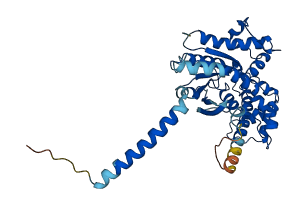
1 structures for P16052
| Entry ID | Method | Resolution | Chain | Position | Source |
|---|---|---|---|---|---|
| AF-P16052-F1 | Predicted | AlphaFoldDB |
No variants for P16052
| Variant ID(s) | Position | Change | Description | Diseaes Association | Provenance |
|---|---|---|---|---|---|
| No variants for P16052 | |||||
No associated diseases with P16052
No regional properties for P16052
| Type | Name | Position | InterPro Accession |
|---|---|---|---|
| No domain, repeats, and functional sites for P16052 | |||
1 GO annotations of cellular component
| Name | Definition |
|---|---|
| plasma membrane | The membrane surrounding a cell that separates the cell from its external environment. It consists of a phospholipid bilayer and associated proteins. |
5 GO annotations of molecular function
| Name | Definition |
|---|---|
| adenylate cyclase activator activity | Increases the activity of the enzyme that catalyzes the reaction: ATP = 3',5'-cyclic AMP + diphosphate. |
| G-protein beta/gamma-subunit complex binding | Binding to a complex of G-protein beta/gamma subunits. |
| GTP binding | Binding to GTP, guanosine triphosphate. |
| GTPase activity | Catalysis of the reaction: GTP + H2O = GDP + H+ + phosphate. |
| metal ion binding | Binding to a metal ion. |
4 GO annotations of biological process
| Name | Definition |
|---|---|
| adenylate cyclase-activating adrenergic receptor signaling pathway | An adenylate cyclase-activating G protein-coupled receptor signaling pathway initiated by a ligand binding to an adrenergic receptor on the surface of the target cell, and ending with the regulation of a downstream cellular process. |
| adenylate cyclase-activating G protein-coupled receptor signaling pathway | A G protein-coupled receptor signaling pathway in which the signal is transmitted via the activation of adenylyl cyclase activity and a subsequent increase in the intracellular concentration of cyclic AMP (cAMP). |
| positive regulation of cAMP-mediated signaling | Any process which activates, maintains or increases the frequency, rate or extent of cAMP-mediated signaling. |
| positive regulation of GTPase activity | Any process that activates or increases the activity of a GTPase. |
No homologous proteins in AiPD
| UniProt AC | Gene Name | Protein Name | Species | Evidence Code |
|---|---|---|---|---|
| No homologous proteins | ||||
| 10 | 20 | 30 | 40 | 50 | 60 |
| MGCLGDSKTE | DQRNEEKAQR | EANKKIEKQL | QKDKQVYRAT | HRLLLLGAGE | SGKSTIVKQM |
| 70 | 80 | 90 | 100 | 110 | 120 |
| RILHVNGFNG | EGGEEDPQAA | RSNSDGEKAT | KVQDIKNNLK | EAIETIVAAM | SNLVPPVELA |
| 130 | 140 | 150 | 160 | 170 | 180 |
| NPENQFRVDY | ILSVMNVPNF | DFPPEFYEHA | KALWEDEGVR | ACYERSNEYQ | LIDCAQYFLD |
| 190 | 200 | 210 | 220 | 230 | 240 |
| KIDVIKQADY | VPSDQDLLRC | RVLTSGIFET | KFQVDKVNFH | MFDVGGQRDE | RRKWIQCFND |
| 250 | 260 | 270 | 280 | 290 | 300 |
| VTAIIFVVAS | SSYNMVIRED | NQTNRLQEAL | NLFKSIWNNR | WLRTISVILF | LNKQDLLAEK |
| 310 | 320 | 330 | 340 | 350 | 360 |
| VLAGKSKIED | YFPEFARYTT | PEDATPEPGE | DPRVTRAKYF | IRDEFLRIST | ASGDGRHYCY |
| 370 | 380 | 390 | |||
| PHFTCAVDTE | NIRRVFNDCR | DIIQRMHLRQ | YELL |