P15691
Gene name |
VEGFA (VEGF) |
Protein name |
Vascular endothelial growth factor A |
Names |
VEGF-A, Vascular permeability factor, VPF |
Species |
Bos taurus (Bovine) |
KEGG Pathway |
bta:281572 |
EC number |
|
Protein Class |
|
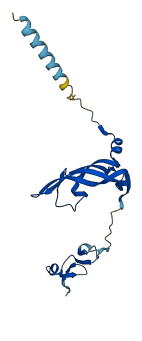
Descriptions
The autoinhibited protein was predicted that may have potential autoinhibitory elements via cis-regPred.
Autoinhibitory domains (AIDs)
Target domain |
|
Relief mechanism |
|
Assay |
cis-regPred |
Accessory elements
No accessory elements
Autoinhibited structure

Activated structure
1 structures for P15691
| Entry ID | Method | Resolution | Chain | Position | Source |
|---|---|---|---|---|---|
| AF-P15691-F1 | Predicted | AlphaFoldDB |
67 variants for P15691
| Variant ID(s) | Position | Change | Description | Diseaes Association | Provenance |
|---|---|---|---|---|---|
| rs469663585 | 24 | S>A | No | EVA | |
| rs445667018 | 24 | S>C | No | EVA | |
| rs477030299 | 25 | Q>P | No | EVA | |
| rs460281873 | 26 | A>D | No | EVA | |
| rs460281873 | 26 | A>G | No | EVA | |
| rs446523797 | 27 | A>S | No | EVA | |
| rs460988834 | 29 | M>I | No | EVA | |
| rs444150383 | 35 | K>I | No | EVA | |
| rs446524083 | 39 | V>G | No | EVA | |
| rs481121917 | 41 | K>N | No | EVA | |
| rs450615259 | 42 | F>L | No | EVA | |
| rs467550890 | 42 | F>L | No | EVA | |
| rs467550890 | 42 | F>V | No | EVA | |
| rs458821311 | 46 | Y>S | No | EVA | |
| rs446097074 | 47 | Q>H | No | EVA | |
| rs477377013 | 51 | C>F | No | EVA | |
| rs475086306 | 56 | T>A | No | EVA | |
| rs475086306 | 56 | T>P | No | EVA | |
| rs475086306 | 56 | T>S | No | EVA | |
| rs461556498 | 57 | L>M | No | EVA | |
| rs444618748 | 59 | D>H | No | EVA | |
| rs476141941 | 62 | Q>* | No | EVA | |
| rs432623303 | 63 | E>D | No | EVA | |
| rs452671317 | 63 | E>G | No | EVA | |
| rs472826096 | 64 | Y>D | No | EVA | |
| rs452748952 | 64 | Y>F | No | EVA | |
| rs472826096 | 64 | Y>N | No | EVA | |
| rs467485073 | 66 | D>V | No | EVA | |
| rs450636610 | 69 | E>K | No | EVA | |
| rs436974181 | 74 | P>L | No | EVA | |
| rs445176727 | 82 | C>S | No | EVA | |
| rs479667624 | 84 | G>V | No | EVA | |
| rs446831523 | 86 | C>S | No | EVA | |
| rs460540999 | 86 | C>S | No | EVA | |
| rs481615535 | 90 | S>G | No | EVA | |
| rs461439172 | 92 | E>K | No | EVA | |
| rs476072773 | 94 | V>G | No | EVA | |
| rs439068651 | 95 | P>L | No | EVA | |
| rs458947621 | 95 | P>T | No | EVA | |
| rs452835115 | 96 | T>A | No | EVA | |
| rs473942995 | 102 | T>P | No | EVA | |
| rs473942995 | 102 | T>S | No | EVA | |
| rs457001305 | 103 | M>L | No | EVA | |
| rs436849327 | 104 | Q>R | No | EVA | |
| rs457464198 | 113 | S>I | No | EVA | |
| rs474355522 | 115 | H>Q | No | EVA | |
| rs442929643 | 123 | Q>H | No | EVA | |
| rs453447008 | 124 | H>R | No | EVA | |
| rs473493889 | 129 | C>W | No | EVA | |
| rs440426786 | 140 | N>S | No | EVA | |
| rs442055841 | 142 | C>R | No | EVA | |
| rs384498513 | 143 | G>W | No | EVA | |
| rs478813572 | 171 | C>* | No | EVA | |
| rs462086557 | 171 | C>F | No | EVA | |
| rs447637645 | 175 | Q>P | No | EVA | |
| rs466690913 | 178 | L>V | No | EVA | |
| rs477375644 | 179 | N>D | No | EVA | |
| rs445949692 | 179 | N>S | No | EVA | |
| rs469117604 | 183 | C>R | No | EVA | |
| rs437800676 | 184 | R>G | No | EVA | |
| rs467360164 | 185 | C>G | No | EVA | |
| rs436153698 | 185 | C>W | No | EVA | |
| rs452885802 | 186 | D>A | No | EVA | |
| rs473114358 | 186 | D>E | No | EVA | |
| rs438363334 | 188 | P>A | No | EVA | |
| rs438363334 | 188 | P>T | No | EVA | |
| rs133889941 | 191 | R>G | No | EVA |
No associated diseases with P15691
2 GO annotations of cellular component
| Name | Definition |
|---|---|
| extracellular space | That part of a multicellular organism outside the cells proper, usually taken to be outside the plasma membranes, and occupied by fluid. |
| membrane | A lipid bilayer along with all the proteins and protein complexes embedded in it an attached to it. |
8 GO annotations of molecular function
| Name | Definition |
|---|---|
| chemoattractant activity | Providing the environmental signal that initiates the directed movement of a motile cell or organism towards a higher concentration of that signal. |
| cytokine activity | The activity of a soluble extracellular gene product that interacts with a receptor to effect a change in the activity of the receptor to control the survival, growth, differentiation and effector function of tissues and cells. |
| growth factor activity | The function that stimulates a cell to grow or proliferate. Most growth factors have other actions besides the induction of cell growth or proliferation. |
| heparin binding | Binding to heparin, a member of a group of glycosaminoglycans found mainly as an intracellular component of mast cells and which consist predominantly of alternating alpha-(1->4)-linked D-galactose and N-acetyl-D-glucosamine-6-sulfate residues. |
| protein homodimerization activity | Binding to an identical protein to form a homodimer. |
| vascular endothelial growth factor receptor 1 binding | Binding to a vascular endothelial growth factor receptor 1. |
| vascular endothelial growth factor receptor 2 binding | Binding to a vascular endothelial growth factor receptor 2. |
| vascular endothelial growth factor receptor binding | Binding to a vascular endothelial growth factor receptor. |
17 GO annotations of biological process
| Name | Definition |
|---|---|
| cellular response to hypoxia | Any process that results in a change in state or activity of a cell (in terms of movement, secretion, enzyme production, gene expression, etc.) as a result of a stimulus indicating lowered oxygen tension. Hypoxia, defined as a decline in O2 levels below normoxic levels of 20.8 - 20.95%, results in metabolic adaptation at both the cellular and organismal level. |
| induction of positive chemotaxis | Any process that initiates the directed movement of a motile cell or organism towards a higher concentration in a concentration gradient of a specific chemical. |
| motor neuron migration | The orderly movement of a motor neuron from one site to another. A motor neuron is an efferent neuron that passes from the central nervous system or a ganglion toward or to a muscle and conducts an impulse that causes movement. |
| positive regulation of angiogenesis | Any process that activates or increases angiogenesis. |
| positive regulation of cell division | Any process that activates or increases the frequency, rate or extent of cell division. |
| positive regulation of endothelial cell migration | Any process that increases the rate, frequency, or extent of the orderly movement of an endothelial cell into the extracellular matrix to form an endothelium. |
| positive regulation of endothelial cell proliferation | Any process that activates or increases the rate or extent of endothelial cell proliferation. |
| positive regulation of focal adhesion assembly | Any process that activates or increases the frequency, rate or extent of focal adhesion assembly, the establishment and maturation of focal adhesions. |
| positive regulation of mast cell chemotaxis | Any process that increases the rate, frequency or extent of mast cell chemotaxis. Mast cell chemotaxis is the movement of a mast cell in response to an external stimulus. |
| positive regulation of peptidyl-tyrosine phosphorylation | Any process that activates or increases the frequency, rate or extent of the phosphorylation of peptidyl-tyrosine. |
| positive regulation of protein phosphorylation | Any process that activates or increases the frequency, rate or extent of addition of phosphate groups to amino acids within a protein. |
| positive regulation of protein-containing complex assembly | Any process that activates or increases the frequency, rate or extent of protein complex assembly. |
| response to hypoxia | Any process that results in a change in state or activity of a cell or an organism (in terms of movement, secretion, enzyme production, gene expression, etc.) as a result of a stimulus indicating lowered oxygen tension. Hypoxia, defined as a decline in O2 levels below normoxic levels of 20.8 - 20.95%, results in metabolic adaptation at both the cellular and organismal level. |
| sprouting angiogenesis | The extension of new blood vessels from existing vessels into avascular tissues, this process includes the specialization of endothelial cells into leading tip and stalk cells, proliferation and migration of the endothelial cells and cell adhesion resulting in angiogenic sprout fusion or lumen formation. |
| tube formation | Creation of the central hole of a tube in an anatomical structure through which gases and/or liquids flow. |
| vascular endothelial growth factor receptor signaling pathway | The series of molecular signals initiated by a ligand binding to a vascular endothelial growth factor receptor (VEGFR) on the surface of the target cell, and ending with the regulation of a downstream cellular process, e.g. transcription. |
| vascular endothelial growth factor signaling pathway | The series of molecular signals initiated by vascular endothelial growth factor (VEGF) binding its receptor on the surface of the target cell, and ending with the regulation of a downstream cellular process, e.g. transcription. |
4 homologous proteins in AiPD
| UniProt AC | Gene Name | Protein Name | Species | Evidence Code |
|---|---|---|---|---|
| Q9GKR0 | VEGFA | Vascular endothelial growth factor A | Equus caballus (Horse) | PR |
| Q00731 | Vegfa | Vascular endothelial growth factor A | Mus musculus (Mouse) | PR |
| P49151 | VEGFA | Vascular endothelial growth factor A | Sus scrofa (Pig) | PR |
| P16612 | Vegfa | Vascular endothelial growth factor A | Rattus norvegicus (Rat) | PR |
| 10 | 20 | 30 | 40 | 50 | 60 |
| MNFLLSWVHW | SLALLLYLHH | AKWSQAAPMA | EGGQKPHEVV | KFMDVYQRSF | CRPIETLVDI |
| 70 | 80 | 90 | 100 | 110 | 120 |
| FQEYPDEIEF | IFKPSCVPLM | RCGGCCNDES | LECVPTEEFN | ITMQIMRIKP | HQSQHIGEMS |
| 130 | 140 | 150 | 160 | 170 | 180 |
| FLQHNKCECR | PKKDKARQEN | PCGPCSERRK | HLFVQDPQTC | KCSCKNTDSR | CKARQLELNE |
| RTCRCDKPRR |