P15479
Gene name |
|
Protein name |
Isocitrate lyase |
Names |
ICL, Isocitrase, Isocitratsysase |
Species |
Ricinus communis (Castor bean) |
KEGG Pathway |
rcu:8264280 |
EC number |
4.1.3.1: Oxo-acid-lyases |
Protein Class |
|
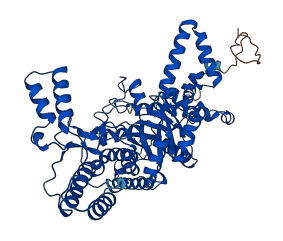
Descriptions
The autoinhibited protein was predicted that may have potential autoinhibitory elements via cis-regPred.
Autoinhibitory domains (AIDs)
Target domain |
|
Relief mechanism |
|
Assay |
cis-regPred |
Accessory elements
No accessory elements
Autoinhibited structure

Activated structure
1 structures for P15479
| Entry ID | Method | Resolution | Chain | Position | Source |
|---|---|---|---|---|---|
| AF-P15479-F1 | Predicted | AlphaFoldDB |
No variants for P15479
| Variant ID(s) | Position | Change | Description | Diseaes Association | Provenance |
|---|---|---|---|---|---|
| No variants for P15479 | |||||
No associated diseases with P15479
Functions
| Description | ||
|---|---|---|
| EC Number | 4.1.3.1 | Oxo-acid-lyases |
| Subcellular Localization |
|
|
| PANTHER Family | ||
| PANTHER Subfamily | ||
| PANTHER Protein Class | ||
| PANTHER Pathway Category | No pathway information available | |
1 GO annotations of cellular component
| Name | Definition |
|---|---|
| glyoxysome | A specialized form of peroxisome that contains the enzymes of the glyoxylate pathway. The glyoxysome is found in some plant cells, notably the cells of germinating seeds. |
2 GO annotations of molecular function
| Name | Definition |
|---|---|
| isocitrate lyase activity | Catalysis of the reaction: isocitrate = glyoxylate + succinate. |
| metal ion binding | Binding to a metal ion. |
2 GO annotations of biological process
| Name | Definition |
|---|---|
| glyoxylate cycle | A modification of the TCA cycle occurring in some plants and microorganisms, in which isocitrate is cleaved to glyoxylate and succinate. Glyoxylate can then react with acetyl-CoA to form malate. |
| tricarboxylic acid cycle | A nearly universal metabolic pathway in which the acetyl group of acetyl coenzyme A is effectively oxidized to two CO2 and four pairs of electrons are transferred to coenzymes. The acetyl group combines with oxaloacetate to form citrate, which undergoes successive transformations to isocitrate, 2-oxoglutarate, succinyl-CoA, succinate, fumarate, malate, and oxaloacetate again, thus completing the cycle. In eukaryotes the tricarboxylic acid is confined to the mitochondria. See also glyoxylate cycle. |
No homologous proteins in AiPD
| UniProt AC | Gene Name | Protein Name | Species | Evidence Code |
|---|---|---|---|---|
| No homologous proteins | ||||
| 10 | 20 | 30 | 40 | 50 | 60 |
| MAASFSGPSM | IMEEEGRFEA | EVAEVQAWWN | SERFKLTRRP | YTARDVVALR | GNLKQSYASN |
| 70 | 80 | 90 | 100 | 110 | 120 |
| ELAKKLWRTL | KTHQANGTAS | RTFGALDPVQ | VTMMAKHLDS | IYVSGWQCSS | THTTTNEPGP |
| 130 | 140 | 150 | 160 | 170 | 180 |
| DLADYPYDTV | PNKVEHLFFA | QQYHDRKQRE | ARMSMSREER | ARTPYVDYLK | PIIADGDTGF |
| 190 | 200 | 210 | 220 | 230 | 240 |
| GGTTATVKLC | KLFVERGAAG | VHIEDQSSVT | KKCGHMAGKV | LVAISEHINR | LVAARLQFDV |
| 250 | 260 | 270 | 280 | 290 | 300 |
| MGVETLLVAR | TDAEAANLIQ | SNVDTRDHQF | ILGVTNPNLR | GKSLATLLAT | GMANGKTGAE |
| 310 | 320 | 330 | 340 | 350 | 360 |
| LQATEDNWLA | MAQLKTFPEC | VMDAIKNMNA | GEDEKRRRMN | EWMNHTSYDK | CLSYEQGREI |
| 370 | 380 | 390 | 400 | 410 | 420 |
| ADRMGLKNLF | WDWDLPRTRE | GFYRFKGSVM | AAVVRGRAFA | PHADIIWMET | AKPDFAECTA |
| 430 | 440 | 450 | 460 | 470 | 480 |
| FAEGVKSMHP | EIMLAYNLSP | SFNWDASGMT | DEQMRDFIPR | IARLGFCWQF | ITLGGFHADA |
| 490 | 500 | 510 | 520 | 530 | 540 |
| LVIDTFAKDY | ARRGMLAYVE | RIQREERKNG | VDTLAHQKWS | GANYYDRYLK | TVQGGISSTA |
| 550 | 560 | 570 | |||
| AMGKGVTEEQ | FKETWTRPGA | MEMGSAGSEV | VAKARM |