P15258
Gene name |
ral2 (SPBC21.05c) |
Protein name |
Protein ral2 |
Names |
|
Species |
Schizosaccharomyces pombe (strain 972 / ATCC 24843) (Fission yeast) |
KEGG Pathway |
spo:SPBC21.05c |
EC number |
|
Protein Class |
|
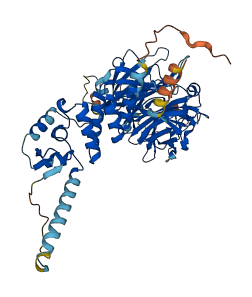
Descriptions
The autoinhibited protein was predicted that may have potential autoinhibitory elements via cis-regPred.
Autoinhibitory domains (AIDs)
Target domain |
|
Relief mechanism |
|
Assay |
cis-regPred |
Accessory elements
No accessory elements
Autoinhibited structure

Activated structure
1 structures for P15258
| Entry ID | Method | Resolution | Chain | Position | Source |
|---|---|---|---|---|---|
| AF-P15258-F1 | Predicted | AlphaFoldDB |
No variants for P15258
| Variant ID(s) | Position | Change | Description | Diseaes Association | Provenance |
|---|---|---|---|---|---|
| No variants for P15258 | |||||
No associated diseases with P15258
No regional properties for P15258
| Type | Name | Position | InterPro Accession |
|---|---|---|---|
| No domain, repeats, and functional sites for P15258 | |||
3 GO annotations of cellular component
| Name | Definition |
|---|---|
| cytosol | The part of the cytoplasm that does not contain organelles but which does contain other particulate matter, such as protein complexes. |
| endoplasmic reticulum | The irregular network of unit membranes, visible only by electron microscopy, that occurs in the cytoplasm of many eukaryotic cells. The membranes form a complex meshwork of tubular channels, which are often expanded into slitlike cavities called cisternae. The ER takes two forms, rough (or granular), with ribosomes adhering to the outer surface, and smooth (with no ribosomes attached). |
| mitochondrion | A semiautonomous, self replicating organelle that occurs in varying numbers, shapes, and sizes in the cytoplasm of virtually all eukaryotic cells. It is notably the site of tissue respiration. |
No GO annotations of molecular function
| Name | Definition |
|---|---|
| No GO annotations for molecular function |
3 GO annotations of biological process
| Name | Definition |
|---|---|
| cell redox homeostasis | Any process that maintains the redox environment of a cell or compartment within a cell. |
| regulation of conjugation with cellular fusion | Any process that modulates the rate or frequency of conjugation with cellular fusion. |
| signal transduction involved in positive regulation of conjugation with cellular fusion | The series of molecular signals that bring about the relay, amplification or dampening of a signal generated in response to a cue, such as starvation or pheromone exposure, in organisms that undergo conjugation with cellular fusion. |
No homologous proteins in AiPD
| UniProt AC | Gene Name | Protein Name | Species | Evidence Code |
|---|---|---|---|---|
| No homologous proteins | ||||
| 10 | 20 | 30 | 40 | 50 | 60 |
| MSEVKRNISL | RNSTNIFTST | FSLSSNNVPK | PLIGESVIKY | GDEAFVYGGR | DALNAQLVND |
| 70 | 80 | 90 | 100 | 110 | 120 |
| MYVVDLNTCS | WKQVEYQGNQ | KPIPRYFHSG | DLWNNKLIFF | GGMGFNDDTK | CLYVLNDIDI |
| 130 | 140 | 150 | 160 | 170 | 180 |
| YDIETKQWSH | IPGMITENQT | NDDAKEVNGS | DVDEKSKHLY | PSARYGHLHC | VLDHYLIIFC |
| 190 | 200 | 210 | 220 | 230 | 240 |
| GQDLSNSYIE | EINIFDLDSG | KWVFKSLFNH | HCGIYRSNCV | VINKDSEFLQ | MCRPINTTQD |
| 250 | 260 | 270 | 280 | 290 | 300 |
| SNEHSIGSLF | FYLNYNFVNV | KRQVIYLELF | ELDTAESEKK | SAALAKDNNQ | SFRFLELDVT |
| 310 | 320 | 330 | 340 | 350 | 360 |
| EKFLSSAMPP | GLRFPAVNIL | GDNLILSGIY | LTSSRQAFVL | WVYSLDKELW | LQLDMLGVLN |
| 370 | 380 | 390 | 400 | 410 | 420 |
| HGSWFKCLVL | DCTNRFVVFG | NKTRKLTQDY | NLRQSNYDHI | VFIELEGYGV | YRKPQMGRVT |
| 430 | 440 | 450 | 460 | 470 | 480 |
| ERSEQLGKLL | LNGISDMEIL | TIERMHIPCL | SRMLYKRWPA | FQKIMDRAVE | KNQEAFQAEV |
| 490 | 500 | 510 | 520 | 530 | 540 |
| SQLGPQLTDL | PFSSIHSTGS | RALYMPYSFE | TCSAFLHYIY | CGTLNGSYCT | AKNLCNLLIL |
| 550 | 560 | 570 | 580 | 590 | 600 |
| CKGFEGLETF | FAYIVHLLHG | VLNRNNVKLI | YETAALTGAK | GLQLRALRRI | ARIEQGGTAI |
| 610 | |||||
| SPTSPLPNLD | D |