P14519
Gene name |
SHMT2 |
Protein name |
Serine hydroxymethyltransferase, mitochondrial |
Names |
SHMT, Glycine hydroxymethyltransferase, Serine methylase |
Species |
Oryctolagus cuniculus (Rabbit) |
KEGG Pathway |
ocu:100009293 |
EC number |
2.1.2.1: Hydroxymethyl-, formyl- and related transferases |
Protein Class |
|
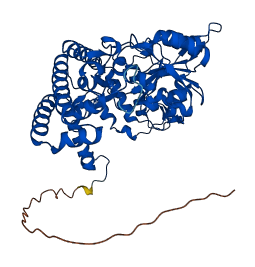
Descriptions
The autoinhibited protein was predicted that may have potential autoinhibitory elements via cis-regPred.
Autoinhibitory domains (AIDs)
Target domain |
|
Relief mechanism |
|
Assay |
cis-regPred |
Accessory elements
No accessory elements
Autoinhibited structure

Activated structure
1 structures for P14519
| Entry ID | Method | Resolution | Chain | Position | Source |
|---|---|---|---|---|---|
| AF-P14519-F1 | Predicted | AlphaFoldDB |
No variants for P14519
| Variant ID(s) | Position | Change | Description | Diseaes Association | Provenance |
|---|---|---|---|---|---|
| No variants for P14519 | |||||
No associated diseases with P14519
Functions
| Description | ||
|---|---|---|
| EC Number | 2.1.2.1 | Hydroxymethyl-, formyl- and related transferases |
| Subcellular Localization |
|
|
| PANTHER Family | ||
| PANTHER Subfamily | ||
| PANTHER Protein Class | ||
| PANTHER Pathway Category | No pathway information available | |
7 GO annotations of cellular component
| Name | Definition |
|---|---|
| BRISC complex | A protein complex that contains the FAM175B/ABRO1, BRCC3/BRCC36, BRE/BRCC45 and MERIT40/NBA1 proteins, and specifically cleaves K63-linked polyubiquitin chains. |
| cytoplasm | The contents of a cell excluding the plasma membrane and nucleus, but including other subcellular structures. |
| mitochondrial inner membrane | The inner, i.e. lumen-facing, lipid bilayer of the mitochondrial envelope. It is highly folded to form cristae. |
| mitochondrial matrix | The gel-like material, with considerable fine structure, that lies in the matrix space, or lumen, of a mitochondrion. It contains the enzymes of the tricarboxylic acid cycle and, in some organisms, the enzymes concerned with fatty acid oxidation. |
| mitochondrial nucleoid | The region of a mitochondrion to which the DNA is confined. |
| mitochondrion | A semiautonomous, self replicating organelle that occurs in varying numbers, shapes, and sizes in the cytoplasm of virtually all eukaryotic cells. It is notably the site of tissue respiration. |
| nucleus | A membrane-bounded organelle of eukaryotic cells in which chromosomes are housed and replicated. In most cells, the nucleus contains all of the cell's chromosomes except the organellar chromosomes, and is the site of RNA synthesis and processing. In some species, or in specialized cell types, RNA metabolism or DNA replication may be absent. |
3 GO annotations of molecular function
| Name | Definition |
|---|---|
| chromatin binding | Binding to chromatin, the network of fibers of DNA, protein, and sometimes RNA, that make up the chromosomes of the eukaryotic nucleus during interphase. |
| glycine hydroxymethyltransferase activity | Catalysis of the reaction: 5,10-methylenetetrahydrofolate + glycine + H2O = tetrahydrofolate + L-serine. |
| pyridoxal phosphate binding | Binding to pyridoxal 5' phosphate, 3-hydroxy-5-(hydroxymethyl)-2-methyl4-pyridine carboxaldehyde 5' phosphate, the biologically active form of vitamin B6. |
13 GO annotations of biological process
| Name | Definition |
|---|---|
| glycine biosynthetic process from serine | The chemical reactions and pathways resulting in the formation of glycine from other compounds, including serine. |
| glycine metabolic process | The chemical reactions and pathways involving glycine, aminoethanoic acid. |
| L-serine metabolic process | The chemical reactions and pathways involving L-serine, the L-enantiomer of serine, i.e. (2S)-2-amino-3-hydroxypropanoic acid. |
| one-carbon metabolic process | The chemical reactions and pathways involving the transfer of one-carbon units in various oxidation states. |
| protein homotetramerization | The formation of a protein homotetramer, a macromolecular structure consisting of four noncovalently associated identical subunits. |
| protein K63-linked deubiquitination | A protein deubiquitination process in which a K63-linked ubiquitin chain, i.e. a polymer of ubiquitin formed by linkages between lysine residues at position 63 of the ubiquitin monomers, is removed from a protein. |
| protein tetramerization | The formation of a protein tetramer, a macromolecular structure consisting of four noncovalently associated identical or nonidentical subunits. |
| regulation of aerobic respiration | Any process that modulates the frequency, rate or extent of aerobic respiration. |
| regulation of mitochondrial translation | Any process that modulates the frequency, rate or extent of the chemical reactions and pathways resulting in the formation of proteins by the translation of mRNA in a mitochondrion. |
| regulation of oxidative phosphorylation | Any process that modulates the frequency, rate or extent of the chemical reactions and pathways resulting in the phosphorylation of ADP to ATP that accompanies the oxidation of a metabolite through the operation of the respiratory chain. Oxidation of compounds establishes a proton gradient across the membrane, providing the energy for ATP synthesis. |
| response to type I interferon | Any process that results in a change in state or activity of a cell or an organism (in terms of movement, secretion, enzyme production, gene expression, etc.) as a result of a type I interferon stimulus. Type I interferons include the interferon-alpha, beta, delta, episilon, zeta, kappa, tau, and omega gene families. |
| tetrahydrofolate interconversion | The chemical reactions and pathways by which one-carbon (C1) units are transferred between tetrahydrofolate molecules, to synthesise other tetrahydrofolate molecules. |
| tetrahydrofolate metabolic process | The chemical reactions and pathways involving tetrahydrofolate, 5,6,7,8-tetrahydrofolic acid, a folate derivative bearing additional hydrogens on the pterin group. |
No homologous proteins in AiPD
| UniProt AC | Gene Name | Protein Name | Species | Evidence Code |
|---|---|---|---|---|
| No homologous proteins | ||||
| 10 | 20 | 30 | 40 | 50 | 60 |
| MLPFSLLWAV | RPLQRCGPLV | RTAVRAQHGK | AAQTQTGEAS | RGWTGQESLS | DTDPEMWELL |
| 70 | 80 | 90 | 100 | 110 | 120 |
| QREKDRQCRG | LELIASENFC | IRAALEALGS | CLNNKYSEGY | PGKRYYGGAE | VVDEIELLCQ |
| 130 | 140 | 150 | 160 | 170 | 180 |
| RRALEAFDLD | PAQWGVNVQP | YSGSPANLAA | YTALLQPHDR | IMGLDLPDGG | HLTHGYMSDV |
| 190 | 200 | 210 | 220 | 230 | 240 |
| KRVSATSIFF | ESMPYKLNPQ | TGLIDYEQLA | LTARLFRPRL | IIAGTSAYAR | LIDYARMREV |
| 250 | 260 | 270 | 280 | 290 | 300 |
| CDEVKAHLLA | DMAHISGLVA | AKVIPSPFKH | ADVVTTTTHK | TLRGARSGLI | FYRKGVRTVD |
| 310 | 320 | 330 | 340 | 350 | 360 |
| PKTGQEIPYT | FEDRINFAVF | PSLQGGPHNH | AIAAVAVALK | QACTPMFREY | SLQVLKNARA |
| 370 | 380 | 390 | 400 | 410 | 420 |
| MADALLERGY | SLVSGGTDNH | LVLVDLRPKG | LDGARAERVL | ELVSITANKN | TCPGDRSAIT |
| 430 | 440 | 450 | 460 | 470 | 480 |
| PGGLRLGAPA | LTSRQFREDD | FRRVVDFIDE | GVNIGLEVKR | KTAKLQDFKS | FLLKDPETSQ |
| 490 | 500 | ||||
| HLADLRRRVQ | QFARAFPMPG | FPEH |