P13528
Gene name |
unc-86 (C30A5.7) |
Protein name |
Transcription factor unc-86 |
Names |
Uncoordinated protein 86 |
Species |
Caenorhabditis elegans |
KEGG Pathway |
cel:CELE_C30A5.7 |
EC number |
|
Protein Class |
|
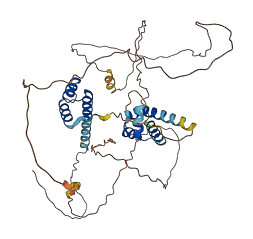
Descriptions
The autoinhibited protein was predicted that may have potential autoinhibitory elements via cis-regPred.
Autoinhibitory domains (AIDs)
Target domain |
|
Relief mechanism |
|
Assay |
cis-regPred |
Accessory elements
No accessory elements
Autoinhibited structure

Activated structure
1 structures for P13528
| Entry ID | Method | Resolution | Chain | Position | Source |
|---|---|---|---|---|---|
| AF-P13528-F1 | Predicted | AlphaFoldDB |
No variants for P13528
| Variant ID(s) | Position | Change | Description | Diseaes Association | Provenance |
|---|---|---|---|---|---|
| No variants for P13528 | |||||
No associated diseases with P13528
No regional properties for P13528
| Type | Name | Position | InterPro Accession |
|---|---|---|---|
| No domain, repeats, and functional sites for P13528 | |||
2 GO annotations of cellular component
| Name | Definition |
|---|---|
| nucleus | A membrane-bounded organelle of eukaryotic cells in which chromosomes are housed and replicated. In most cells, the nucleus contains all of the cell's chromosomes except the organellar chromosomes, and is the site of RNA synthesis and processing. In some species, or in specialized cell types, RNA metabolism or DNA replication may be absent. |
| RNA polymerase II transcription regulator complex | A transcription factor complex that acts at a regulatory region of a gene transcribed by RNA polymerase II. |
5 GO annotations of molecular function
| Name | Definition |
|---|---|
| DNA-binding transcription factor activity, RNA polymerase II-specific | A DNA-binding transcription factor activity that modulates the transcription of specific gene sets transcribed by RNA polymerase II. |
| RNA polymerase II cis-regulatory region sequence-specific DNA binding | Binding to a specific upstream regulatory DNA sequence (transcription factor recognition sequence or binding site) located in cis relative to the transcription start site (i.e., on the same strand of DNA) of a gene transcribed by RNA polymerase II. |
| RNA polymerase II transcription regulatory region sequence-specific DNA binding | Binding to a specific sequence of DNA that is part of a regulatory region that controls the transcription of a gene or cistron by RNA polymerase II. |
| sequence-specific DNA binding | Binding to DNA of a specific nucleotide composition, e.g. GC-rich DNA binding, or with a specific sequence motif or type of DNA e.g. promotor binding or rDNA binding. |
| transcription factor binding | Binding to a transcription factor, a protein required to initiate or regulate transcription. |
7 GO annotations of biological process
| Name | Definition |
|---|---|
| mechanosensory behavior | Behavior that is dependent upon the sensation of a mechanical stimulus. |
| neuron development | The process whose specific outcome is the progression of a neuron over time, from initial commitment of the cell to a specific fate, to the fully functional differentiated cell. |
| neuron fate specification | The process in which a cell becomes capable of differentiating autonomously into a neuron in an environment that is neutral with respect to the developmental pathway. Upon specification, the cell fate can be reversed. |
| positive regulation of transcription by RNA polymerase II | Any process that activates or increases the frequency, rate or extent of transcription from an RNA polymerase II promoter. |
| regulation of transcription by RNA polymerase II | Any process that modulates the frequency, rate or extent of transcription mediated by RNA polymerase II. |
| response to mechanical stimulus | Any process that results in a change in state or activity of a cell or an organism (in terms of movement, secretion, enzyme production, gene expression, etc.) as a result of a mechanical stimulus. |
| sensory perception of smell | The series of events required for an organism to receive an olfactory stimulus, convert it to a molecular signal, and recognize and characterize the signal. Olfaction involves the detection of chemical composition of an organism's ambient medium by chemoreceptors. This is a neurological process. |
No homologous proteins in AiPD
| UniProt AC | Gene Name | Protein Name | Species | Evidence Code |
|---|---|---|---|---|
| No homologous proteins | ||||
| 10 | 20 | 30 | 40 | 50 | 60 |
| MQNTAPVPTT | TTASKMQPFN | NSLFGSFDDP | ILNARAAQVA | LADIDVKNVP | QLTNPLMRPH |
| 70 | 80 | 90 | 100 | 110 | 120 |
| DMFSYSNYFS | GIHDTSAATN | IYQGLPSSSE | PFDASVVVPT | SSDDQMTPLQ | QVMAMQQSYG |
| 130 | 140 | 150 | 160 | 170 | 180 |
| APPPFQYNMT | HPFSTTSIAS | SNNLARYPIA | PPTSDMDTDP | RQLETFAEHF | KQRRIKLGVT |
| 190 | 200 | 210 | 220 | 230 | 240 |
| QADVGKALAH | LKMPGVGSLS | QSTICRFESL | TLSHNNMVAL | KPILHSWLEK | AEEAMKQKDT |
| 250 | 260 | 270 | 280 | 290 | 300 |
| IGDINGILPN | TDKKRKRTSI | AAPEKRELEQ | FFKQQPRPSG | ERIASIADRL | DLKKNVVRVW |
| 310 | 320 | 330 | 340 | 350 | |
| FCNQRQKQKR | DFRSQFRARS | AAAVMGPRVM | PVLNGNNSNN | NLKQGQTTYN | GLPGFFD |