P12611
Gene name |
WHI2 (YOR043W) |
Protein name |
Growth regulation protein |
Names |
|
Species |
Saccharomyces cerevisiae (strain ATCC 204508 / S288c) (Baker's yeast) |
KEGG Pathway |
sce:YOR043W |
EC number |
|
Protein Class |
|
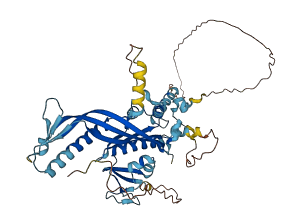
Descriptions
The autoinhibited protein was predicted that may have potential autoinhibitory elements via cis-regPred.
Autoinhibitory domains (AIDs)
Target domain |
|
Relief mechanism |
|
Assay |
cis-regPred |
Accessory elements
No accessory elements
Autoinhibited structure

Activated structure
1 structures for P12611
| Entry ID | Method | Resolution | Chain | Position | Source |
|---|---|---|---|---|---|
| AF-P12611-F1 | Predicted | AlphaFoldDB |
13 variants for P12611
| Variant ID(s) | Position | Change | Description | Diseaes Association | Provenance |
|---|---|---|---|---|---|
| s15-410873 | 2 | D>N | No | SGRP | |
| s15-410960 | 31 | E>K | No | SGRP | |
| s15-411026 | 53 | I>V | No | SGRP | |
| s15-411119 | 84 | T>A | No | SGRP | |
| s15-411561 | 231 | Q>L | No | SGRP | |
| s15-411579 | 237 | G>E | No | SGRP | |
| s15-411585 | 239 | N>T | No | SGRP | |
| s15-411606 | 246 | S>F | No | SGRP | |
| s15-411735 | 289 | S>F | No | SGRP | |
| s15-411900 | 344 | T>N | No | SGRP | |
| s15-411906 | 346 | S>F | No | SGRP | |
| s15-411948 | 360 | T>I | No | SGRP | |
| s15-411947 | 360 | T>S | No | SGRP |
No associated diseases with P12611
No regional properties for P12611
| Type | Name | Position | InterPro Accession |
|---|---|---|---|
| No domain, repeats, and functional sites for P12611 | |||
3 GO annotations of cellular component
| Name | Definition |
|---|---|
| cell periphery | The part of a cell encompassing the cell cortex, the plasma membrane, and any external encapsulating structures. |
| nucleus | A membrane-bounded organelle of eukaryotic cells in which chromosomes are housed and replicated. In most cells, the nucleus contains all of the cell's chromosomes except the organellar chromosomes, and is the site of RNA synthesis and processing. In some species, or in specialized cell types, RNA metabolism or DNA replication may be absent. |
| phosphatase complex | A protein complex which is capable of phosphatase activity. |
2 GO annotations of molecular function
| Name | Definition |
|---|---|
| protein phosphatase binding | Binding to a protein phosphatase. |
| RNA binding | Binding to an RNA molecule or a portion thereof. |
12 GO annotations of biological process
| Name | Definition |
|---|---|
| actin filament organization | A process that is carried out at the cellular level which results in the assembly, arrangement of constituent parts, or disassembly of cytoskeletal structures comprising actin filaments. Includes processes that control the spatial distribution of actin filaments, such as organizing filaments into meshworks, bundles, or other structures, as by cross-linking. |
| autophagy of mitochondrion | The autophagic process in which mitochondria are delivered to a type of vacuole and degraded in response to changing cellular conditions. |
| cell cycle | The progression of biochemical and morphological phases and events that occur in a cell during successive cell replication or nuclear replication events. Canonically, the cell cycle comprises the replication and segregation of genetic material followed by the division of the cell, but in endocycles or syncytial cells nuclear replication or nuclear division may not be followed by cell division. |
| endocytosis | A vesicle-mediated transport process in which cells take up external materials or membrane constituents by the invagination of a small region of the plasma membrane to form a new membrane-bounded vesicle. |
| negative regulation of TORC1 signaling | Any process that stops, prevents or reduces the frequency, rate or extent of TORC1 signaling. |
| positive regulation of G1 to G0 transition | Any process that activates or increases the frequency, rate or extent of G1 to G0 transition. |
| positive regulation of gene expression | Any process that increases the frequency, rate or extent of gene expression. Gene expression is the process in which a gene's coding sequence is converted into a mature gene product (protein or RNA). |
| positive regulation of transcription from RNA polymerase II promoter in response to heat stress | Any process that increases the frequency, rate or extent of transcription from an RNA polymerase II promoter as a result of a heat stimulus, a temperature stimulus above the optimal temperature for that organism. |
| protein dephosphorylation | The process of removing one or more phosphoric residues from a protein. |
| response to heat | Any process that results in a change in state or activity of a cell or an organism (in terms of movement, secretion, enzyme production, gene expression, etc.) as a result of a heat stimulus, a temperature stimulus above the optimal temperature for that organism. |
| response to hydrogen peroxide | Any process that results in a change in state or activity of a cell or an organism (in terms of movement, secretion, enzyme production, gene expression, etc.) as a result of a hydrogen peroxide (H2O2) stimulus. |
| response to salt stress | Any process that results in a change in state or activity of a cell or an organism (in terms of movement, secretion, enzyme production, gene expression, etc.) as a result of a stimulus indicating an increase or decrease in the concentration of salt (particularly but not exclusively sodium and chloride ions) in the environment. |
No homologous proteins in AiPD
| UniProt AC | Gene Name | Protein Name | Species | Evidence Code |
|---|---|---|---|---|
| No homologous proteins | ||||
| 10 | 20 | 30 | 40 | 50 | 60 |
| MDDIITQVSP | DNAESAPILQ | EQQQQQNSQY | EGNEEDYGDS | LIHLNIQENH | YFITRDQLMS |
| 70 | 80 | 90 | 100 | 110 | 120 |
| LPESLLLCLF | PSGVFLDRCG | QVITNLTRDD | EVYIVNFPPD | CFEYIMEIYT | KAHDDLYNHP |
| 130 | 140 | 150 | 160 | 170 | 180 |
| VEKFFDRPSS | SFVSNAKGFF | GLSSNNSISS | NNEQDILHQK | PAIIVLREDL | DYYCVPQEEF |
| 190 | 200 | 210 | 220 | 230 | 240 |
| QFDSTNEENN | EDLLRHFMAQ | VKMAAGSYLT | SKTSIFQGLY | SSNRLKQQQQ | QQKIEKGSNS |
| 250 | 260 | 270 | 280 | 290 | 300 |
| SSNTKSTSKK | LGPAEQHLMD | MLCSSGFTKE | TCWGNRTQET | GKTVISSLSL | CRLANETTEG |
| 310 | 320 | 330 | 340 | 350 | 360 |
| FRQKFNEAKA | KWEAEHKPSQ | DNFITPMQSN | ISINSLSASK | SNSTISTARN | LTSGSTAPAT |
| 370 | 380 | 390 | 400 | 410 | 420 |
| ARDKRKSRLS | KLADNVRSHS | SSRHSSQTRS | KPPELPKLYD | LVPKPNINAK | LLLFWRKPAR |
| 430 | 440 | 450 | 460 | 470 | 480 |
| KCWWGEEDIE | LEVEVFGSWK | DESKKIIELI | LPTNVDPEAE | LHKIIVPVRL | HIRRVWTLEL |
| SVIGVQ |