P12345
Gene name |
GOT2 |
Protein name |
Aspartate aminotransferase, mitochondrial |
Names |
mAspAT, Fatty acid-binding protein, FABP-1, Glutamate oxaloacetate transaminase 2, Kynurenine aminotransferase 4, Kynurenine aminotransferase IV, Kynurenine--oxoglutarate transaminase 4, Kynurenine--oxoglutarate transaminase IV, Plasma membrane-associated fatty acid-binding protein, FABPpm, Transaminase A |
Species |
Oryctolagus cuniculus (Rabbit) |
KEGG Pathway |
ocu:100348732 |
EC number |
2.6.1.1: Transaminases |
Protein Class |
|
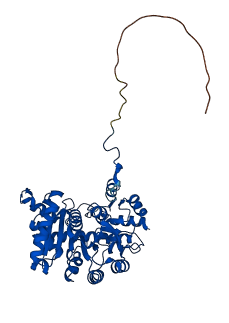
Descriptions
The autoinhibited protein was predicted that may have potential autoinhibitory elements via cis-regPred.
Autoinhibitory domains (AIDs)
Target domain |
|
Relief mechanism |
|
Assay |
cis-regPred |
Accessory elements
No accessory elements
Autoinhibited structure

Activated structure
1 structures for P12345
| Entry ID | Method | Resolution | Chain | Position | Source |
|---|---|---|---|---|---|
| AF-P12345-F1 | Predicted | AlphaFoldDB |
No variants for P12345
| Variant ID(s) | Position | Change | Description | Diseaes Association | Provenance |
|---|---|---|---|---|---|
| No variants for P12345 | |||||
No associated diseases with P12345
Functions
| Description | ||
|---|---|---|
| EC Number | 2.6.1.1 | Transaminases |
| Subcellular Localization |
|
|
| PANTHER Family | ||
| PANTHER Subfamily | ||
| PANTHER Protein Class | ||
| PANTHER Pathway Category | No pathway information available | |
3 GO annotations of cellular component
| Name | Definition |
|---|---|
| mitochondrial matrix | The gel-like material, with considerable fine structure, that lies in the matrix space, or lumen, of a mitochondrion. It contains the enzymes of the tricarboxylic acid cycle and, in some organisms, the enzymes concerned with fatty acid oxidation. |
| mitochondrion | A semiautonomous, self replicating organelle that occurs in varying numbers, shapes, and sizes in the cytoplasm of virtually all eukaryotic cells. It is notably the site of tissue respiration. |
| plasma membrane | The membrane surrounding a cell that separates the cell from its external environment. It consists of a phospholipid bilayer and associated proteins. |
3 GO annotations of molecular function
| Name | Definition |
|---|---|
| kynurenine-oxoglutarate transaminase activity | Catalysis of the reaction: L-kynurenine + 2-oxoglutarate = 4-(2-aminophenyl)-2,4-dioxobutanoate + L-glutamate. |
| L-aspartate:2-oxoglutarate aminotransferase activity | Catalysis of the reaction: L-aspartate + 2-oxoglutarate = oxaloacetate + L-glutamate. |
| pyridoxal phosphate binding | Binding to pyridoxal 5' phosphate, 3-hydroxy-5-(hydroxymethyl)-2-methyl4-pyridine carboxaldehyde 5' phosphate, the biologically active form of vitamin B6. |
6 GO annotations of biological process
| Name | Definition |
|---|---|
| 2-oxoglutarate metabolic process | The chemical reactions and pathways involving oxoglutarate, the dianion of 2-oxoglutaric acid. It is a key constituent of the TCA cycle and a key intermediate in amino-acid metabolism. |
| aspartate metabolic process | The chemical reactions and pathways involving aspartate, the anion derived from aspartic acid, 2-aminobutanedioic acid. |
| biosynthetic process | The chemical reactions and pathways resulting in the formation of substances; typically the energy-requiring part of metabolism in which simpler substances are transformed into more complex ones. |
| glutamate metabolic process | The chemical reactions and pathways involving glutamate, the anion of 2-aminopentanedioic acid. |
| lipid transport | The directed movement of lipids into, out of or within a cell, or between cells, by means of some agent such as a transporter or pore. Lipids are compounds soluble in an organic solvent but not, or sparingly, in an aqueous solvent. |
| protein folding | The process of assisting in the covalent and noncovalent assembly of single chain polypeptides or multisubunit complexes into the correct tertiary structure. |
No homologous proteins in AiPD
| UniProt AC | Gene Name | Protein Name | Species | Evidence Code |
|---|---|---|---|---|
| No homologous proteins | ||||
| 10 | 20 | 30 | 40 | 50 | 60 |
| MALLHSARVL | SGVASAFHPG | LAAAASARAS | SWWAHVEMGP | PDPILGVTEA | YKRDTNSKKM |
| 70 | 80 | 90 | 100 | 110 | 120 |
| NLGVGAYRDD | NGKPYVLPSV | RKAEAQIAAK | GLDKEYLPIG | GLAEFCRASA | ELALGENSEV |
| 130 | 140 | 150 | 160 | 170 | 180 |
| VKSGRFVTVQ | TISGTGALRI | GASFLQRFFK | FSRDVFLPKP | SWGNHTPIFR | DAGMQLQSYR |
| 190 | 200 | 210 | 220 | 230 | 240 |
| YYDPKTCGFD | FTGALEDISK | IPEQSVLLLH | ACAHNPTGVD | PRPEQWKEIA | TVVKKRNLFA |
| 250 | 260 | 270 | 280 | 290 | 300 |
| FFDMAYQGFA | SGDGDKDAWA | VRHFIEQGIN | VCLCQSYAKN | MGLYGERVGA | FTVICKDADE |
| 310 | 320 | 330 | 340 | 350 | 360 |
| AKRVESQLKI | LIRPMYSNPP | IHGARIASTI | LTSPDLRKQW | LQEVKGMADR | IIGMRTQLVS |
| 370 | 380 | 390 | 400 | 410 | 420 |
| NLKKEGSTHS | WQHITDQIGM | FCFTGLKPEQ | VERLTKEFSI | YMTKDGRISV | AGVTSGNVGY |
| LAHAIHQVTK |