P12019
Gene name |
pdsA (pde1, pdeA, DDB_G0285995) |
Protein name |
cAMP/cGMP-dependent 3',5'-cAMP/cGMP phosphodiesterase A |
Names |
CD179 antigen-like family member A, Protein VPreB1, V(pre)B protein, VpreB protein, PDEase A, 3',5'-cyclic-nucleotide phosphodiesterase, 3':5'-CNP, Phosphodiesterase 1, DdPDE1, cAMP/cGMP-dependent 3',5'-cAMP/cGMP phosphodiesterase 1 |
Species |
Dictyostelium discoideum (Slime mold) |
KEGG Pathway |
ddi:DDB_G0285995 |
EC number |
3.1.4.35: Phosphoric diester hydrolases |
Protein Class |
|
Descriptions
The autoinhibited protein was predicted that may have potential autoinhibitory elements via cis-regPred.
Autoinhibitory domains (AIDs)
Target domain |
|
Relief mechanism |
|
Assay |
cis-regPred |
Accessory elements
No accessory elements
Autoinhibited structure

Activated structure
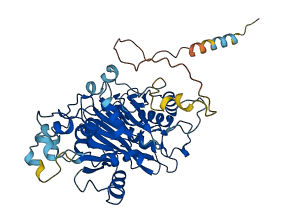
1 structures for P12019
| Entry ID | Method | Resolution | Chain | Position | Source |
|---|---|---|---|---|---|
| AF-P12019-F1 | Predicted | AlphaFoldDB |
No variants for P12019
| Variant ID(s) | Position | Change | Description | Diseaes Association | Provenance |
|---|---|---|---|---|---|
| No variants for P12019 | |||||
No associated diseases with P12019
1 regional properties for P12019
| Type | Name | Position | InterPro Accession |
|---|---|---|---|
| conserved_site | Cyclic-AMP phosphodiesterase class-II, conserved site | 170 - 184 | IPR024225 |
Functions
| Description | ||
|---|---|---|
| EC Number | 3.1.4.35 | Phosphoric diester hydrolases |
| Subcellular Localization |
|
|
| PANTHER Family | ||
| PANTHER Subfamily | ||
| PANTHER Protein Class | ||
| PANTHER Pathway Category | No pathway information available | |
5 GO annotations of cellular component
| Name | Definition |
|---|---|
| cell surface | The external part of the cell wall and/or plasma membrane. |
| endoplasmic reticulum | The irregular network of unit membranes, visible only by electron microscopy, that occurs in the cytoplasm of many eukaryotic cells. The membranes form a complex meshwork of tubular channels, which are often expanded into slitlike cavities called cisternae. The ER takes two forms, rough (or granular), with ribosomes adhering to the outer surface, and smooth (with no ribosomes attached). |
| extracellular region | The space external to the outermost structure of a cell. For cells without external protective or external encapsulating structures this refers to space outside of the plasma membrane. This term covers the host cell environment outside an intracellular parasite. |
| extracellular space | That part of a multicellular organism outside the cells proper, usually taken to be outside the plasma membranes, and occupied by fluid. |
| plasma membrane | The membrane surrounding a cell that separates the cell from its external environment. It consists of a phospholipid bilayer and associated proteins. |
5 GO annotations of molecular function
| Name | Definition |
|---|---|
| 3',5'-cyclic-AMP phosphodiesterase activity | Catalysis of the reaction: 3',5'-cyclic AMP + H2O = AMP + H+. |
| 3',5'-cyclic-GMP phosphodiesterase activity | Catalysis of the reaction: 3',5'-cyclic GMP + H2O = GMP + H+. |
| 3',5'-cyclic-nucleotide phosphodiesterase activity | Catalysis of the reaction: a nucleoside 3',5'-cyclic phosphate + H2O = a nucleoside 5'-phosphate. |
| cAMP binding | Binding to cAMP, the nucleotide cyclic AMP (adenosine 3',5'-cyclophosphate). |
| cGMP binding | Binding to cGMP, the nucleotide cyclic GMP (guanosine 3',5'-cyclophosphate). |
11 GO annotations of biological process
| Name | Definition |
|---|---|
| adenylate cyclase-inhibiting G protein-coupled receptor signaling pathway | A G protein-coupled receptor signaling pathway in which the signal is transmitted via the inhibition of adenylyl cyclase activity and a subsequent decrease in the intracellular concentration of cyclic AMP (cAMP). |
| aggregation involved in sorocarp development | The process whose specific outcome is the progression of the aggregate over time, from its formation to the point when a slug is formed. Aggregate development begins in response to starvation and continues by the chemoattractant-mediated movement of cells toward each other. The aggregate is a multicellular structure that gives rise to the slug. |
| cAMP catabolic process | The chemical reactions and pathways resulting in the breakdown of the nucleotide cAMP (cyclic AMP, adenosine 3',5'-cyclophosphate). |
| cGMP catabolic process | The chemical reactions and pathways resulting in the breakdown of cyclic GMP, guanosine 3',5'-phosphate. |
| extracellular regulation of signal transduction | Any regulation of signal transduction that takes place in the extracellular region. |
| negative regulation of glucose mediated signaling pathway | Any process that stops, prevents or reduces the frequency, rate or extent of glucose mediated signaling pathway. |
| response to cAMP | Any process that results in a change in state or activity of a cell or an organism (in terms of movement, secretion, enzyme production, gene expression, etc.) as a result of a cAMP (cyclic AMP, adenosine 3',5'-cyclophosphate) stimulus. |
| response to catechin | Any process that results in a change in state or activity of a cell or an organism (in terms of movement, secretion, enzyme production, gene expression, etc.) as a result of a catechin stimulus. |
| response to differentiation-inducing factor 1 | Any process that results in a change in state or activity of a cell or an organism (in terms of movement, secretion, enzyme production, gene expression, etc.) as a result of a 1-(3,5-dichloro-2,6-dihydroxy-4-methoxyphenyl)hexan-1-one stimulus. |
| response to dithiothreitol | Any process that results in a change in state or activity of a cell or an organism (in terms of movement, secretion, enzyme production, gene expression, etc.) as a result of a dithiothreitol stimulus. |
| slug development involved in sorocarp development | The process whose specific outcome is the progression of the slug over time, from its formation to the mature structure. Slug development begins when the aggregate rises upwards to form a finger-shaped structure and ends when culmination begins. Slug development begins after aggregation and ends before culmination in sorocarp development. |
No homologous proteins in AiPD
| UniProt AC | Gene Name | Protein Name | Species | Evidence Code |
|---|---|---|---|---|
| No homologous proteins | ||||
| 10 | 20 | 30 | 40 | 50 | 60 |
| MALNKKLISL | LLLIFIILNI | VNSHQQEDCD | DDDEDIGISA | ERSERRSVKN | SNDGSNFYNL |
| 70 | 80 | 90 | 100 | 110 | 120 |
| NDYYTPENWN | YYSGSFATKD | CRDASYITIP | LGTTGGLDEG | NLSSFLLTKK | GSNLFIALDA |
| 130 | 140 | 150 | 160 | 170 | 180 |
| GTVWQGVRRL | TTFKYFNTLF | NITYPSWAVL | PEQRTSWFLK | NHVMSYFIGH | SHLDHVGGLI |
| 190 | 200 | 210 | 220 | 230 | 240 |
| LVSPEDYLAK | NWIDVQPPIN | NGIMGLIRKL | GFKPTDFTSS | SILQKKTIMG | LPSTINSIST |
| 250 | 260 | 270 | 280 | 290 | 300 |
| NLFNNQVWPN | LPSFGRYQYF | SLASGIEYPF | TELVPYNATT | MSLVANEFPF | SVKVKPFELC |
| 310 | 320 | 330 | 340 | 350 | 360 |
| HDNLISTSFL | FTDSISGEQI | AFFSDTGVPS | SVACDWEGKI | YAVWKQIKID | KLKAIYIETS |
| 370 | 380 | 390 | 400 | 410 | 420 |
| FPNNTPDSAM | FGHLRPRDVM | KLMDQLLVQS | IQTSPPMTNL | KHVKLIIEHI | KPQVAEDPNG |
| 430 | 440 | 450 | |||
| WTTQRVIYQQ | LKEANNNGVR | IIIPNQGDPI | CI |