P11434
Gene name |
epb41 |
Protein name |
Protein 4.1 |
Names |
Band 4.1, Erythrocyte membrane protein band 4.1 |
Species |
Xenopus laevis (African clawed frog) |
KEGG Pathway |
xla:397741 |
EC number |
|
Protein Class |
|
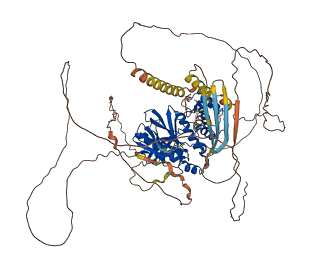
Descriptions
The autoinhibited protein was predicted that may have potential autoinhibitory elements via cis-regPred.
Autoinhibitory domains (AIDs)
Target domain |
|
Relief mechanism |
|
Assay |
cis-regPred |
Accessory elements
No accessory elements
Autoinhibited structure

Activated structure
1 structures for P11434
| Entry ID | Method | Resolution | Chain | Position | Source |
|---|---|---|---|---|---|
| AF-P11434-F1 | Predicted | AlphaFoldDB |
No variants for P11434
| Variant ID(s) | Position | Change | Description | Diseaes Association | Provenance |
|---|---|---|---|---|---|
| No variants for P11434 | |||||
No associated diseases with P11434
11 regional properties for P11434
| Type | Name | Position | InterPro Accession |
|---|---|---|---|
| domain | FERM domain | 193 - 474 | IPR000299 |
| domain | SAB domain | 605 - 653 | IPR007477 |
| domain | Band 4.1, C-terminal | 692 - 799 | IPR008379 |
| domain | FERM adjacent | 481 - 527 | IPR014847 |
| domain | FERM, N-terminal | 197 - 258 | IPR018979 |
| domain | FERM, C-terminal PH-like domain | 388 - 478 | IPR018980 |
| conserved_site | FERM conserved site | 247 - 275 | IPR019747-1 |
| conserved_site | FERM conserved site | 354 - 383 | IPR019747-2 |
| domain | FERM central domain | 277 - 384 | IPR019748 |
| domain | Band 4.1 domain | 189 - 384 | IPR019749 |
| domain | Band 4.1 protein, FERM domain, F1 sub-domain | 193 - 275 | IPR021187 |
3 GO annotations of cellular component
| Name | Definition |
|---|---|
| cell cortex | The region of a cell that lies just beneath the plasma membrane and often, but not always, contains a network of actin filaments and associated proteins. |
| cytoskeleton | A cellular structure that forms the internal framework of eukaryotic and prokaryotic cells. The cytoskeleton includes intermediate filaments, microfilaments, microtubules, the microtrabecular lattice, and other structures characterized by a polymeric filamentous nature and long-range order within the cell. The various elements of the cytoskeleton not only serve in the maintenance of cellular shape but also have roles in other cellular functions, including cellular movement, cell division, endocytosis, and movement of organelles. |
| nucleus | A membrane-bounded organelle of eukaryotic cells in which chromosomes are housed and replicated. In most cells, the nucleus contains all of the cell's chromosomes except the organellar chromosomes, and is the site of RNA synthesis and processing. In some species, or in specialized cell types, RNA metabolism or DNA replication may be absent. |
3 GO annotations of molecular function
| Name | Definition |
|---|---|
| actin binding | Binding to monomeric or multimeric forms of actin, including actin filaments. |
| calmodulin binding | Binding to calmodulin, a calcium-binding protein with many roles, both in the calcium-bound and calcium-free states. |
| structural molecule activity | The action of a molecule that contributes to the structural integrity of a complex or its assembly within or outside a cell. |
4 GO annotations of biological process
| Name | Definition |
|---|---|
| cell cycle | The progression of biochemical and morphological phases and events that occur in a cell during successive cell replication or nuclear replication events. Canonically, the cell cycle comprises the replication and segregation of genetic material followed by the division of the cell, but in endocycles or syncytial cells nuclear replication or nuclear division may not be followed by cell division. |
| cell division | The process resulting in division and partitioning of components of a cell to form more cells; may or may not be accompanied by the physical separation of a cell into distinct, individually membrane-bounded daughter cells. |
| cortical actin cytoskeleton organization | A process that is carried out at the cellular level which results in the assembly, arrangement of constituent parts, or disassembly of actin-based cytoskeletal structures in the cell cortex, i.e. just beneath the plasma membrane. |
| positive regulation of protein localization to cell cortex | Any process that activates or increases the frequency, rate or extent of protein localization to cell cortex. |
No homologous proteins in AiPD
| UniProt AC | Gene Name | Protein Name | Species | Evidence Code |
|---|---|---|---|---|
| No homologous proteins | ||||
| 10 | 20 | 30 | 40 | 50 | 60 |
| MTTEKGLLAE | AESPPQDQKQ | EGEEEVESCT | TQPVVGSGDK | DPETEQSQES | PSTTSPSTRK |
| 70 | 80 | 90 | 100 | 110 | 120 |
| SKDRHSQGKG | LSRLFSSFLK | RPKSQVSSDE | KEVELLGEKG | QDQKDVDEGL | GEQLEDDVFL |
| 130 | 140 | 150 | 160 | 170 | 180 |
| KAPIAAPEPE | LRTDPSLDLH | SLSSAETQPA | QEEQKEDQDP | EADCEDVEGK | EPIKKPEGES |
| 190 | 200 | 210 | 220 | 230 | 240 |
| KASHKVVRRS | PNMRCKVTLL | DDTVYECDLE | KHAKGQDIFK | KVCSHLNIVE | EDYFGLAIWE |
| 250 | 260 | 270 | 280 | 290 | 300 |
| SPTCKVWLDP | LKDIRKQVHG | GPCEFTSNVK | FYPPDPAQLS | EDITRYYLCL | QLRKDIFSGR |
| 310 | 320 | 330 | 340 | 350 | 360 |
| LPCSFATLAL | LGSYTVQSEV | GDYEEDLHGV | DYVSEFKLSP | NQTKDLEEKV | GELHKSYRSM |
| 370 | 380 | 390 | 400 | 410 | 420 |
| TPAQADLEFL | ENAKKLTMYG | VDIHQAKDLE | GVDIKLGVCS | GGLMVFKDNL | RINRFPWPKV |
| 430 | 440 | 450 | 460 | 470 | 480 |
| LKISYKRSSF | FIKIRPGEQE | QYESTIGFKL | PSYKAAKKLW | KVCVEHHTFF | RLTSTESIPK |
| 490 | 500 | 510 | 520 | 530 | 540 |
| HRFLSLGSTF | RYSGRTQAQT | RHASALIDRP | APHFVRTGSK | RASRSLDGAA | VATPEASRTH |
| 550 | 560 | 570 | 580 | 590 | 600 |
| RPVSAPVFPP | EFPAVQRKTP | GPRVEEMPKK | TEEKPKEGMP | NQRESPKDVK | ATQQDSPSPT |
| 610 | 620 | 630 | 640 | 650 | 660 |
| VNGDKVKDLE | KTQDEIIRHH | ASIRELKKSF | MESVPAPRPS | EWDKRLSTHS | PFRTLSFNGQ |
| 670 | 680 | 690 | 700 | 710 | 720 |
| VQTGTDGPPL | VKTQTVTISN | ATNGEKGEIP | TKEVPLVHTE | TKTITYEAAR | SDDVNTDQEP |
| 730 | 740 | 750 | 760 | 770 | 780 |
| GILLTAHTIT | SETTSSTTTT | QITKTVKGGI | SETLIEKRIV | ITGDGDLDHD | QVLVQAIKEA |
| 790 | 800 | ||||
| KEQHPDMSVT | KGVVHQETEI | A |