P11410
Gene name |
|
Protein name |
Glucose-6-phosphate 1-dehydrogenase |
Names |
G6PD |
Species |
Cyberlindnera jadinii (Torula yeast) (Pichia jadinii) |
KEGG Pathway |
|
EC number |
1.1.1.49: With NAD(+) or NADP(+) as acceptor |
Protein Class |
|
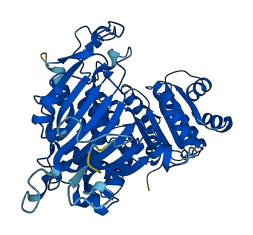
Descriptions
The autoinhibited protein was predicted that may have potential autoinhibitory elements via cis-regPred.
Autoinhibitory domains (AIDs)
Target domain |
|
Relief mechanism |
|
Assay |
cis-regPred |
Accessory elements
No accessory elements
Autoinhibited structure

Activated structure
1 structures for P11410
| Entry ID | Method | Resolution | Chain | Position | Source |
|---|---|---|---|---|---|
| AF-P11410-F1 | Predicted | AlphaFoldDB |
3 variants for P11410
| Variant ID(s) | Position | Change | Description | Diseaes Association | Provenance |
|---|---|---|---|---|---|
| 107 | H>G | No | |||
| 138 | P>M | No | |||
| 416 | I>T | No |
No associated diseases with P11410
Functions
| Description | ||
|---|---|---|
| EC Number | 1.1.1.49 | With NAD(+) or NADP(+) as acceptor |
| Subcellular Localization |
|
|
| PANTHER Family | ||
| PANTHER Subfamily | ||
| PANTHER Protein Class | ||
| PANTHER Pathway Category | No pathway information available | |
No GO annotations of cellular component
| Name | Definition |
|---|---|
| No GO annotations for cellular component |
2 GO annotations of molecular function
| Name | Definition |
|---|---|
| glucose-6-phosphate dehydrogenase activity | Catalysis of the reaction: D-glucose 6-phosphate + NADP+ = D-glucono-1,5-lactone 6-phosphate + NADPH + H+. |
| NADP binding | Binding to nicotinamide-adenine dinucleotide phosphate, a coenzyme involved in many redox and biosynthetic reactions; binding may be to either the oxidized form, NADP+, or the reduced form, NADPH. |
2 GO annotations of biological process
| Name | Definition |
|---|---|
| glucose metabolic process | The chemical reactions and pathways involving glucose, the aldohexose gluco-hexose. D-glucose is dextrorotatory and is sometimes known as dextrose; it is an important source of energy for living organisms and is found free as well as combined in homo- and hetero-oligosaccharides and polysaccharides. |
| pentose-phosphate shunt | The metabolic process in which glucose-6-phosphate is oxidized to form carbon dioxide (CO2) and ribulose 5-phosphate, coupled to reduction of NADP+ to NADPH; ribulose 5-P then enters a series of reactions that can yield biosynthetic precursors (ribose-5-phosphate and erythrose-4-phosphate) and glycolytic intermediates (fructose-6-phosphate and glyceraldehyde-3-phosphate). |
No homologous proteins in AiPD
| UniProt AC | Gene Name | Protein Name | Species | Evidence Code |
|---|---|---|---|---|
| No homologous proteins | ||||
| 10 | 20 | 30 | 40 | 50 | 60 |
| SYDSFGDRVT | IIVFGASGDL | ARKKTFPALF | GLFREKQLPS | TVQIIGYARS | HLSDKDFKDY |
| 70 | 80 | 90 | 100 | 110 | 120 |
| ISSHFKGGDD | KTKEDFLNLC | SYISDPYDTD | EGYKKLEARC | QEYESKHNVK | VPERLFYLAL |
| 130 | 140 | 150 | 160 | 170 | 180 |
| PPSVFHTVCE | QVKKNVYPKN | EKSRIIIEKP | FGRDLETYRE | LQKQISPLFT | EDEVYRIDHY |
| 190 | 200 | 210 | 220 | 230 | 240 |
| LGKEMVKNLL | VLRFGNELFS | GIWNNKHITS | VQISFKEAFG | TEGRGGYFDN | IGIIRDVMQN |
| 250 | 260 | 270 | 280 | 290 | 300 |
| HLLQVLTLLT | MERPVSFDPE | AVRDEKVKVL | KAFDKIDVND | VLLGQYGKSE | DGTKPGYLDD |
| 310 | 320 | 330 | 340 | 350 | 360 |
| STVKPNSKAV | TYAAFRVNIH | NERWDGVPIV | LRAGKALDEG | KAEIRIQFKP | VAKGMFKEIQ |
| 370 | 380 | 390 | 400 | 410 | 420 |
| RNELVIRIQP | NEAIYLKINS | KIPGISTETS | LTDLDLTYST | RYSKDFWIPE | AYEALIRDCY |
| 430 | 440 | 450 | 460 | 470 | 480 |
| LGNHSNFVRD | DELEVSWKLF | TPLLEAVEKE | ENVKLESYPY | GSKGPKELRK | YLIDHGYVFN |
| 490 | |||||
| DPGTYQWPLT | NTDVK |