P11344
Gene name |
Tyr |
Protein name |
Tyrosinase |
Names |
Albino locus protein, Monophenol monooxygenase |
Species |
Mus musculus (Mouse) |
KEGG Pathway |
mmu:22173 |
EC number |
1.14.18.1: With another compound as one donor, and incorporation of one atom of oxygen |
Protein Class |
|
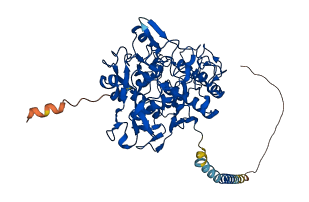
Descriptions
The autoinhibited protein was predicted that may have potential autoinhibitory elements via cis-regPred.
Autoinhibitory domains (AIDs)
Target domain |
|
Relief mechanism |
|
Assay |
cis-regPred |
Accessory elements
No accessory elements
Autoinhibited structure

Activated structure
1 structures for P11344
| Entry ID | Method | Resolution | Chain | Position | Source |
|---|---|---|---|---|---|
| AF-P11344-F1 | Predicted | AlphaFoldDB |
31 variants for P11344
| Variant ID(s) | Position | Change | Description | Diseaes Association | Provenance |
|---|---|---|---|---|---|
| rs247022873 | 12 | S>I | No | EVA | |
| rs3388925852 | 19 | H>Q | No | EVA | |
| rs3388917541 | 27 | S>Y | No | EVA | |
| rs3388906608 | 28 | K>N | No | EVA | |
| rs38358457 | 49 | L>F | No | EVA | |
| rs230187559 | 64 | P>S | No | EVA | |
| rs3398270445 | 72 | K>E | No | EVA | |
| rs3388925698 | 73 | G>R | No | EVA | |
| rs31191169 | 103 | C>S | albino mice [UniProt] | No | EVA |
| rs3388912152 | 125 | D>G | No | EVA | |
| rs3388912122 | 131 | K>R | No | EVA | |
| rs3388926906 | 143 | H>R | No | EVA | |
| rs3388919533 | 151 | I>T | No | EVA | |
| rs242698493 | 173 | Y>H | No | EVA | |
| rs217870945 | 193 | E>V | No | EVA | |
| rs3388917586 | 197 | D>V | No | EVA | |
| rs3388926943 | 203 | E>A | No | EVA | |
| rs3388923398 | 208 | L>Q | No | EVA | |
| rs3388919470 | 215 | L>S | No | EVA | |
| rs3388923397 | 230 | N>Y | No | EVA | |
| rs3388912170 | 248 | T>I | No | EVA | |
| rs250107030 | 259 | N>K | No | EVA | |
| rs3388884426 | 259 | N>T | No | EVA | |
| rs237830526 | 268 | F>L | No | EVA | |
| rs3388906676 | 280 | E>Q | No | EVA | |
| rs3388917559 | 284 | S>N | No | EVA | |
| rs3388925422 | 300 | N>S | No | EVA | |
| rs214317222 | 320 | F>L | No | EVA | |
| 420 | H>R | strain: Himalayan [UniProt] | No | ||
| rs247394753 | 482 | A>T | chinchilla mice [UniProt] | No | EVA |
| rs37137376 | 501 | L>H | No | EVA |
1 associated diseases with P11344
Without disease ID
1 regional properties for P11344
| Type | Name | Position | InterPro Accession |
|---|---|---|---|
| domain | Tyrosinase copper-binding domain | 172 - 402 | IPR002227 |
Functions
| Description | ||
|---|---|---|
| EC Number | 1.14.18.1 | With another compound as one donor, and incorporation of one atom of oxygen |
| Subcellular Localization |
|
|
| PANTHER Family | ||
| PANTHER Subfamily | ||
| PANTHER Protein Class | ||
| PANTHER Pathway Category | No pathway information available | |
8 GO annotations of cellular component
| Name | Definition |
|---|---|
| cytoplasm | The contents of a cell excluding the plasma membrane and nucleus, but including other subcellular structures. |
| cytosol | The part of the cytoplasm that does not contain organelles but which does contain other particulate matter, such as protein complexes. |
| integral component of membrane | The component of a membrane consisting of the gene products and protein complexes having at least some part of their peptide sequence embedded in the hydrophobic region of the membrane. |
| intracellular membrane-bounded organelle | Organized structure of distinctive morphology and function, bounded by a single or double lipid bilayer membrane and occurring within the cell. Includes the nucleus, mitochondria, plastids, vacuoles, and vesicles. Excludes the plasma membrane. |
| melanosome | A tissue-specific, membrane-bounded cytoplasmic organelle within which melanin pigments are synthesized and stored. Melanosomes are synthesized in melanocyte cells. |
| melanosome membrane | The lipid bilayer surrounding a melanosome. |
| nucleus | A membrane-bounded organelle of eukaryotic cells in which chromosomes are housed and replicated. In most cells, the nucleus contains all of the cell's chromosomes except the organellar chromosomes, and is the site of RNA synthesis and processing. In some species, or in specialized cell types, RNA metabolism or DNA replication may be absent. |
| perinuclear region of cytoplasm | Cytoplasm situated near, or occurring around, the nucleus. |
4 GO annotations of molecular function
| Name | Definition |
|---|---|
| copper ion binding | Binding to a copper (Cu) ion. |
| identical protein binding | Binding to an identical protein or proteins. |
| protein homodimerization activity | Binding to an identical protein to form a homodimer. |
| tyrosinase activity | Catalysis of the reaction: L-tyrosine + O2 = L-DOPAquinone + H2O. This reaction can use both monophenols (such as tyrosine) and catechols (o-diphenols) as substrates. |
8 GO annotations of biological process
| Name | Definition |
|---|---|
| cell population proliferation | The multiplication or reproduction of cells, resulting in the expansion of a cell population. |
| melanin biosynthetic process | The chemical reactions and pathways resulting in the formation of melanins, pigments largely of animal origin. High molecular weight polymers of indole quinone, they are irregular polymeric structures and are divided into three groups: allomelanins in the plant kingdom and eumelanins and phaeomelanins in the animal kingdom. |
| pigmentation | The accumulation of pigment in an organism, tissue or cell, either by increased deposition or by increased number of cells. |
| response to blue light | Any process that results in a change in state or activity of a cell or an organism (in terms of movement, secretion, enzyme production, gene expression, etc.) as a result of a blue light stimulus. Blue light is electromagnetic radiation with a wavelength of between 440 and 500nm. |
| response to cAMP | Any process that results in a change in state or activity of a cell or an organism (in terms of movement, secretion, enzyme production, gene expression, etc.) as a result of a cAMP (cyclic AMP, adenosine 3',5'-cyclophosphate) stimulus. |
| response to UV | Any process that results in a change in state or activity of a cell or an organism (in terms of movement, secretion, enzyme production, gene expression, etc.) as a result of an ultraviolet radiation (UV light) stimulus. Ultraviolet radiation is electromagnetic radiation with a wavelength in the range of 10 to 380 nanometers. |
| response to vitamin D | Any process that results in a change in state or activity of a cell or an organism (in terms of movement, secretion, enzyme production, gene expression, etc.) as a result of a vitamin D stimulus. |
| thymus development | The process whose specific outcome is the progression of the thymus over time, from its formation to the mature structure. The thymus is a symmetric bi-lobed organ involved primarily in the differentiation of immature to mature T cells, with unique vascular, nervous, epithelial, and lymphoid cell components. |
No homologous proteins in AiPD
| UniProt AC | Gene Name | Protein Name | Species | Evidence Code |
|---|---|---|---|---|
| No homologous proteins | ||||
| 10 | 20 | 30 | 40 | 50 | 60 |
| MFLAVLYCLL | WSFQISDGHF | PRACASSKNL | LAKECCPPWM | GDGSPCGQLS | GRGSCQDILL |
| 70 | 80 | 90 | 100 | 110 | 120 |
| SSAPSGPQFP | FKGVDDRESW | PSVFYNRTCQ | CSGNFMGFNC | GNCKFGFGGP | NCTEKRVLIR |
| 130 | 140 | 150 | 160 | 170 | 180 |
| RNIFDLSVSE | KNKFFSYLTL | AKHTISSVYV | IPTGTYGQMN | NGSTPMFNDI | NIYDLFVWMH |
| 190 | 200 | 210 | 220 | 230 | 240 |
| YYVSRDTLLG | GSEIWRDIDF | AHEAPGFLPW | HRLFLLLWEQ | EIRELTGDEN | FTVPYWDWRD |
| 250 | 260 | 270 | 280 | 290 | 300 |
| AENCDICTDE | YLGGRHPENP | NLLSPASFFS | SWQIICSRSE | EYNSHQVLCD | GTPEGPLLRN |
| 310 | 320 | 330 | 340 | 350 | 360 |
| PGNHDKAKTP | RLPSSADVEF | CLSLTQYESG | SMDRTANFSF | RNTLEGFASP | LTGIADPSQS |
| 370 | 380 | 390 | 400 | 410 | 420 |
| SMHNALHIFM | NGTMSQVQGS | ANDPIFLLHH | AFVDSIFEQW | LRRHRPLLEV | YPEANAPIGH |
| 430 | 440 | 450 | 460 | 470 | 480 |
| NRDSYMVPFI | PLYRNGDFFI | TSKDLGYDYS | YLQESDPGFY | RNYIEPYLEQ | ASRIWPWLLG |
| 490 | 500 | 510 | 520 | 530 | |
| AALVGAVIAA | ALSGLSSRLC | LQKKKKKKQP | QEERQPLLMD | KDDYHSLLYQ | SHL |