P10962
Gene name |
MAK16 (YAL025C) |
Protein name |
Protein MAK16 |
Names |
Maintenance of killer protein 16 |
Species |
Saccharomyces cerevisiae (strain ATCC 204508 / S288c) (Baker's yeast) |
KEGG Pathway |
sce:YAL025C |
EC number |
|
Protein Class |
|
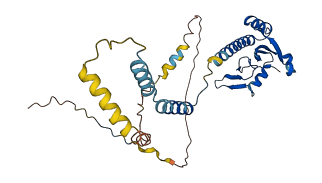
Descriptions
The autoinhibited protein was predicted that may have potential autoinhibitory elements via cis-regPred.
Autoinhibitory domains (AIDs)
Target domain |
|
Relief mechanism |
|
Assay |
cis-regPred |
Accessory elements
No accessory elements
Autoinhibited structure

Activated structure
12 structures for P10962
| Entry ID | Method | Resolution | Chain | Position | Source |
|---|---|---|---|---|---|
| 5Z3G | EM | 365 A | Z | 1-306 | PDB |
| 6C0F | EM | 370 A | D | 1-306 | PDB |
| 6CB1 | EM | 460 A | D | 1-306 | PDB |
| 6EM1 | EM | 360 A | 3 | 1-306 | PDB |
| 6EM3 | EM | 320 A | 3 | 1-306 | PDB |
| 6EM4 | EM | 410 A | 3 | 1-306 | PDB |
| 6EM5 | EM | 430 A | 3 | 1-306 | PDB |
| 7OHS | EM | 438 A | 3 | 1-306 | PDB |
| 7OHW | EM | 350 A | 3 | 1-306 | PDB |
| 7OHX | EM | 330 A | 3 | 1-306 | PDB |
| 8E5T | EM | 400 A | D | 1-306 | PDB |
| AF-P10962-F1 | Predicted | AlphaFoldDB |
No variants for P10962
| Variant ID(s) | Position | Change | Description | Diseaes Association | Provenance |
|---|---|---|---|---|---|
| No variants for P10962 | |||||
No associated diseases with P10962
1 regional properties for P10962
| Type | Name | Position | InterPro Accession |
|---|---|---|---|
| domain | Ribosomal L28e/Mak16 | 5 - 117 | IPR029004 |
2 GO annotations of cellular component
| Name | Definition |
|---|---|
| nucleolus | A small, dense body one or more of which are present in the nucleus of eukaryotic cells. It is rich in RNA and protein, is not bounded by a limiting membrane, and is not seen during mitosis. Its prime function is the transcription of the nucleolar DNA into 45S ribosomal-precursor RNA, the processing of this RNA into 5.8S, 18S, and 28S components of ribosomal RNA, and the association of these components with 5S RNA and proteins synthesized outside the nucleolus. This association results in the formation of ribonucleoprotein precursors; these pass into the cytoplasm and mature into the 40S and 60S subunits of the ribosome. |
| preribosome, large subunit precursor | A preribosomal complex consisting of 27SA, 27SB, and/or 7S pre-rRNA, 5S rRNA, ribosomal proteins including late-associating large subunit proteins, and associated proteins; a precursor of the eukaryotic cytoplasmic large ribosomal subunit. |
No GO annotations of molecular function
| Name | Definition |
|---|---|
| No GO annotations for molecular function |
6 GO annotations of biological process
| Name | Definition |
|---|---|
| cell cycle | The progression of biochemical and morphological phases and events that occur in a cell during successive cell replication or nuclear replication events. Canonically, the cell cycle comprises the replication and segregation of genetic material followed by the division of the cell, but in endocycles or syncytial cells nuclear replication or nuclear division may not be followed by cell division. |
| maturation of 5.8S rRNA | Any process involved in the maturation of a precursor 5.8S ribosomal RNA (rRNA) molecule into a mature 5.8S rRNA molecule. |
| maturation of 5.8S rRNA from tricistronic rRNA transcript (SSU-rRNA, 5.8S rRNA, LSU-rRNA) | Any process involved in the maturation of an rRNA molecule originally produced as part of a tricistronic rRNA transcript that contained the Small SubUnit (SSU) rRNA, the 5.8S rRNA, and the Large SubUnit (LSU) rRNA, in that order, from 5' to 3' along the primary transcript. |
| maturation of LSU-rRNA | Any process involved in the maturation of a precursor Large SubUnit (LSU) ribosomal RNA (rRNA) molecule into a mature LSU-rRNA molecule. |
| maturation of LSU-rRNA from tricistronic rRNA transcript (SSU-rRNA, 5.8S rRNA, LSU-rRNA) | Any process involved in the maturation of a precursor Large SubUnit (LSU) ribosomal RNA (rRNA) molecule into a mature LSU-rRNA molecule from the pre-rRNA molecule originally produced as a tricistronic rRNA transcript that contains the Small Subunit (SSU) rRNA, 5.8S rRNA, and Large Subunit (LSU) in that order from 5' to 3' along the primary transcript. |
| ribosomal large subunit biogenesis | A cellular process that results in the biosynthesis of constituent macromolecules, assembly, and arrangement of constituent parts of a large ribosomal subunit; includes transport to the sites of protein synthesis. |
No homologous proteins in AiPD
| UniProt AC | Gene Name | Protein Name | Species | Evidence Code |
|---|---|---|---|---|
| No homologous proteins | ||||
| 10 | 20 | 30 | 40 | 50 | 60 |
| MSDEIVWQVI | NQSFCSHRIK | APNGQNFCRN | EYNVTGLCTR | QSCPLANSKY | ATVKCDNGKL |
| 70 | 80 | 90 | 100 | 110 | 120 |
| YLYMKTPERA | HTPAKLWERI | KLSKNYTKAL | QQIDEHLLHW | SKFFRHKCKQ | RFTKLTQVMI |
| 130 | 140 | 150 | 160 | 170 | 180 |
| TERRLALREE | ERHYVGVAPK | VKRREQNRER | KALVAAKIEK | AIEKELMDRL | KSGAYGDKPL |
| 190 | 200 | 210 | 220 | 230 | 240 |
| NVDEKVWKKI | MGQMEEENSQ | DEEEDWDEEE | ESDDGEVEYV | ADDGEGEYVD | VDDLEKWLAD |
| 250 | 260 | 270 | 280 | 290 | 300 |
| SDREASSASE | SESDSESESD | SDSDEENKNS | AKRRKKGTSA | KTKRPKVEIE | YEEEHEVQNA |
| EQEVAQ |