P10830
Gene name |
PRKCE |
Protein name |
Protein kinase C epsilon type |
Names |
nPKC-epsilon |
Species |
Oryctolagus cuniculus (Rabbit) |
KEGG Pathway |
ocu:100009103 |
EC number |
2.7.11.13: Protein-serine/threonine kinases |
Protein Class |
|
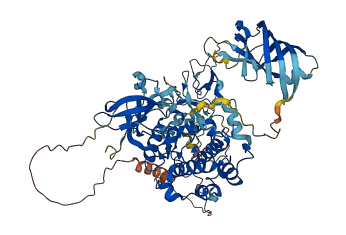
Descriptions
The autoinhibited protein was predicted that may have potential autoinhibitory elements via cis-regPred.
Autoinhibitory domains (AIDs)
Target domain |
|
Relief mechanism |
|
Assay |
cis-regPred |
Accessory elements
548-571 (Activation loop from InterPro)
Target domain |
411-731 (Catalytic domain of the Serine/Threonine Kinase, Novel Protein Kinase C epsilon) |
Relief mechanism |
|
Assay |
|
Autoinhibited structure

Activated structure
1 structures for P10830
| Entry ID | Method | Resolution | Chain | Position | Source |
|---|---|---|---|---|---|
| AF-P10830-F1 | Predicted | AlphaFoldDB |
No variants for P10830
| Variant ID(s) | Position | Change | Description | Diseaes Association | Provenance |
|---|---|---|---|---|---|
| No variants for P10830 | |||||
No associated diseases with P10830
13 regional properties for P10830
| Type | Name | Position | InterPro Accession |
|---|---|---|---|
| domain | C2 domain | 1 - 117 | IPR000008 |
| domain | Protein kinase domain | 407 - 667 | IPR000719 |
| domain | AGC-kinase, C-terminal | 668 - 736 | IPR000961 |
| domain | Protein kinase C-like, phorbol ester/diacylglycerol-binding domain | 169 - 220 | IPR002219-1 |
| domain | Protein kinase C-like, phorbol ester/diacylglycerol-binding domain | 242 - 294 | IPR002219-2 |
| active_site | Serine/threonine-protein kinase, active site | 527 - 539 | IPR008271 |
| binding_site | Protein kinase, ATP binding site | 413 - 436 | IPR017441 |
| domain | Protein kinase, C-terminal | 691 - 729 | IPR017892 |
| domain | Diacylglycerol/phorbol-ester binding | 167 - 181 | IPR020454-1 |
| domain | Diacylglycerol/phorbol-ester binding | 183 - 192 | IPR020454-2 |
| domain | Diacylglycerol/phorbol-ester binding | 197 - 208 | IPR020454-3 |
| domain | Diacylglycerol/phorbol-ester binding | 281 - 293 | IPR020454-4 |
| domain | Novel protein kinase C epsilon, catalytic domain | 411 - 731 | IPR034669 |
Functions
| Description | ||
|---|---|---|
| EC Number | 2.7.11.13 | Protein-serine/threonine kinases |
| Subcellular Localization |
|
|
| PANTHER Family | ||
| PANTHER Subfamily | ||
| PANTHER Protein Class | ||
| PANTHER Pathway Category | No pathway information available | |
5 GO annotations of cellular component
| Name | Definition |
|---|---|
| cell periphery | The part of a cell encompassing the cell cortex, the plasma membrane, and any external encapsulating structures. |
| cytoskeleton | A cellular structure that forms the internal framework of eukaryotic and prokaryotic cells. The cytoskeleton includes intermediate filaments, microfilaments, microtubules, the microtrabecular lattice, and other structures characterized by a polymeric filamentous nature and long-range order within the cell. The various elements of the cytoskeleton not only serve in the maintenance of cellular shape but also have roles in other cellular functions, including cellular movement, cell division, endocytosis, and movement of organelles. |
| nucleus | A membrane-bounded organelle of eukaryotic cells in which chromosomes are housed and replicated. In most cells, the nucleus contains all of the cell's chromosomes except the organellar chromosomes, and is the site of RNA synthesis and processing. In some species, or in specialized cell types, RNA metabolism or DNA replication may be absent. |
| perinuclear region of cytoplasm | Cytoplasm situated near, or occurring around, the nucleus. |
| plasma membrane | The membrane surrounding a cell that separates the cell from its external environment. It consists of a phospholipid bilayer and associated proteins. |
7 GO annotations of molecular function
| Name | Definition |
|---|---|
| actin monomer binding | Binding to monomeric actin, also known as G-actin. |
| ATP binding | Binding to ATP, adenosine 5'-triphosphate, a universally important coenzyme and enzyme regulator. |
| calcium-dependent protein kinase C activity | Calcium-dependent catalysis of the reaction: ATP + a protein = ADP + a phosphoprotein. |
| calcium-independent protein kinase C activity | Catalysis of the reaction: ATP + a protein = ADP + a phosphoprotein. This reaction requires diacylglycerol but not calcium. |
| metal ion binding | Binding to a metal ion. |
| protein kinase activity | Catalysis of the phosphorylation of an amino acid residue in a protein, usually according to the reaction: a protein + ATP = a phosphoprotein + ADP. |
| protein serine kinase activity | Catalysis of the reactions: ATP + protein serine = ADP + protein serine phosphate. |
12 GO annotations of biological process
| Name | Definition |
|---|---|
| cell adhesion | The attachment of a cell, either to another cell or to an underlying substrate such as the extracellular matrix, via cell adhesion molecules. |
| cell cycle | The progression of biochemical and morphological phases and events that occur in a cell during successive cell replication or nuclear replication events. Canonically, the cell cycle comprises the replication and segregation of genetic material followed by the division of the cell, but in endocycles or syncytial cells nuclear replication or nuclear division may not be followed by cell division. |
| cell division | The process resulting in division and partitioning of components of a cell to form more cells; may or may not be accompanied by the physical separation of a cell into distinct, individually membrane-bounded daughter cells. |
| immune system process | Any process involved in the development or functioning of the immune system, an organismal system for calibrated responses to potential internal or invasive threats. |
| lipopolysaccharide-mediated signaling pathway | The series of molecular signals initiated by the binding of a lipopolysaccharide (LPS) to a receptor on the surface of a target cell, and ending with the regulation of a downstream cellular process, e.g. transcription. Lipopolysaccharides are major components of the outer membrane of Gram-negative bacteria, making them prime targets for recognition by the immune system. |
| positive regulation of actin filament polymerization | Any process that activates or increases the frequency, rate or extent of actin polymerization. |
| positive regulation of cytokinesis | Any process that activates or increases the frequency, rate or extent of the division of the cytoplasm of a cell, and its separation into two daughter cells. |
| positive regulation of epithelial cell migration | Any process that activates or increases the frequency, rate or extent of epithelial cell migration. |
| positive regulation of fibroblast migration | Any process that increases the rate, frequency or extent of fibroblast cell migration. Fibroblast cell migration is accomplished by extension and retraction of a pseudopodium. |
| positive regulation of wound healing | Any process that increases the rate, frequency, or extent of the series of events that restore integrity to a damaged tissue, following an injury. |
| protein phosphorylation | The process of introducing a phosphate group on to a protein. |
| TRAM-dependent toll-like receptor 4 signaling pathway | The series of molecular signals initiated by a ligand binding to a toll-like receptor 4 where the TRAM adaptor mediates transduction of the signal. Toll-like 4 receptors are pattern recognition receptors that bind bacterial lipopolysaccharide (LPS) to initiate an innate immune response. |
No homologous proteins in AiPD
| UniProt AC | Gene Name | Protein Name | Species | Evidence Code |
|---|---|---|---|---|
| No homologous proteins | ||||
| 10 | 20 | 30 | 40 | 50 | 60 |
| MVVFNGLLKI | KICEAVSLKP | TAWSLRHAVG | PRPQTFLLDP | YIALNVDDSR | IGQTATKQKT |
| 70 | 80 | 90 | 100 | 110 | 120 |
| NSPAWHDEFV | TDVCNGRKIE | LAVFHDAPIG | YDDFVANCTI | QFEELLQNGS | RHFEDWIDLE |
| 130 | 140 | 150 | 160 | 170 | 180 |
| PEGKVYVIID | LSGSSGEAPK | DNEERVFRER | MRPRKRQGAV | RRRVHQVNGH | KFMATYLRQP |
| 190 | 200 | 210 | 220 | 230 | 240 |
| TYCSHCRDFI | WGVIGKQGYQ | CQVCTCVVHK | RCHELIITKV | AGLKKQETPD | EVGSQRFSVN |
| 250 | 260 | 270 | 280 | 290 | 300 |
| MPHKFGIHNY | KVPTFCDHCG | SLLWGLLRQG | LQCKVCKMNV | HRRCETNVAP | NCGVDARGIA |
| 310 | 320 | 330 | 340 | 350 | 360 |
| KVLADLGVTP | DKITNSGQRR | KKLIGGAESP | QPTSGSSPSE | EDRSKSAPTS | PCDQELKELE |
| 370 | 380 | 390 | 400 | 410 | 420 |
| NNIRKALSFD | NRGEEHRAAS | STDGQLGSPE | NGEVRQGQAK | RLGLDEFNFI | KVLGKGSFGK |
| 430 | 440 | 450 | 460 | 470 | 480 |
| VMLAELKGKD | EVYAVKVLKK | DVILQDDDVD | CTMTEKRILA | LARKHPYLTQ | LYCCFQTKDR |
| 490 | 500 | 510 | 520 | 530 | 540 |
| LFFVMEYVNG | GDLMFQIQRS | RKFDEPRSRF | YAAEVTSALM | FLHQHGVIYR | DLKLDNILLD |
| 550 | 560 | 570 | 580 | 590 | 600 |
| AEGHCKLADF | GMCKEGILNG | VTTTTFCGTP | DYIAPEILQE | LEYGPSVDWW | ALGVLMYEMM |
| 610 | 620 | 630 | 640 | 650 | 660 |
| AGQPPFEADN | EDDLFESILH | DDVLYPVWLS | KEAVSILKAF | MTKNPHKRLG | CVAAQNGEDA |
| 670 | 680 | 690 | 700 | 710 | 720 |
| IKQHPFFKEI | DWVLLEQKKI | KPPFKPRIKT | KRDVNNFDQD | FTREEPVLTL | VDEAIVKQIN |
| 730 | |||||
| QEEFKGFSYF | GEDLMP |