P10650
Gene name |
MOS |
Protein name |
Proto-oncogene serine/threonine-protein kinase mos |
Names |
Oocyte maturation factor mos, Proto-oncogene c-Mos |
Species |
Chlorocebus aethiops (Green monkey) (Cercopithecus aethiops) |
KEGG Pathway |
|
EC number |
2.7.11.1: Protein-serine/threonine kinases |
Protein Class |
|
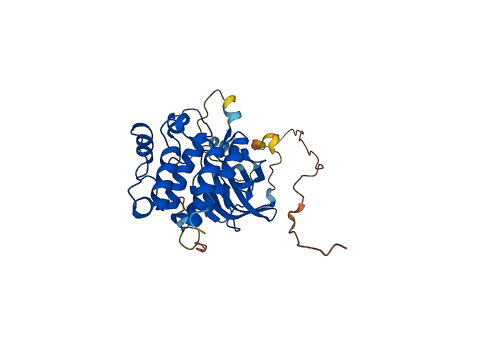
Descriptions
The autoinhibited protein was predicted that may have potential autoinhibitory elements via cis-regPred.
Autoinhibitory domains (AIDs)
Target domain |
|
Relief mechanism |
|
Assay |
cis-regPred |
Accessory elements
218-244 (Activation loop from InterPro)
Target domain |
60-341 (Protein kinase domain) |
Relief mechanism |
|
Assay |
|
Autoinhibited structure

Activated structure
1 structures for P10650
| Entry ID | Method | Resolution | Chain | Position | Source |
|---|---|---|---|---|---|
| AF-P10650-F1 | Predicted | AlphaFoldDB |
No variants for P10650
| Variant ID(s) | Position | Change | Description | Diseaes Association | Provenance |
|---|---|---|---|---|---|
| No variants for P10650 | |||||
No associated diseases with P10650
Functions
| Description | ||
|---|---|---|
| EC Number | 2.7.11.1 | Protein-serine/threonine kinases |
| Subcellular Localization |
|
|
| PANTHER Family | ||
| PANTHER Subfamily | ||
| PANTHER Protein Class | ||
| PANTHER Pathway Category | No pathway information available | |
1 GO annotations of cellular component
| Name | Definition |
|---|---|
| cytosol | The part of the cytoplasm that does not contain organelles but which does contain other particulate matter, such as protein complexes. |
4 GO annotations of molecular function
| Name | Definition |
|---|---|
| ATP binding | Binding to ATP, adenosine 5'-triphosphate, a universally important coenzyme and enzyme regulator. |
| MAP kinase kinase kinase activity | Catalysis of the phosphorylation and activation of a MAP kinase kinase; each MAP kinase kinase can be phosphorylated by any of several MAP kinase kinase kinases. |
| protein serine kinase activity | Catalysis of the reactions: ATP + protein serine = ADP + protein serine phosphate. |
| protein serine/threonine kinase activity | Catalysis of the reactions: ATP + protein serine = ADP + protein serine phosphate, and ATP + protein threonine = ADP + protein threonine phosphate. |
7 GO annotations of biological process
| Name | Definition |
|---|---|
| chromatin organization | The assembly or remodeling of chromatin composed of DNA complexed with histones, other associated proteins, and sometimes RNA. |
| establishment of meiotic spindle orientation | Any process that set the alignment of meiotic spindle relative to other cellular structures. |
| MAPK cascade | An intracellular protein kinase cascade containing at least a MAPK, a MAPKK and a MAP3K. The cascade can also contain an additional tiers: the upstream MAP4K. The kinases in each tier phosphorylate and activate the kinase in the downstream tier to transmit a signal within a cell. |
| meiotic spindle organization | A process that is carried out at the cellular level which results in the assembly, arrangement of constituent parts, or disassembly of the microtubule spindle during a meiotic cell cycle. |
| negative regulation of metaphase/anaphase transition of meiotic cell cycle | Any process that stops, prevents or reduces the frequency, rate or extent of metaphase/anaphase transition of meiotic cell cycle. |
| positive regulation of MAPK cascade | Any process that activates or increases the frequency, rate or extent of signal transduction mediated by the MAPK cascade. |
| protein autophosphorylation | The phosphorylation by a protein of one or more of its own amino acid residues (cis-autophosphorylation), or residues on an identical protein (trans-autophosphorylation). |
No homologous proteins in AiPD
| UniProt AC | Gene Name | Protein Name | Species | Evidence Code |
|---|---|---|---|---|
| No homologous proteins | ||||
| 10 | 20 | 30 | 40 | 50 | 60 |
| MPSPLALRPY | LPSEFSPSVD | ARPCSSPSEL | PAKLLLGATP | PRAPRLPRRL | AWCSIDWEQV |
| 70 | 80 | 90 | 100 | 110 | 120 |
| CLLQRLGAGG | FGSVYKATYH | GVPVAIKQVN | KCTKNRLASR | RSFWAELNVA | RLRHDNIVRV |
| 130 | 140 | 150 | 160 | 170 | 180 |
| VAASTRTPAG | SNSLGTIIME | FGGNVTLHQV | IYGAASHPEG | DAGEPHCSTG | GPLTLGKCLK |
| 190 | 200 | 210 | 220 | 230 | 240 |
| YSLDVVNGLL | FLHSQSIVHL | DLKPANILIS | EQDVCKISDF | GCSEKLEDLL | CFQTPLYPLG |
| 250 | 260 | 270 | 280 | 290 | 300 |
| GTYTHRAPEL | LKGEGVTPKA | DIYSFAITLW | QMTTKQAPYS | GERQHILYAV | VAYDLRPSLS |
| 310 | 320 | 330 | 340 | ||
| AAVFQDSLPG | QRLGDVIRRC | WRPSAAQRPS | ARPLLVDLTS | LKAEFG |