P10250
Gene name |
secY |
Protein name |
Protein translocase subunit SecY |
Names |
|
Species |
Mycoplasma capricolum subsp. capricolum (strain California kid / ATCC 27343 / NCTC 10154) |
KEGG Pathway |
mcp:MCAP_0677 |
EC number |
|
Protein Class |
|
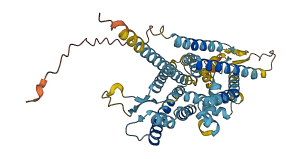
Descriptions
The autoinhibited protein was predicted that may have potential autoinhibitory elements via cis-regPred.
Autoinhibitory domains (AIDs)
Target domain |
|
Relief mechanism |
|
Assay |
cis-regPred |
Accessory elements
No accessory elements
Autoinhibited structure

Activated structure
1 structures for P10250
| Entry ID | Method | Resolution | Chain | Position | Source |
|---|---|---|---|---|---|
| AF-P10250-F1 | Predicted | AlphaFoldDB |
No variants for P10250
| Variant ID(s) | Position | Change | Description | Diseaes Association | Provenance |
|---|---|---|---|---|---|
| No variants for P10250 | |||||
No associated diseases with P10250
2 regional properties for P10250
| Type | Name | Position | InterPro Accession |
|---|---|---|---|
| conserved_site | SecY conserved site | 93 - 112 | IPR030659-1 |
| conserved_site | SecY conserved site | 196 - 213 | IPR030659-2 |
2 GO annotations of cellular component
| Name | Definition |
|---|---|
| integral component of membrane | The component of a membrane consisting of the gene products and protein complexes having at least some part of their peptide sequence embedded in the hydrophobic region of the membrane. |
| plasma membrane | The membrane surrounding a cell that separates the cell from its external environment. It consists of a phospholipid bilayer and associated proteins. |
No GO annotations of molecular function
| Name | Definition |
|---|---|
| No GO annotations for molecular function |
3 GO annotations of biological process
| Name | Definition |
|---|---|
| intracellular protein transmembrane transport | The directed movement of proteins in a cell, from one side of a membrane to another by means of some agent such as a transporter or pore. |
| protein targeting | The process of targeting specific proteins to particular regions of the cell, typically membrane-bounded subcellular organelles. Usually requires an organelle specific protein sequence motif. |
| protein transport by the Sec complex | The process in which unfolded proteins are transported across the cytoplasmic membrane in Gram-positive and Gram-negative bacteria by the Sec complex, in a process involving proteolytic cleavage of an N-terminal signal peptide. |
No homologous proteins in AiPD
| UniProt AC | Gene Name | Protein Name | Species | Evidence Code |
|---|---|---|---|---|
| No homologous proteins | ||||
| 10 | 20 | 30 | 40 | 50 | 60 |
| MVIKKPANKV | DKKSTFKSSN | KKKNPFKSSF | LTKNKDLIYR | ILFTLLALII | IRLGVYITVP |
| 70 | 80 | 90 | 100 | 110 | 120 |
| GVTLDKRFAT | DSSRIQFFQL | LSTLGGGSIG | RFSILALGVS | PYITASIIVQ | LLSTDVIPVL |
| 130 | 140 | 150 | 160 | 170 | 180 |
| TRWSKSGERG | RKKLDKLTKI | IMIPFALMQA | EATIFTLSSQ | GLIIPGWDNT | NAIANSAFYY |
| 190 | 200 | 210 | 220 | 230 | 240 |
| ILIPLVMLGG | SFFMLWIADQ | ITIKGIGNGI | SIVIFIGIII | SMPSNLKSTF | EYWVSNSGEE |
| 250 | 260 | 270 | 280 | 290 | 300 |
| ANIFFSGLLN | FMIYISVFLL | VILSVVIMNE | AERKIPIQQT | GSGLTDSSEH | TPYLPLKLNN |
| 310 | 320 | 330 | 340 | 350 | 360 |
| AGVIPVIFAS | AIISTPITIS | QIIEAVNPDS | GFVIFTRDYL | SFNTWWGISI | FGILIVLFTF |
| 370 | 380 | 390 | 400 | 410 | 420 |
| LYSQVQINPE | KIAENFQKSG | TFIPGIKPGK | DTTKYLTGII | NRLSVVGSVF | LAIIALLPYV |
| 430 | 440 | 450 | 460 | 470 | 480 |
| ISKLTQLPSN | LAIGGTGLII | CISVAIQTVQ | QLKGRIIQQN | FIEKKKEKFT | NNINKNKTSH |
| IW |