P10069
Gene name |
brlA |
Protein name |
C2H2 type master regulator of conidiophore development brlA |
Names |
Bristle A protein |
Species |
Emericella nidulans (strain FGSC A4 / ATCC 38163 / CBS 112.46 / NRRL 194 / M139) (Aspergillus nidulans) |
KEGG Pathway |
ani:AN0973.2 |
EC number |
|
Protein Class |
|
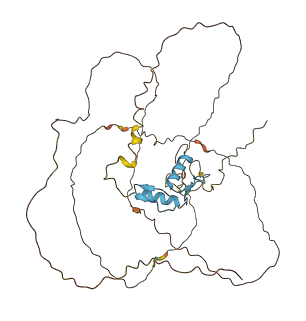
Descriptions
The autoinhibited protein was predicted that may have potential autoinhibitory elements via cis-regPred.
Autoinhibitory domains (AIDs)
Target domain |
|
Relief mechanism |
|
Assay |
cis-regPred |
Accessory elements
No accessory elements
Autoinhibited structure

Activated structure
1 structures for P10069
| Entry ID | Method | Resolution | Chain | Position | Source |
|---|---|---|---|---|---|
| AF-P10069-F1 | Predicted | AlphaFoldDB |
No variants for P10069
| Variant ID(s) | Position | Change | Description | Diseaes Association | Provenance |
|---|---|---|---|---|---|
| No variants for P10069 | |||||
No associated diseases with P10069
2 regional properties for P10069
| Type | Name | Position | InterPro Accession |
|---|---|---|---|
| domain | Zinc finger C2H2-type | 320 - 349 | IPR013087-1 |
| domain | Zinc finger C2H2-type | 350 - 380 | IPR013087-2 |
1 GO annotations of cellular component
| Name | Definition |
|---|---|
| nucleus | A membrane-bounded organelle of eukaryotic cells in which chromosomes are housed and replicated. In most cells, the nucleus contains all of the cell's chromosomes except the organellar chromosomes, and is the site of RNA synthesis and processing. In some species, or in specialized cell types, RNA metabolism or DNA replication may be absent. |
4 GO annotations of molecular function
| Name | Definition |
|---|---|
| cis-regulatory region sequence-specific DNA binding | Binding to a specific upstream regulatory DNA sequence (transcription factor recognition sequence or binding site) located in cis relative to the transcription start site (i.e., on the same strand of DNA) of a gene transcribed by some RNA polymerase. The proximal promoter is in cis with and relatively close to the core promoter. |
| DNA-binding transcription factor activity | A transcription regulator activity that modulates transcription of gene sets via selective and non-covalent binding to a specific double-stranded genomic DNA sequence (sometimes referred to as a motif) within a cis-regulatory region. Regulatory regions include promoters (proximal and distal) and enhancers. Genes are transcriptional units, and include bacterial operons. |
| DNA-binding transcription factor activity, RNA polymerase II-specific | A DNA-binding transcription factor activity that modulates the transcription of specific gene sets transcribed by RNA polymerase II. |
| metal ion binding | Binding to a metal ion. |
11 GO annotations of biological process
| Name | Definition |
|---|---|
| autolysis | A programmed cell death process observed in bacteria and filamentous fungi and leading to spontaneous death by lysis. Examples are lysis of the mother cell during sporulation of Bacillus subtilis and self-degradation of fungal cells in Aspergillus nidulans. Autolysis is also involved in bacterial biofilm formation. |
| conidium formation | The process of producing non-motile spores, called conidia, via mitotic asexual reproduction in higher fungi. Conidia are haploid cells genetically identical to their haploid parent. They are produced by conversion of hyphal elements, or are borne on sporogenous cells on or within specialized structures termed conidiophores, and participate in dispersal of the fungus. |
| positive regulation of conidium formation | Any process that activates, maintains or increases the frequency, rate or extent of conidium formation, a process of producing non-motile spores, called conidia, via mitotic asexual reproduction in higher fungi. Conidia are haploid cells genetically identical to their haploid parent. They are produced by conversion of hyphal elements, or are borne on sporogenous cells on or within specialized structures termed conidiophores, and participate in dispersal of the fungus. |
| regulation of secondary metabolite biosynthetic process | Any process that modulates the frequency, rate or extent of secondary metabolite biosynthetic process. |
| regulation of sterigmatocystin biosynthetic process | Any process that modulates the rate, frequency, or extent of sterigmatocystin biosynthesis. Sterigmatocystin biosynthetic processes are the chemical reactions and pathways resulting in the formation of sterigmatocystin, a carcinogenic mycotoxin produced in high yields by strains of the common molds. |
| regulation of transcription by RNA polymerase II | Any process that modulates the frequency, rate or extent of transcription mediated by RNA polymerase II. |
| regulation of transcription from RNA polymerase II promoter in response to oxidative stress | Modulation of the frequency, rate or extent of transcription from an RNA polymerase II promoter as a result of a stimulus indicating the organism is under oxidative stress, a state often resulting from exposure to high levels of reactive oxygen species, e.g. superoxide anions, hydrogen peroxide (H2O2), and hydroxyl radicals. |
| response to starvation | Any process that results in a change in state or activity of a cell or an organism (in terms of movement, secretion, enzyme production, gene expression, etc.) as a result of a starvation stimulus, deprivation of nourishment. |
| sporocarp development involved in asexual reproduction | The formation of a spore-bearing structure by fungus where spores will arise from asexual reproduction. |
| sporulation resulting in formation of a cellular spore | The process in which a relatively unspecialized cell acquires the specialized features of a cellular spore, a cell form that can be used for dissemination, for survival of adverse conditions because of its heat and dessication resistance, and/or for reproduction. |
| sterigmatocystin biosynthetic process | The chemical reactions and pathways resulting in the formation of sterigmatocystin, a carcinogenic mycotoxin produced in high yields by strains of the common molds. |
No homologous proteins in AiPD
| UniProt AC | Gene Name | Protein Name | Species | Evidence Code |
|---|---|---|---|---|
| No homologous proteins | ||||
| 10 | 20 | 30 | 40 | 50 | 60 |
| MRNQSSLSDR | LTVEVDCSSL | GSNECPSMTS | SFSPLESPTP | TPTSIYSQGS | LESPGWHGAG |
| 70 | 80 | 90 | 100 | 110 | 120 |
| SLPNNTYERT | PGSASMRSAF | RLAGMASTES | LGLPYGSMEG | QERMPMPDFL | SGYDENIEQL |
| 130 | 140 | 150 | 160 | 170 | 180 |
| WMPSEAPKSY | DHVAQGLAYH | QGMHQYPTMA | RNTNNNYRHQ | AAAYLPESTT | NPCLSRSIFH |
| 190 | 200 | 210 | 220 | 230 | 240 |
| QPERVPSSMS | SSMSMNNMLP | WMNLGDSIAP | QTIAPSQVGP | VTPPPSYTDF | PTSLSAFKQH |
| 250 | 260 | 270 | 280 | 290 | 300 |
| SPTTPIRSCS | LGTGSGADTP | LSRLSGGPCE | YMDDFQPSPV | YRDGFQRPHR | VASRKMLRRQ |
| 310 | 320 | 330 | 340 | 350 | 360 |
| TSKQNLMLEN | LPQVIKQVQF | KCKEPGCNGR | FKRQEHLKRH | MKSHSKEKPH | VCWVPGCHRA |
| 370 | 380 | 390 | 400 | 410 | 420 |
| FSRSDNLNAH | YTKTHSKRGG | RNRYVATLDE | NSPDYDPEFR | GQLTPDGRPI | YGSKLDDPIP |
| 430 | |||||
| GAGDMSLDGW | DE |